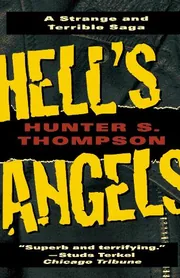
Hell's Angels
by Hunter S. Thompson · 1966
It suits adult readers and mature older teens who can handle a frank account of an outlaw gang.
307 pages, about 5 to 7 hours.
Thompson rides with the Angels and files a gonzo classic. 59% taste match
What it covers
Hell's Angels: A Strange and Terrible Saga is a work of journalism and memoir by Hunter S. Thompson, first published in 1966 by Random House. It follows the Hell's Angels motorcycle club in California during the 1960s, a period when the gang had a fearsome public reputation and was linked to a range of criminal activity. The setting is the Bay Area of Northern California, with scenes that move through Frisco, Hollywood, Berdoo and East Oakland.
Thompson spent close to a year in contact with members of the club's Californian chapter. He interviewed them at length and watched their customs and behavior at close range, writing about outlaw riders in chains, shades and greasy Levis. The book belongs to the tradition of gonzo reporting and draws on themes of subculture, motorcycle gangs, crime and criminology. It runs to roughly 307 pages in its median edition, and the title has appeared in 27 editions.
"California, Labor Day weekend . . . early, with ocean fog still in the streets, outlaw motorcyclists wearing chains, shades and greasy Levis roll out from damp garages, all-night diners and cast-off one-night pads in Frisco, Hollywood, Berdoo and East Oakl"
Setting
Bay Area Northen California
Period
1960s
Themes
GonZoHell's AngelsMotorcycle gangsCaliforniaOrganized crimeSocial sciencesCriminologyMotorclubs
- Want to read 126
- Reading now 6
- Read 23
Most people shelving it are saving it for later.
Of 155 readers who put it on a shelf, 81% want to read it, 4% are reading it now, 15% have finished it and 0% stopped before the end.
By the numbers
- The median edition runs 307 pages. Counting about 275 words a page and an adult reading pace of 250 words a minute, that is about 5.6 hours of reading.
- Open Library tracks 27 editions from 12 publishers, the earliest dated 1966 and the latest 2012, across 2 languages.
- On reader demand it ranks in the top 9% of the classic books in our catalog (8,749 of them).
- Libraries shelve it under Dewey 364.1066 and Library of Congress class HV-6489.00000000.C2 T48 1996.
 BookWard’s take
Thompson rides with the Angels and files a gonzo classic
Thompson spent close to a year inside the California chapter, and the book opens in motion: outlaws in chains, shades and greasy Levis rolling out on Labor Day weekend. It's a hook that works at once, and a reader who likes a fast start will be on board from the first page. The voice is the real draw, opinionated and unmistakable, and nothing else reads quite like it. This is narrative nonfiction rather than a dry study, which leaves the rigor looser than some readers would want, since access and observation carry the argument more than data do. The politics and the violence on the page are part of the territory, never added for show. If you want reportage with a pulse and a point of view, this delivers it, fast and without padding.
At 307 pages it is solid but not bloated, tighter than a sprawling study though longer than BookWard's shortest picks.
Scenes of riders on the road keep it moving, with some slower stretches of background and reflection.
Gonzo reporting from inside a feared club was fresh in 1966 and still reads as distinctive.
The prose is muscular and colorful, more stylized than plain without turning ornate.
It follows people and their culture more than a driving plot, so it leans character-led.
The picture is of outlaws, fear and violence, with little uplift, which leans bleak.
It reads as a fairly conventional reported narrative with a strong personal slant.
Thompson's dark wit runs through the reporting, but the subject keeps the tone mostly serious.
The material of crime, menace and intimidation is dark, though told with reportorial control.
Feeling is kept in check beneath the swagger and wit, though tension runs high.
See all 50 dialsEvery position, side by side with this book
Where it lines up
- OriginalityBookWard 9 · book 9
- OpeningBookWard 10 · book 9
- PaceBookWard 8 · book 7
Where it pulls apart
- Internal logicBookWard 10 · book 6
- LengthBookWard 1 · book 4
- EndingBookWard 8 · book 4
At 307 pages it is solid but not bloated, tighter than a sprawling study though longer than BookWard's shortest picks.
It opens mid-motion on Labor Day weekend with outlaw riders rolling out, which is exactly the instant pull BookWard wants.
Thompson reports the subculture firsthand rather than repeating the stock image of the biker menace, which suits BookWard well.
The reporting builds a coherent case from observation, though gonzo method trades some tidy argument for immediacy.
Scenes of riders on the road keep it moving, with some slower stretches of background and reflection.
Gonzo reporting from inside a feared club was fresh in 1966 and still reads as distinctive.
Members come through as vivid individuals in observation, though the book studies a group more than any one life.
As reportage it closes on its subject rather than tying everything into a neat resolution.
Thompson keeps romance about the outlaw life at arm's length and writes with a cool, wary eye, which BookWard values.
The darkness comes from what Thompson witnessed and reported, so it is earned rather than staged for effect.
Close access and long interviews ground it, but it relies on observation and voice more than systematic evidence.
Thompson's voice is brash, sharp and unmistakable, easily the strongest card the book holds.
It is led by the story of the club and its riders, with ideas about subculture arising from events.
Thompson explains the club and its reputation outright at times, though much still arrives through scenes.
Energy mostly holds because the material stays vivid, with a few stretches of background that slow it.
The prose is muscular and colorful, more stylized than plain without turning ornate.
It follows people and their culture more than a driving plot, so it leans character-led.
The picture is of outlaws, fear and violence, with little uplift, which leans bleak.
It reads as a fairly conventional reported narrative with a strong personal slant.
Thompson's dark wit runs through the reporting, but the subject keeps the tone mostly serious.
The style is lively and accessible, with some period slang and dense stretches to work through.
Thompson's own eye dominates, though he gathers the accounts of many riders and observers.
This is real reportage with no fantastical element.
A whole chapter of riders and their associates populate the book, making the cast large.
The focus stays on one club in one region, intimate in scope, though its reputation looms large.
It favors observed action and behavior over interior reflection, with Thompson's own thoughts breaking in.
Quoted interviews and exchanges carry real weight but share space with Thompson's own narration.
Romance plays no meaningful part in this account of an outlaw club.
The outlaw motorcycle world was alien to most readers of its day and still feels unfamiliar.
It is rooted in 1960s California, a past setting rather than the present day.
Its portrait of subculture and fear still resonates well beyond the moment it was written.
Thompson is an upfront reporter who tells you where he stands, so he reads as reliable though plainly partisan.
Thompson resists easy verdicts on the Angels and the forces that vilified them, leaving judgment unsettled.
Scenes of fog-bound streets, chains and greasy Levis show a rich, vivid eye for detail.
It is told as narrative reportage rather than as an analytical treatise.
Thompson's own presence and opinions run through the book, so the perspective is deeply personal.
It stands alone as a self-contained work.
Reporting delivers events rather than plot reversals, so surprises are few.
It unsettles easy assumptions about the Angels and the people who feared them.
The material of crime, menace and intimidation is dark, though told with reportorial control.
Feeling is kept in check beneath the swagger and wit, though tension runs high.
The humor is sardonic with a broader comic streak than purely dry.
Violence is part of the club's world and appears on the page without being the sole focus.
The subculture involves sexual content, which appears in places but does not drive the book.
It engages with law, public fear and authority, though not as party politics.
Period slang and biker talk add some density without making the language hard.
Thompson's opinions saturate the narration, making this about as opinionated as nonfiction gets.
The book looks back at a specific stretch of the 1960s as it unfolded.
The tone is wary and skeptical about institutions and the outlaw myth alike.
Review written by BookWard, dial version 1, November 2026.
Who is Hell's Angels right for?
It suits adult readers and mature older teens who can handle a frank account of an outlaw gang. It includes violence, crime, drug and sexual references, and rough language.
The style is lively and accessible, with some period slang and dense stretches to work through.
The material of crime, menace and intimidation is dark, though told with reportorial control.
Feeling is kept in check beneath the swagger and wit, though tension runs high.
Violence is part of the club's world and appears on the page without being the sole focus.
Book CompanionHell's Angels: ideas, characters, themes
By riding alongside the California Hell's Angels for about a year, Thompson shows a feared subculture up close, set against the public image of it.
- Access over distance. Thompson was allowed extraordinary access to members of the California chapter and observed them for almost a year.
- A feared reputation. The club was highly feared and accused of numerous criminal activities during the period the book covers.
- Place and moment. The story is set in the Bay Area of Northern California in the 1960s.
- Gonzo reporting. The book belongs to the gonzo tradition, putting the reporter's presence and voice at the center of the telling.
- Subculture on the page. Customs, behavior and dress of the outlaw riders are recorded closely rather than summarized from afar.
Characters
Hunter S. Thompson
Author and reporter
He is the observer who spends close to a year among the Angels and shapes how the reader sees them.
The Hell's Angels
Subject club
The California chapter of the motorcycle club forms the heart of the book and its collective cast.
Themes
How a closed group builds its own customs, dress and codes apart from mainstream society.
The gap between a gang's public image and what close observation shows.
How criminal activity and official response shape a group's place in public life.
The reporter's role, access and bias in telling a story from the inside.
Discussion questions
- How does Thompson's close access change what he can report about the Angels?
- Where does his own voice help the reporting, and where does it get in the way?
- How does the public reputation of the club compare with what he describes?
- What does the book suggest about why people fear or romanticize outlaws?
- Does the book still read as relevant to how groups are portrayed today?
Personalize your Book Companion
This is the general edition. In BookWard, the Companion is written for you: your reading profile, your notes, and spoiler-safe to the page you are on.
Buy, listen or borrow Hell's Angels
Each link opens a search for this book on that store, in a new tab.
Read on a device
Borrow
Reviews and community
If you liked Hell's Angels
Orwell's first book, and a clear-eyed look at poverty
DispatchesMichael HerrVietnam as one reporter lived it, in prose that burns
Kitchen ConfidentialAnthony BourdainBourdain's unfiltered, funny tour through the back of the house
MindhunterJohn E. DouglasA profiler's firsthand tour through the minds of killers
Sources: Open Library.
Track Hell's Angels and find your next favorite
Add it to your shelf, rate what you have read, and BookWard will recommend what fits you.
Free to start. No credit card needed.