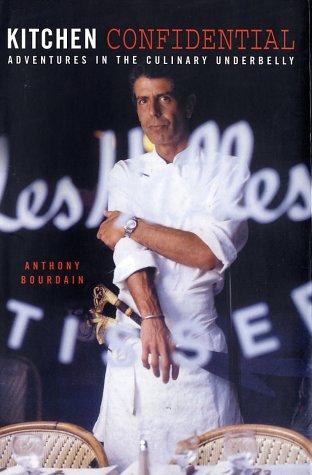
Kitchen Confidential
by Anthony Bourdain
★ Top 10 book of 2000 · #10 on Best Books of 2000
A celebrity chef looks back on his time in the restaurant business, sharing stories from the kitchen. The book follows his rise from humble dishwasher to a place of fame in the food world.
Best for: Food lovers curious about restaurant life and one chef's rise to fame
Kitchen Confidential is #10 on BookWard's Best Books of 2000, out of 46 2000 books that cleared our data bar.
What Kitchen Confidential is about
Anthony Bourdain's book takes you through the back door of professional restaurants and shows what happens behind the swinging doors. It began as a 1999 New Yorker essay, "Don't Eat Before Reading This", which his mother submitted to the magazine and which launched his media career. The book is part memoir and part exposé, told as a loose run of funny, blunt anecdotes.
Bourdain describes kitchens as intense, hazardous places staffed by misfits, and he is just as frank about his own failings, drug use included. He also explains how restaurants make their money, passes on warnings about the tricks some owners play on diners, and offers practical advice, such as skipping fish on Mondays and avoiding well-done beef. He names George Orwell's Down and Out in Paris and London as an influence. It will appeal to food lovers, anyone curious about restaurant work, and readers who like their memoirs brash and honest.
Kitchen Confidential on the Best Books of 2000
Kitchen Confidential came out in 2000. Of the 46 books first published in 2000 that met BookWard's data bar, it ranks #10 on our Best Books of 2000 list.
Why it made the list: 346 readers have shelved it on Open Library; readers rate it 4 out of 5 (54 ratings). The list ranks each year’s books on how many readers have picked them up, how highly readers rate them, and how many are reading them right now.
Nearby on the 2000 list
- Angels & Demons Dan Brown, #8
- Stormbreaker Anthony Horowitz, #9
- How Do Dinosaurs Say Good Night? Jane Yolen, #11
- A Living Nightmare... (Cirque Du Freak #1) Darren Shan, #12
See all Best Books of 2000 Best books by year
More years: Best Books of 1999 Best Books of 2001.
The numbers behind it
- Readers: 243 want to read it, 19 are reading it now and 84 have read it, according to Open Library.
- Ratings: 4 out of 5 from 54 Open Library ratings.
| Signal | This book (0 to 100) | Weight |
|---|---|---|
| Reach | 72 | 55% |
| Reader love | 61 | 25% |
| Being read right now | 67 | 20% |
Questions about Kitchen Confidential
When was Kitchen Confidential published?
Kitchen Confidential by Anthony Bourdain was first published in 2000.
Was Kitchen Confidential one of the best books of 2000?
Kitchen Confidential is #10 on BookWard's Best Books of 2000, out of 46 2000 books that cleared our data bar. 346 readers have shelved it on Open Library; readers rate it 4 out of 5 (54 ratings).
Why is Kitchen Confidential on the Best Books of 2000 list?
346 readers have shelved it on Open Library; readers rate it 4 out of 5 (54 ratings).
More of the best books of 2000
- Harry Potter and the Goblet of Fire J. K. Rowling, #1
- The 48 Laws of Power Robert Greene, #2
- Because of Winn-Dixie Kate DiCamillo, #3
- The Gruffalo Julia Donaldson, #4
- Life of Pi Yann Martel, #5
- Esperanza Rising Pam Muñoz Ryan, #6
See the full Best Books of 2000, the Top 100, or new books on Rising.
How we know
This page uses public data: Open Library reader counts and ratings, and Wikipedia page views for recent years. The description is paraphrased from real source text. Rankings reflect reading interest, not quality or sales, and can be affected by data gaps. Lists update monthly.
Best suited to adult readers and mature teens interested in food or work culture.
Depends on the edition you pick.
Bourdain's unfiltered, funny tour through the back of the house. 59% taste match
 BookWard’s take
Bourdain's unfiltered, funny tour through the back of the house
Kitchen Confidential opens on a New Yorker essay's worth of attitude and rarely lets up. Bourdain's authorial voice is the draw: profane, opinionated, and unmistakably his, which suits BookWard's love of a distinctive voice. It is structured as a loose run of anecdotes, so the pace stays brisk and the sag never sets in, though it is far more personal and opinionated than rigorous. The restaurant economics and consumer warnings are explained outright rather than dramatized, which cuts against BookWard's preference for showing in scene. Bourdain is also candid about his own misdeeds, including drug use, so the memoir earns its edge instead of leaning on shock. A fast, funny, lived-in look at a world most diners never see.
A loose collection of anecdotes keeps it brisk and compact, close to BookWard's taste for tight books.
Short, punchy anecdotes keep it moving quickly, matching BookWard's liking for speed.
The writing is conversational and punchy, with swagger rather than ornament.
The drive comes from Bourdain's personality and the people around him more than from plot machinery.
It is gritty and unsparing about kitchens, yet carries a survivor's wry affection for the life.
A conventional memoir run of anecdotes without formal tricks, a little plainer than BookWard's middle ground.
Humorous anecdotes are central to its identity, well above BookWard's comfortable level of wit.
Drug use and a brutal working culture bring grit, without overwhelming the humor.
Emotion runs through grit and bravado, more wry than wrenching.
See all 50 dialsEvery position, side by side with this book
Where it lines up
- PaceBookWard 8 · book 8
- SentimentBookWard 8 · book 8
- Sagging middleBookWard 8 · book 8
Where it pulls apart
- Internal logicBookWard 10 · book 6
- Rigor (nonfiction)BookWard 9 · book 3
- Familiar tropesBookWard 10 · book 7
A loose collection of anecdotes keeps it brisk and compact, close to BookWard's taste for tight books.
It launches straight from a famously provocative essay premise, grabbing attention at once, just as BookWard likes.
Behind-the-scenes memoir is a familiar form, but Bourdain's candor keeps it from feeling like stock celebrity-chef material.
Its claims about how restaurants work hold together as a coherent worldview, though anecdote carries more weight than argument.
Short, punchy anecdotes keep it moving quickly, matching BookWard's liking for speed.
Bourdain draws himself and his misfit colleagues vividly, though the cast is sketched more quickly than deeply.
Bourdain pointedly avoids sentimentality, favoring gruff honesty over nostalgia, which BookWard appreciates.
The drug use and kitchen misdeeds are offered as honest confession rather than shock for its own sake.
It rests on personal experience and anecdote rather than systematic research, below what BookWard prizes in nonfiction.
Bourdain's profane, swaggering voice is the book's signature and a perfect match for BookWard's taste.
It is story-led, built on anecdotes, with industry commentary woven through rather than driving the book.
Bourdain often explains restaurant economics and tricks outright, which runs against BookWard's preference for scene.
Self-contained anecdotes keep energy up, so the middle holds without drifting.
The writing is conversational and punchy, with swagger rather than ornament.
The drive comes from Bourdain's personality and the people around him more than from plot machinery.
It is gritty and unsparing about kitchens, yet carries a survivor's wry affection for the life.
A conventional memoir run of anecdotes without formal tricks, a little plainer than BookWard's middle ground.
Humorous anecdotes are central to its identity, well above BookWard's comfortable level of wit.
Easy, conversational reading that rewards a quick sitting rather than close study.
Everything is filtered through Bourdain's own eyes, a single viewpoint throughout.
It moves broadly forward through a career, with anecdotes that loop back a little.
Entirely grounded in real kitchens and real working life.
A steady parade of cooks, owners and eccentrics fills the pages, giving it a fairly big cast.
It stays inside kitchens and one working life, an intimate canvas.
Mostly outward action and incident, with Bourdain's reflections threaded between scenes.
Romance is not a concern of this book.
The back-of-house world is unfamiliar to most readers, which is much of the appeal.
Published in 2000 and rooted in its era, it reads as recent but not strictly present day.
Its attitude and insider warnings have stayed popular, earning bestseller status again after 2018.
Bourdain tells his own story with blunt candor, owning his weaknesses, so he reads as reliable.
He is clear about what he admires and disdains, even while confessing his own misdeeds.
Kitchens, heat and food are rendered vividly without being fussy.
This is narrative memoir through and through, with commentary stitched in.
It is an intensely personal, first-person account from start to finish.
A standalone book.
Anecdotes carry occasional surprises, but there is no plot to twist.
It is bracing and candid but more entertaining than demanding.
Drug use and a brutal working culture bring grit, without overwhelming the humor.
Emotion runs through grit and bravado, more wry than wrenching.
The humor is irreverent and salty, closer to broad than dry.
Kitchen hazards and rough behavior appear, but violence is not the focus.
Some crude kitchen talk surfaces, though it is not a central element.
Workplace culture is explored, but politics stays in the background.
Kitchen slang and profanity abound, though the language is easy to follow.
Bourdain is aggressively opinionated on food, restaurants and the people in them.
It looks back on a career and on kitchen life as it was lived.
A hardened, skeptical outlook, softened by love of the craft.
Review written by BookWard, dial version 1, November 2026.
Who is Kitchen Confidential right for?
Best suited to adult readers and mature teens interested in food or work culture. It includes frank discussion of drug use, crude language and a rough workplace culture.
Easy, conversational reading that rewards a quick sitting rather than close study.
Drug use and a brutal working culture bring grit, without overwhelming the humor.
Emotion runs through grit and bravado, more wry than wrenching.
Kitchen hazards and rough behavior appear, but violence is not the focus.
Book CompanionKitchen Confidential: ideas, characters, themes
Behind the glamour of fine dining lies an intense, hazardous, misfit-filled working world that Bourdain exposes with candor and humor.
- The essay that started it. The book grew from Bourdain's 1999 New Yorker piece, 'Don't Eat Before Reading This', which launched his media career.
- Memoir and commentary. It combines a confessional career story with industry commentary on how the cooking trade really operates.
- A kitchen without dilettantes. Bourdain argues that only those with a masochistic dedication to cooking will stick with the work.
- How restaurants make money. He explains restaurant economics and warns diners about the tricks restaurateurs use.
- Honest about himself. He details his own misdeeds and weaknesses, including drug use, rather than casting himself as a hero.
Characters
Anthony Bourdain
Author and narrator
The chef telling his own story, rising from dishwasher to fame in the food industry.
Themes
The gap between how restaurants look to diners and what happens behind the swinging door.
The idea that cooking demands a near-masochistic commitment that weeds out the unserious.
Kitchens as havens for unconventional people who find a home in demanding work.
Bourdain's refusal to sanitize either the industry or his own failings.
How economic pressures shape what ends up on a diner's plate.
Discussion questions
- Did the book change how you think about ordering in restaurants?
- Why does Bourdain's candor about his own misdeeds make him more or less trustworthy?
- How does the anecdotal structure shape what the book can and cannot prove?
- What does the book suggest about the people who thrive in kitchens?
- How does Bourdain's tone affect your sense of the work he describes?
Personalize your Book Companion
This is the general edition. In BookWard, the Companion is written for you: your reading profile, your notes, and spoiler-safe to the page you are on.
Buy, listen or borrow Kitchen Confidential
Each link opens a search for this book on that store, in a new tab.
Read on a device
Borrow
Reviews and community
If you liked Kitchen Confidential
Sedaris at his sharpest: family, odd jobs, and failing at French
A Walk in the WoodsBill BrysonA funny, warm Appalachian Trail memoir that wanders into history and ecology
BoyRoald DahlDahl's boyhood, told as sharp, funny, unsentimental anecdotes
Down and Out in Paris and LondonGeorge OrwellOrwell's first book, and a clear-eyed look at poverty
Find your own best books
Add what you have read, rate it, and BookWard will recommend what to read next.
Free to start. No credit card needed.