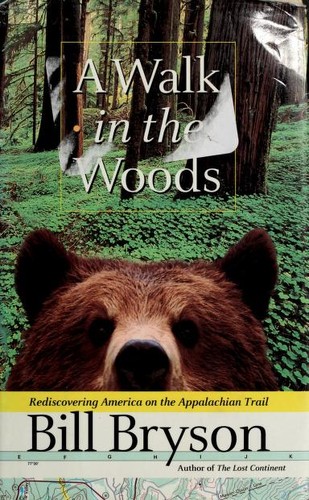
A Walk in the Woods
by Bill Bryson
★ Top 25 book of 1997 · #14 on Best Books of 1997
Bill Bryson recounts his attempt to hike the Appalachian Trail alongside a friend, mixing comic storytelling with more serious reflection. Along the way he explores the trail's history, wildlife, plants, and the people who live near it.
Best for: Armchair adventurers who enjoy funny travel writing with nature and history woven in
A Walk in the Woods is #14 on BookWard's Best Books of 1997, out of 28 1997 books that cleared our data bar.
What A Walk in the Woods is about
Bill Bryson sets out to walk the Appalachian Trail, despite being far from an experienced hiker. His companion is an old friend, called Stephen Katz in the book, who is blunt, out of shape and even less ready for the woods than Bryson himself. They begin in Georgia and quickly learn how much of their gear and food they never needed to carry.
The humor comes from misadventure, but the book also stops to explain the Trail's history, the people who use it, its ecology and the fight to protect it, with a side trip to a Pennsylvania town sitting above a burning coal seam. The walk does not go exactly to plan, and the book is honest about that. Readers who enjoy a warm, funny travel companion, or who have ever overestimated their own ambitions, will find good company here.
A Walk in the Woods on the Best Books of 1997
A Walk in the Woods came out in 1997. Of the 28 books first published in 1997 that met BookWard's data bar, it ranks #14 on our Best Books of 1997 list.
Why it made the list: 277 readers have shelved it on Open Library; readers rate it 3.9 out of 5 (68 ratings). The list ranks each year’s books on how many readers have picked them up, how highly readers rate them, and how many are reading them right now.
Nearby on the 1997 list
- The Spirit Catches You and You Fall Down Anne Fadiman, #12
- Sex and the City Candace Bushnell, #13
- Out of the Dust Karen Hesse, #15
- Cat & Mouse James Patterson, #16
See all Best Books of 1997 Best books by year
More years: Best Books of 1996 Best Books of 1998.
The numbers behind it
- Readers: 177 want to read it, 4 are reading it now and 96 have read it, according to Open Library.
- Ratings: 3.9 out of 5 from 68 Open Library ratings.
| Signal | This book (0 to 100) | Weight |
|---|---|---|
| Reach | 57 | 55% |
| Reader love | 50 | 25% |
| Being read right now | 11 | 20% |
Questions about A Walk in the Woods
When was A Walk in the Woods published?
A Walk in the Woods by Bill Bryson was first published in 1997.
Was A Walk in the Woods one of the best books of 1997?
A Walk in the Woods is #14 on BookWard's Best Books of 1997, out of 28 1997 books that cleared our data bar. 277 readers have shelved it on Open Library; readers rate it 3.9 out of 5 (68 ratings).
Why is A Walk in the Woods on the Best Books of 1997 list?
277 readers have shelved it on Open Library; readers rate it 3.9 out of 5 (68 ratings).
More of the best books of 1997
- Harry Potter and the Philosopher's Stone J. K. Rowling, #1
- Rich Dad, Poor Dad Robert T. Kiyosaki, #2
- Guns, Germs, and Steel Jared Diamond, #3
- The Adventures of Captain Underpants Dav Pilkey, #4
- The Power of Now Eckhart Tolle, #5
- Into Thin Air Jon Krakauer, #6
See the full Best Books of 1997, the Top 100, or new books on Rising.
How we know
This page uses public data: Open Library reader counts and ratings, and Wikipedia page views for recent years. The description is paraphrased from real source text. Rankings reflect reading interest, not quality or sales, and can be affected by data gaps. Lists update monthly.
Suits adult and older teen readers who enjoy humor and nature writing.
Depends on the edition you pick.
A funny, warm Appalachian Trail memoir that wanders into history and ecology. 53% taste match
 BookWard’s take
A funny, warm Appalachian Trail memoir that wanders into history and ecology
Bill Bryson sets out to hike the Appalachian Trail with his old friend Stephen Katz, and the comedy comes from two underprepared men finding out how big the project is. The book moves between the walk and broader material on the Trail's history, ecology and the people along it. The voice is where it excels: Bryson's wry, opinionated narration is unmistakable. It is also a funny, hopeful and restrained book, rather than a sentimental one. Readers who like their books tight and fast may find this one sprawls a little, and the digressions into history and conservation mean it is not strictly driven by story. It suits readers who want a companionable guide and a travel book with real information in it.
The walking scenes move along, but the history and ecology detours slow it below BookWard's brisk preference.
The trail memoir is a known form, though Bryson's blend of humor and research gives it a distinct flavor.
The writing is clear and conversational, with comic flourishes but nothing ornate.
The book is driven by Bryson and Katz as personalities more than by any plot machinery.
Setbacks abound, yet the tone stays good-humored and appreciative of the outdoors.
A chronological journey, broken up by essay-like tangents, but conventional in shape.
Comedy is central, from Bryson's self-deprecation to his portrait of the crude, unprepared Katz.
Mostly light, with only occasional grim notes about nature's dangers and conservation.
Feelings run mild and wry, rarely rising to intensity.
See all 50 dialsEvery position, side by side with this book
Where it lines up
- Shock for effectBookWard 9 · book 9
- SentimentBookWard 8 · book 7
- Authorial voiceBookWard 9 · book 10
Where it pulls apart
- LengthBookWard 1 · book 5
- Familiar tropesBookWard 10 · book 6
- OpeningBookWard 10 · book 7
The premise of two unfit men facing a vast trail pulls you in quickly, though not with BookWard's instant grip.
Trail-memoir staples like gear woes and eccentric hikers appear, but Bryson's comic angle keeps them from feeling stale.
The account follows a clear chain of decisions and consequences, which suits BookWard's taste for coherence.
The walking scenes move along, but the history and ecology detours slow it below BookWard's brisk preference.
The trail memoir is a known form, though Bryson's blend of humor and research gives it a distinct flavor.
Katz and the other hikers are sketched vividly and comically, with more color than inner depth.
The hike does not end in the tidy completion a reader might expect, but the book still reaches a clear close.
Warmth toward Katz and the trail is present, yet Bryson keeps it dry rather than syrupy, which BookWard likes.
The book gets its laughs from honest mishaps rather than manufactured darkness, matching BookWard's taste.
The historical and ecological digressions are informed and serious, within a deliberately personal and comic frame.
Bryson's dry, self-mocking narration is instantly recognizable and is the book's main draw.
The walk gives the book its spine, but the essays on history and conservation carry real weight.
Bryson often stops to explain the Trail's history and ecology outright, which BookWard prefers to see shown in scene.
The long middle of the trek is held up by humor, though the digressions let energy dip at times.
The writing is clear and conversational, with comic flourishes but nothing ornate.
The book is driven by Bryson and Katz as personalities more than by any plot machinery.
Setbacks abound, yet the tone stays good-humored and appreciative of the outdoors.
A chronological journey, broken up by essay-like tangents, but conventional in shape.
Comedy is central, from Bryson's self-deprecation to his portrait of the crude, unprepared Katz.
The plain, chatty style makes it an easy read at nearly any pace.
Everything is filtered through Bryson alone.
The narrative moves forward through the hiking seasons of one year.
This is a real hike through real places, with no fantastical element.
Katz is the main companion, with a small rotating set of fellow hikers and trail people around him.
A personal journey, though the Trail's vast length gives it some sweep.
Bryson's thoughts and the trail's events share the stage fairly evenly.
Exchanges with Katz and fellow hikers add banter, but narration dominates.
Romance plays no meaningful part in the book.
The Appalachian backcountry and its trail culture will be new ground for many readers.
The hike took place in 1996, so it reads as a recent past rather than the present day.
Its humor and nature themes hold up well, though the details are of the 1990s.
Bryson tells it straight as himself, with the comic exaggeration of a memoirist.
There is little moral puzzle here; the book is more about endurance and appreciation.
Bryson gives the landscape, towns and history of the Trail generous, vivid attention.
It reads as a personal story first, with analysis worked in around the edges.
Told in first person with Bryson's own foibles front and center.
A standalone book, though Katz appeared in an earlier Bryson travel book.
The surprises are the mishaps and encounters of the road, not plot reversals.
A genial, easy-going read that asks little of the reader.
Mostly light, with only occasional grim notes about nature's dangers and conservation.
Feelings run mild and wry, rarely rising to intensity.
The humor is dry and self-aware, with some broad comic set pieces.
Little violence appears; hardship comes from terrain and fatigue.
The sexual content is minimal and played for brief laughs.
Conservation and land policy come up, but as background rather than a campaign.
The language is plain and accessible throughout.
Bryson's opinions on gear, hikers and park management are offered freely and with relish.
The book looks back at a past trek and the Trail's history more than it looks ahead.
A shade of affection for the wild places tempers Bryson's wry skepticism.
Review written by BookWard, dial version 1, November 2026.
Who is A Walk in the Woods right for?
Suits adult and older teen readers who enjoy humor and nature writing. It includes crude humor and references to alcoholism and sexuality, mostly played lightly.
The plain, chatty style makes it an easy read at nearly any pace.
Mostly light, with only occasional grim notes about nature's dangers and conservation.
Feelings run mild and wry, rarely rising to intensity.
Little violence appears; hardship comes from terrain and fatigue.
Book CompanionA Walk in the Woods: ideas, characters, themes
Bill Bryson's attempt to walk the Appalachian Trail with his friend Stephen Katz becomes a funny, informative look at the Trail, the land and the people around it.
- Setting out. Bryson explains his curiosity about the Appalachian Trail near his home and buys the gear for the attempt.
- An unlikely pair. Bryson hikes with old friend Stephen Katz, a crude and unprepared recovering alcoholic.
- Lightening the load. Overburdened by their equipment, the two discard extra food and gear early on.
- Skipping ahead. Realizing the scale of the task, they skip a large stretch and resume the hike in Virginia.
- History and ecology. Between hiking scenes, Bryson digs into the Trail's history, conservation and the places he passes through.
Characters
Bill Bryson
Narrator and hiker
The author walks the Trail as the book's comic, curious guide.
Stephen Katz
Hiking companion
A pseudonym for Bryson's friend, shown as crude, overweight and even less prepared than Bryson.
Themes
How far ordinary people can push themselves, and where they stop.
The mix of irritation and loyalty between Bryson and Katz.
The state and survival of the wild places the Trail passes through.
Turning discomfort and failure into comedy.
Discussion questions
- Why does Bryson mix comic hiking scenes with history and ecology?
- What does Katz bring to the journey, for better and worse?
- Is it a failure that Bryson does not hike the whole Trail?
- How does the book's humor shape your view of the outdoors?
- What does the Trail seem to mean to the people Bryson meets?
Personalize your Book Companion
This is the general edition. In BookWard, the Companion is written for you: your reading profile, your notes, and spoiler-safe to the page you are on.
Buy, listen or borrow A Walk in the Woods
Each link opens a search for this book on that store, in a new tab.
Read on a device
Borrow
Reviews and community
If you liked A Walk in the Woods
Bourdain's unfiltered, funny tour through the back of the house
Born to RunChristopher McDougallA running quest through Copper Canyon that reads like an adventure
Me Talk Pretty One DayDavid SedarisSedaris at his sharpest: family, odd jobs, and failing at French
Lucky JimKingsley AmisA sharp, funny academic satire that still bites
Find your own best books
Add what you have read, rate it, and BookWard will recommend what to read next.
Free to start. No credit card needed.