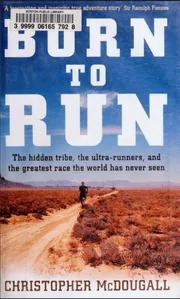
Born to Run
by Christopher McDougall, Fred Sanders · 2009
Not to be confused with Bruce Springsteen, Michael Morpurgo’s book of the same title (2016).
Suits teens and adults who enjoy sports, travel and adventure writing.
287 pages, about 4.5 to 6.5 hours.
A running quest through Copper Canyon that reads like an adventure. 58% taste match
What it covers
Born to Run is a work of narrative nonfiction by Christopher McDougall, an American author and journalist. First published in 2009, it belongs to the sports and memoir shelf and centers on long-distance and marathon running, with the Tarahumara people of Mexico's Copper Canyon region as a central subject. The book follows the author's journey into the Sierra Madre, where he goes in search of a figure known as Caballo Blanco, also named Micah True.
Alongside the Tarahumara, the narrative brings in a group of runners and ultra-distance athletes, among them Scott Jurek, Jenn Shelton, Ann Trason and Barefoot Ted, as well as local figures such as Manuel Luna and Luis Escobar. The story moves between Mexico and the United States and builds toward a race that draws these runners together. The book runs to roughly 287 pages in its median edition and has appeared in 28 editions since its release. It has sold over three million copies, and it suits readers interested in running, endurance sports and the people who take them up.
Characters
Christopher McDougallCaballo BlancoMicah TrueScott JurekJenn SheltonManuel Luna
Setting
Copper Canyon RegionMexicoUnited States
Themes
Tarahumara Indiansrunnerssportsatheletesmarathon runningLong-distance runnersLong-distance runningRunning
- Want to read 135
- Reading now 4
- Read 34
Most people shelving it are saving it for later.
Of 173 readers who put it on a shelf, 78% want to read it, 2% are reading it now, 20% have finished it and 0% stopped before the end.
By the numbers
- The median edition runs 287 pages. Counting about 275 words a page and an adult reading pace of 250 words a minute, that is about 5.3 hours of reading.
- Open Library tracks 28 editions from 16 publishers, the earliest dated 2009 and the latest 2016, across 7 languages.
- On reader demand it ranks in the top 5% of the modern books in our catalog (15,152 of them).
- Libraries shelve it under Dewey 796.4209721 and Library of Congress class GV-1061.23000000.M6 M33 2009.
 BookWard’s take
A running quest through Copper Canyon that reads like an adventure
Born to Run tells its story the way a good magazine feature would, with a search at the center and a cast of unusual people orbiting it. McDougall goes into Mexico's Sierra Madre looking for Caballo Blanco, and the book never wanders far from that pull. It hooks quickly and rewards that momentum, which suits readers who like a story that starts moving at once. The pace stays brisk across 287 pages, and the voice is unmistakably the author's own, opinionated and energetic. Character depth comes through vivid portraits of runners like Scott Jurek and Ann Trason. Where it falls short is rigor: it leans toward anecdote and enthusiasm over careful argument, so treat its bigger claims about running as part of the storytelling.
At 287 pages it is compact for a book with this much ground to cover, which BookWard likes.
Short chapters and a clear destination keep it moving, close to BookWard's preferred speed.
A hidden tribe, ultrarunners and a secret race make an unusual mix, fresher than most sports writing.
The writing is clear and punchy, with bursts of color but little ornament.
A quest structure drives events, with the personalities of the runners close behind.
It celebrates human endurance and joy in movement, leaving a lifting overall mood.
It follows a mostly conventional quest-narrative frame with some detours into background.
The tone is lively and often playful, though it is not a comic book.
The subject is mostly uplifting, with injury and hardship kept in the background.
It builds real feeling around endurance and community without becoming heavy.
See all 50 dialsEvery position, side by side with this book
Where it lines up
- PaceBookWard 8 · book 8
- EndingBookWard 8 · book 8
- Authorial voiceBookWard 9 · book 9
Where it pulls apart
- Familiar tropesBookWard 10 · book 6
- Internal logicBookWard 10 · book 6
- Rigor (nonfiction)BookWard 9 · book 4
At 287 pages it is compact for a book with this much ground to cover, which BookWard likes.
It opens on a search into the Sierra Madre and builds its pull from the start, matching BookWard's love of fast openings.
The underdog-tribe and obsessive-athlete framing is a familiar adventure shape, though the specific subjects keep it from feeling stock.
The narrative holds together as a quest, though its larger running claims are carried more by enthusiasm than tight argument.
Short chapters and a clear destination keep it moving, close to BookWard's preferred speed.
A hidden tribe, ultrarunners and a secret race make an unusual mix, fresher than most sports writing.
Runners like Scott Jurek, Ann Trason and Jenn Shelton are drawn as vivid individuals, though not explored in great depth.
It builds toward a race that draws its cast together, giving the story a clear payoff.
It is warm and admiring toward its subjects, with some emotion on display, though not heavily sentimental.
It earns its drama through real events and real people rather than manufactured shocks.
It is told as narrative journalism, favoring story and enthusiasm over careful evidence, which sits below BookWard's rigor bar.
McDougall's energetic, opinionated, journalist's voice is distinctive and carries the whole book.
Ideas about running ride along, but the quest and its people drive the book.
Much of the information arrives through scenes and encounters, with some outright explaining of running and history.
The mounting build toward the race keeps the middle purposeful throughout.
The writing is clear and punchy, with bursts of color but little ornament.
A quest structure drives events, with the personalities of the runners close behind.
It celebrates human endurance and joy in movement, leaving a lifting overall mood.
It follows a mostly conventional quest-narrative frame with some detours into background.
The tone is lively and often playful, though it is not a comic book.
It reads easily and invites a quick, absorbed pace.
The story is told from the author's single vantage point as he gathers others' stories.
It moves forward with the search and the race, stepping aside for background.
It deals in real people and places, though the Tarahumara carry a mythic aura.
A moderate roster of runners and locals appears, each distinct enough to follow.
A single search and one race anchor it, though the topic gestures at something larger.
Events, travel and running dominate over interior reflection.
Scenes include conversation with runners and locals, but narration carries most of the book.
Romance is not part of what this book is about.
Copper Canyon and its Tarahumara runners are unfamiliar territory for most readers.
It is set in the recent past around its 2009 publication.
Its adventure and its subjects have lasting appeal, though some running-science talk may date.
The author narrates his own journey plainly, with his enthusiasms in the open.
It is an admiring portrait of its heroes, with a clear sense of who and what it champions.
It paints the canyon landscape and the runners' physiques and habits with real color.
It is firmly narrative nonfiction, built around a journey and its people.
McDougall is present throughout, as participant and guide, so the perspective is personal.
It stands alone as a single complete book.
Some surprises arrive along the way, but the route is largely followable.
It is encouraging and inviting rather than difficult to sit with.
The subject is mostly uplifting, with injury and hardship kept in the background.
It builds real feeling around endurance and community without becoming heavy.
Humor leans broad and playful, with larger-than-life characters.
There is little violence beyond the physical toll of extreme running.
Sexual content is essentially absent.
It touches on culture and commerce lightly without becoming a political book.
The language is plain and conversational throughout.
The author's views on running and its culture come through strongly and often.
It looks to the past of a people and the present of a sport in about equal measure.
It is openly idealistic about running, community and human potential.
Review written by BookWard, dial version 1, November 2026.
Who is Born to Run right for?
Suits teens and adults who enjoy sports, travel and adventure writing. It contains physical strain and injury but little else sensitive.
It reads easily and invites a quick, absorbed pace.
The subject is mostly uplifting, with injury and hardship kept in the background.
It builds real feeling around endurance and community without becoming heavy.
There is little violence beyond the physical toll of extreme running.
Book CompanionBorn to Run: ideas, characters, themes
A journalist's search for a hidden tribe of endurance runners becomes a story about why humans run and what joy that can hold.
- The search. McDougall travels into Mexico's Sierra Madre seeking Caballo Blanco, also named Micah True.
- The Tarahumara. The Tarahumara people of Copper Canyon are a central subject of the book.
- The runners. Ultra-distance athletes such as Scott Jurek, Jenn Shelton, Ann Trason and Barefoot Ted join the story.
- Two countries. The narrative moves between Mexico and the United States.
- The race. The book builds toward a race that brings these runners together.
Characters
Christopher McDougall
Author and narrator
The American journalist who travels to Copper Canyon and tells the story.
Caballo Blanco (Micah True)
The figure being sought
The man McDougall goes into the Sierra Madre to find.
Scott Jurek
Ultra-distance runner
One of the athletes who joins the story.
Jenn Shelton
Runner
One of the athletes drawn into the narrative.
Barefoot Ted
Runner
One of the runners who features in the book.
Themes
What the body and will can do over long distances.
How a shared pursuit draws very different people together.
The meeting of a hidden culture and the wider athletic world.
Running as something natural and enjoyable, not only a discipline.
The pull that sends people far out of their way for a pursuit.
Discussion questions
- Why do you think McDougall frames the book as a search for one person?
- How does the book portray the Tarahumara, and what might it simplify?
- Which runner stayed with you most, and why?
- How much should a narrative like this be trusted on its claims about running?
- What did the climactic race add to the story?
Personalize your Book Companion
This is the general edition. In BookWard, the Companion is written for you: your reading profile, your notes, and spoiler-safe to the page you are on.
Buy, listen or borrow Born to Run
Each link opens a search for this book on that store, in a new tab.
Read on a device
Borrow
Reviews and community
If you liked Born to Run
A funny, warm Appalachian Trail memoir that wanders into history and ecology
The Boy Who Harnessed the WindWilliam KamkwambaA Malawian teenager builds a windmill from scrap and stubbornness
Maniac MageeJerry SpinelliA tall-tale runaway crosses a segregated town and refuses to see the line
Never Split the DifferenceChris VossHostage-negotiation tactics, turned into a handbook for everyday deals
Sources: Open Library.
Track Born to Run and find your next favorite
Add it to your shelf, rate what you have read, and BookWard will recommend what fits you.
Free to start. No credit card needed.