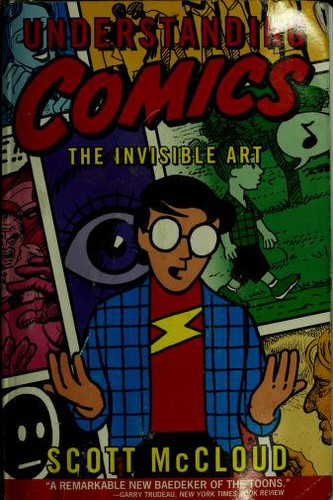
Understanding Comics
by Scott McCloud
★ Top 10 book of 1993 · #6 on Best Books of 1993
Scott McCloud takes a close look at comics as an art form, tracing its history, its technical building blocks and its cultural weight. He invites readers to explore the meaning hidden between panels, lines and symbols.
Best for: Comics fans and curious readers wanting to understand how the art form works
Understanding Comics is #6 on BookWard's Best Books of 1993, out of 36 1993 books that cleared our data bar.
What Understanding Comics is about
Scott McCloud explains how comics work, and he does it in the form of a comic. His central argument is that comics are defined by sequences of images, and he builds from there with a playful, analytical, and easy-to-follow touch. He looks at how readers fill in the gaps between panels, a process he calls closure, and at why simple cartoon-like faces draw us in more readily than realistic ones.
He also sketches a long history of visual storytelling, from the Bayeux Tapestry to Rodolphe Töpffer, and offers tools such as masking and the Big Triangle for thinking about how artists choose their style. It will suit anyone curious about comics, from lifelong fans to newcomers, as well as artists, writers, and teachers who want a clearer sense of how images tell stories.
Understanding Comics on the Best Books of 1993
Understanding Comics came out in 1993. Of the 36 books first published in 1993 that met BookWard's data bar, it ranks #6 on our Best Books of 1993 list.
Why it made the list: 369 readers have shelved it on Open Library; readers rate it 4.2 out of 5 (26 ratings). The list ranks each year’s books on how many readers have picked them up, how highly readers rate them, and how many are reading them right now.
Nearby on the 1993 list
- A Suitable Boy Vikram Seth, #4
- Girl, Interrupted Susanna Kaysen, #5
- Trainspotting Irvine Welsh, #7
- The Virgin Suicides Jeffrey Eugenides, #8
See all Best Books of 1993 Best books by year
More years: Best Books of 1992 Best Books of 1994.
The numbers behind it
- Readers: 320 want to read it, 12 are reading it now and 37 have read it, according to Open Library.
- Ratings: 4.2 out of 5 from 26 Open Library ratings.
| Signal | This book (0 to 100) | Weight |
|---|---|---|
| Reach | 86 | 55% |
| Reader love | 86 | 25% |
| Being read right now | 53 | 20% |
Questions about Understanding Comics
When was Understanding Comics published?
Understanding Comics by Scott McCloud was first published in 1993.
Was Understanding Comics one of the best books of 1993?
Understanding Comics is #6 on BookWard's Best Books of 1993, out of 36 1993 books that cleared our data bar. 369 readers have shelved it on Open Library; readers rate it 4.2 out of 5 (26 ratings).
Why is Understanding Comics on the Best Books of 1993 list?
369 readers have shelved it on Open Library; readers rate it 4.2 out of 5 (26 ratings).
More of the best books of 1993
- The Giver Lois Lowry, #1
- The Scam Debashis Basu, #2
- Along Came a Spider James Patterson, #3
- A Suitable Boy Vikram Seth, #4
- Girl, Interrupted Susanna Kaysen, #5
- Trainspotting Irvine Welsh, #7
See the full Best Books of 1993, the Top 100, or new books on Rising.
How we know
This page uses public data: Open Library reader counts and ratings, and Wikipedia page views for recent years. The description is paraphrased from real source text. Rankings reflect reading interest, not quality or sales, and can be affected by data gaps. Lists update monthly.
Suitable for teens and adults interested in art, comics or media, with accessible language and visuals.
Depends on the edition you pick.
A comic about comics that teaches you to see the medium. 58% taste match
 BookWard’s take
A comic about comics that teaches you to see the medium
Understanding Comics is a 1993 work of nonfiction written entirely in comic form, and it earns that choice on nearly every page. McCloud takes on the definition, history and vocabulary of the medium, building his argument around sequences of images and the reader's role in filling the gaps between panels. It is hard to think of anything quite like it, since the form is the argument. The voice is unmistakable, with McCloud guiding you as a drawn version of himself. He is serious about his claims, even where debate remains. It runs more idea-led than story-led and explains outright, but it shows as much as it tells, which keeps the pace brisk and your interest high throughout.
The panel format keeps ideas moving quickly, a little gentler than BookWard's brisk preference.
A book-length argument made in the form it describes was strikingly new, and BookWard prizes that.
The words are plain and clear, in service of the drawings, a bit plainer than BookWard's middle ground.
It is enthusiastic about what the medium can do, giving it a quietly hopeful tilt.
Telling nonfiction through comics is an experimental choice, more adventurous than BookWard's conventional-leaning middle.
Wit runs through the narration and visual jokes, though the book stays focused on its subject.
A bright, inquisitive book with nothing dark about it.
Curiosity drives it more than feeling, so the emotional register is low.
See all 50 dialsEvery position, side by side with this book
Where it lines up
- OriginalityBookWard 9 · book 9
- SentimentBookWard 8 · book 8
- Shock for effectBookWard 9 · book 9
Where it pulls apart
- Story or ideasBookWard 3 · book 10
- ExpositionBookWard 2 · book 8
- Character depthBookWard 8 · book 3
The opening pulls you straight into the question of what comics are, so it grabs fast, close to BookWard's taste.
Nothing here is boilerplate; it treats a familiar medium as unexplored ground, which BookWard rewards.
Each chapter builds on the last, with terms defined and then used, so the argument holds together well.
The panel format keeps ideas moving quickly, a little gentler than BookWard's brisk preference.
A book-length argument made in the form it describes was strikingly new, and BookWard prizes that.
There are no characters to deepen, only a guide figure, so this dial barely applies and BookWard won't miss it.
It stays analytical and avoids tugging at the heartstrings, matching BookWard's restraint.
It never reaches for shock; the surprises come from ideas, not provocation.
It builds claims on history and structure, though some conclusions have been debated, so it is firm but not unassailable.
McCloud's drawn, conversational persona is instantly recognizable, a clear match for BookWard's love of distinctive voice.
This is an argument first and a story only incidentally, well off BookWard's story-led lean.
It frequently explains outright, though pictures carry much of the work, so it leans more explanatory than BookWard prefers.
Chapters stay purposeful from start to finish, with no stretch that coasts, which BookWard values.
The words are plain and clear, in service of the drawings, a bit plainer than BookWard's middle ground.
It is enthusiastic about what the medium can do, giving it a quietly hopeful tilt.
Telling nonfiction through comics is an experimental choice, more adventurous than BookWard's conventional-leaning middle.
Wit runs through the narration and visual jokes, though the book stays focused on its subject.
The ideas take attention but the form is welcoming, so it is moderately effortful at most.
McCloud's guiding perspective carries the book throughout, so it stays singular.
It deals in drawn images and real art, firmly grounded despite the cartoon style.
A single guide figure leads the way, so the cast is as small as it gets.
It takes in the whole history of a medium, but through a personal, conversational lens.
It is about ideas and perception, so it sits on the inner, reflective side.
Speech balloons carry the narration, but it is more lecture than conversation.
Not a topic here at all.
The subject, comics and images, is entirely familiar to any reader.
Published in 1993, it sits in the recent past but still reads as current.
Its ideas about closure and iconic imagery remain common reference points in discussions of the medium.
The narrator is open about being a guide with a view, so reliability is not in question.
It argues a point of view rather than weighing right and wrong.
Visuals do the describing, and they do it richly, though the text itself is spare.
It leans analytical, though a thread of history and personal address softens it.
The author's direct, personable presence makes it feel close, not detached.
It offers new ways of seeing rather than plot turns, so few classic surprises.
It asks you to rethink how you read images, a gentle but real challenge.
A bright, inquisitive book with nothing dark about it.
Curiosity drives it more than feeling, so the emotional register is low.
The humor is dry and visual, more wry aside than broad gag.
It is about art and communication, not political argument.
The language is plain and easy to follow.
McCloud argues a case with conviction, making this firmly opinionated narration.
It looks back across history while pointing toward what the form could become.
It believes deeply in the power and potential of its medium.
Review written by BookWard, dial version 1, November 2026.
Who is Understanding Comics right for?
Suitable for teens and adults interested in art, comics or media, with accessible language and visuals. It contains no content that needs a warning.
The ideas take attention but the form is welcoming, so it is moderately effortful at most.
A bright, inquisitive book with nothing dark about it.
Curiosity drives it more than feeling, so the emotional register is low.
Book CompanionUnderstanding Comics: ideas, characters, themes
Comics are an art form defined by sequences of images, and understanding how they work reveals how readers make meaning between the panels.
- Comics defined. McCloud argues that comics are defined by the primacy of images arranged in sequence.
- Closure. Readers mentally fill the gaps between panels, a role that makes them active participants in the story.
- Iconic versus realistic. Simple, iconic figures draw readers in differently than detailed, photographic ones.
- A history of the form. The book places antecedents like the Bayeux Tapestry and Rodolphe Töpffer in the medium's lineage.
- Masking. Simple, archetypal characters set against detailed backgrounds can pull readers into the story.
Themes
Learning to read images with the same care we bring to words.
Meaning in comics depends on what the audience supplies between panels.
The book argues its case in the very medium it describes.
Comics are traced through earlier traditions of visual narrative.
Stripped-down images can invite readers to see themselves in the story.
Discussion questions
- How does the comic format change the way McCloud's argument lands compared with a prose essay?
- What does closure ask of you as a reader, and where have you noticed yourself doing it?
- Do simple, iconic images draw you in more than realistic ones, as McCloud suggests?
- Which of McCloud's claims would you push back on, and why?
- What has the book changed about how you look at comics or other sequential images?
Personalize your Book Companion
This is the general edition. In BookWard, the Companion is written for you: your reading profile, your notes, and spoiler-safe to the page you are on.
Buy, listen or borrow Understanding Comics
Each link opens a search for this book on that store, in a new tab.
Read on a device
Borrow
Reviews and community
If you liked Understanding Comics
Six levers of persuasion, laid out with evidence and field work
The botany of desireMichael PollanA plant's-eye view of us, one apple at a time
DriveDaniel H. PinkA lively case that autonomy, mastery and purpose beat carrots and sticks
The Happiness HypothesisJonathan HaidtAncient wisdom on happiness, tested against modern psychology, by Jonathan Haidt
Find your own best books
Add what you have read, rate it, and BookWard will recommend what to read next.
Free to start. No credit card needed.