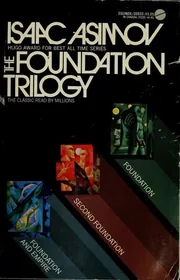
The Foundation Trilogy
by Isaac Asimov · 1950
Suits teenagers and adults who enjoy big ideas and classic science fiction.
605 pages, about 9.5 to 14 hours.
A galaxy-spanning idea novel that trades characters for the sweep of history. 46% taste match
The story
The Foundation Trilogy collects three science fiction novels by Isaac Asimov, first published in 1950: Foundation, Foundation and Empire, and Second Foundation. The edition runs to roughly 605 pages and has appeared in 54 editions. The story is set in a far future galaxy, where the Trantorian Empire is in decline and the future of humanity is at stake.
At the center is Hari Seldon, a psychohistorian whose science of predicting the course of history shapes the path of the Foundation, a planet of scholars and scientists. Its people rely on his prophecies as they face the greed and barbarism of neighboring warrior-planets, and later the Empire itself, when an ambitious general turns the imperial fleet against them. A mutant known as The Mule then appears, possessing a mental power that can bend even strong-willed people into obedience and threatens everything the Foundation has planned for.
The books combine space adventure with themes of prophecy, life on other planets, and the survival of knowledge through an age of violence. Readers of American science fiction who enjoy large-scale future histories will find the series a natural fit.
Setting
Trantorian Empire (Fictitious place)
Themes
PsychohistoryLife on other planetsPropheciesAbenteuerWeltraumProphecyLong Now Manual for Civilization
- Want to read 485
- Reading now 36
- Read 99
Most people shelving it are saving it for later.
Of 620 readers who put it on a shelf, 78% want to read it, 6% are reading it now, 16% have finished it and 0% stopped before the end.
By the numbers
- The median edition runs 605 pages. Counting about 275 words a page and an adult reading pace of 250 words a minute, that is about 11 hours of reading.
- Open Library tracks 54 editions from 38 publishers, the earliest dated 1950 and the latest 2022, across 6 languages.
- On reader demand it ranks in the top 1% of the classic books in our catalog (8,749 of them).
- Libraries shelve it under Dewey 813.54 and Library of Congress class PS-3551.00000000.S5 A85.
 BookWard’s take
A galaxy-spanning idea novel that trades characters for the sweep of history
The Foundation Trilogy opens with a premise that grabs you quickly: a science of predicting history, a dying Empire, and a small planet of scholars holding humanity's future. It is driven by ideas rather than story, and that shapes everything. The characters are thin, because people serve the argument more than the other way round. The exposition is blunt, with characters talking their way through much of what matters. But the internal logic holds up, since each crisis follows from the one before, and in 1950 the originality was a genuine departure. The Mule brings in a real surprise, and the ending resolves cleanly. The prose is plain and functional, and the cast is large, spread across the decades. Reading it today means accepting a mid-century voice and a heavy reliance on dialogue, in exchange for a vision of history that still feels bold.
At 605 pages across three novels it is substantial, though each section is built from self-contained episodes, which is longer than BookWard prefers.
Episodes move briskly from crisis to crisis, though long stretches of talk slow it slightly below BookWard's fast preference.
A science of predicting history across millennia was a fresh idea in 1950, matching BookWard's appetite for originality.
The writing is plain and utilitarian, a touch plainer than BookWard's middling taste.
Events and historical forces drive everything, well toward plot and away from BookWard's character lean.
Civilization is shown surviving a collapse, giving a cautiously hopeful outlook close to BookWard's.
Linked episodes spanning generations are mildly unconventional, a bit more than BookWard's middle position.
The tone is serious and cerebral, with little levity, which is more sober than BookWard prefers.
The collapse of an empire is the backdrop, but the tone stays measured, a little gentler than BookWard's middle.
Feeling is muted throughout, keeping it less intense than BookWard's level.
See all 50 dialsEvery position, side by side with this book
Where it lines up
- OriginalityBookWard 9 · book 9
- SentimentBookWard 8 · book 8
- EndingBookWard 8 · book 7
Where it pulls apart
- LengthBookWard 1 · book 6
- Familiar tropesBookWard 10 · book 6
- Story or ideasBookWard 3 · book 9
At 605 pages across three novels it is substantial, though each section is built from self-contained episodes, which is longer than BookWard prefers.
The central premise of predicting the fall of an empire draws you in fast, close to BookWard's taste for an immediate hook.
It helped create the tropes later space opera borrowed, though some period conventions now read as familiar.
Each crisis follows from the Foundation's earlier choices and Seldon's plan, which suits BookWard's liking for tight internal logic.
Episodes move briskly from crisis to crisis, though long stretches of talk slow it slightly below BookWard's fast preference.
A science of predicting history across millennia was a fresh idea in 1950, matching BookWard's appetite for originality.
Characters mostly serve the sweep of events rather than carrying it, which falls short of the depth BookWard values.
The long arc is brought to a clear resolution, which fits BookWard's preference for endings that settle.
Feeling is kept at arm's length throughout, and the book prizes cool reasoning over tenderness, which BookWard welcomes.
Its surprises come from the logic of events rather than cruelty, which sits well with BookWard.
Asimov's clear, rational narration has a recognizable stamp, though less strongly flavored than BookWard's favorites.
Ideas about history, prophecy and power lead the book, well beyond BookWard's story-led lean.
Characters often explain situations and plans in conversation, much more than BookWard's preference for showing in scene.
Crisis follows crisis, though the shift between episodes occasionally resets momentum.
The writing is plain and utilitarian, a touch plainer than BookWard's middling taste.
Events and historical forces drive everything, well toward plot and away from BookWard's character lean.
Civilization is shown surviving a collapse, giving a cautiously hopeful outlook close to BookWard's.
Linked episodes spanning generations are mildly unconventional, a bit more than BookWard's middle position.
The tone is serious and cerebral, with little levity, which is more sober than BookWard prefers.
The ideas are easy to follow, yet the long timeframe and rotating players ask for some attention, close to BookWard's comfort.
Each section follows a new set of people, so many viewpoints cover the centuries, matching BookWard's range.
Time jumps forward by decades between episodes, shifting more than BookWard's usual linear taste.
A galactic empire and mind-altering mutants place it firmly in the fantastical, beyond BookWard's mid-range.
New generations bring new figures, so the cast grows large over the series, more than BookWard prefers.
An entire galaxy and a millennium of history make it among the most epic books around, well beyond BookWard's lean.
Politics, diplomacy and battle outweigh interior thought, tilting outward a little past BookWard's leaning.
Plans and debates unfold largely through conversation, heavier than even BookWard's dialogue-friendly taste.
Romance is nearly absent, which is lighter than BookWard's middle position.
A far-future galaxy with invented planets and institutions is highly unfamiliar, which BookWard enjoys.
Set in the distant future, it is far from the present day, though its postwar voice is clear.
Its questions about history and power still feel relevant, close to BookWard's liking for lasting books.
The narration is straightforward and trustworthy, far from the unreliable narrators BookWard leans toward.
Choices carry real tradeoffs, but the book tends to back the Foundation's survival, so it is moderately clear.
Settings are sketched briefly in service of the plot, sparser than BookWard's leaning.
It is a trilogy with a continuing arc, more series-bound than BookWard's middle position.
Seldon's plan and The Mule produce several reversals, fitting BookWard's fondness for surprise.
The central ideas pose real questions about determinism and power, with some intellectual challenge, a bit under BookWard's taste.
The collapse of an empire is the backdrop, but the tone stays measured, a little gentler than BookWard's middle.
Feeling is muted throughout, keeping it less intense than BookWard's level.
Humor is rare and mild, drier than BookWard's middle position.
Wars and threats shape events, yet most conflict is political and discussed rather than shown.
Sexual content is essentially absent, lighter than BookWard's middle position.
Statecraft, imperial decline and manipulation sit at the center, much more than BookWard's usual political load.
The language is clear and standard, plainer than BookWard's middle position.
The narration mostly stays neutral, only lightly colored by the author's preferences, a bit under BookWard's taste.
It is about the future and humanity's long path, leaning forward like BookWard.
It trusts reason and planning to guide civilization, an idealistic bent matching BookWard's.
Review written by BookWard, dial version 1, November 2026.
Who is The Foundation Trilogy right for?
Suits teenagers and adults who enjoy big ideas and classic science fiction. There is conflict and war throughout, but little graphic content.
The ideas are easy to follow, yet the long timeframe and rotating players ask for some attention, close to BookWard's comfort.
The collapse of an empire is the backdrop, but the tone stays measured, a little gentler than BookWard's middle.
Feeling is muted throughout, keeping it less intense than BookWard's level.
Wars and threats shape events, yet most conflict is political and discussed rather than shown.
Book CompanionThe Foundation Trilogy: ideas, characters, themes
Hari Seldon's psychohistory predicts the fall of a galactic empire, and the Foundation is founded to shorten the dark age that follows, until The Mule disrupts the plan.
- A galaxy in decline. The Trantorian Empire is dying, and the story starts from that long, slow collapse.
- Psychohistory. Hari Seldon's science of predicting the course of history shapes the Foundation's path.
- The Foundation. A planet of scholars and scientists relies on Seldon's prophecies to survive hostile neighbors.
- Threats from outside. Greedy warrior-planets and then the Empire's own fleet press in on the Foundation.
- The Mule. A mutant with the power to bend strong-willed people into obedience threatens everything planned.
Characters
Hari Seldon
Psychohistorian and founder
His science of predicting history guides the Foundation's course.
The Mule
Mutant adversary
A mutant whose mental power can make even the strongest-willed person obey.
Themes
Can the course of history be forecast, and what happens when something unforeseen appears?
The slow fall of a mighty civilization and what might replace it.
Scholars and scientists keep humanity's light alive through an age of violence.
Armies, wealth and mental control all compete to shape the galaxy.
Discussion questions
- Is it comforting or unsettling that history might be predictable?
- Why might the book keep individuals in the background while it follows entire eras?
- What does the Foundation's reliance on prophecy cost it?
- How does The Mule change what the story is asking about?
- Does the book's trust in knowledge and planning still feel convincing today?
Personalize your Book Companion
This is the general edition. In BookWard, the Companion is written for you: your reading profile, your notes, and spoiler-safe to the page you are on.
Buy, listen or borrow The Foundation Trilogy
Each link opens a search for this book on that store, in a new tab.
Read on a device
Borrow
Reviews and community
If you liked The Foundation Trilogy
Two sharp novellas about empires, prophecy, and one thing the math missed
Children of TimeAdrian TchaikovskySpiders build a civilization while humanity's last ark ship closes in
Forward the FoundationIsaac AsimovHari Seldon's forty years, told as linked episodes of a life
The Complete RobotIsaac AsimovAsimov's robot stories, gathered into one clever, rule-bound whole
Sources: Open Library.
Track The Foundation Trilogy and find your next favorite
Add it to your shelf, rate what you have read, and BookWard will recommend what fits you.
Free to start. No credit card needed.