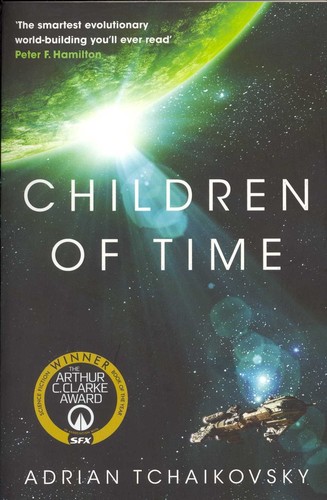
Children of Time
by Adrian Tchaikovsky
★ Top 25 book of 2015 · #14 on Best Books of 2015
Humanity's last survivors flee a dying Earth and follow ancient star maps to a world prepared for them. They find it already occupied by new threats, setting two civilisations toward conflict and leaving open who truly inherits the planet.
Best for: Space-opera fans who like survival stakes and questions about who deserves a new world
Children of Time is #14 on BookWard's Best Books of 2015, out of 55 2015 books that cleared our data bar.
What Children of Time is about
A scientist named Dr. Avrana Kern orbits a terraformed planet, preparing to release a nanovirus that will speed up the evolution of monkeys. When the plan goes wrong, the virus reaches a very different species: jumping spiders. Over generations, those spiders begin to build a civilization of their own, guided in part by an artificial intelligence shaped from a human personality.
Meanwhile, the last humans from a dying Earth travel aboard the ark ship Gilgamesh, searching for somewhere to live. Much of their story is seen through Holsten Mason, the ship's chief classicist. The two threads move toward each other across vast stretches of time, asking what intelligence looks like, how societies survive, and whether strangers can ever learn to share a world. Epic in scale yet thoughtful in tone, it won the 2016 Arthur C. Clarke Award and began a series.
Children of Time on the Best Books of 2015
Children of Time came out in 2015. Of the 55 books first published in 2015 that met BookWard's data bar, it ranks #14 on our Best Books of 2015 list.
Why it made the list: 493 readers have shelved it on Open Library; readers rate it 4.3 out of 5 (76 ratings). The list ranks each year’s books on how many readers have picked them up, how highly readers rate them, and how many are reading them right now.
Nearby on the 2015 list
- The Bazaar of Bad Dreams Stephen King, #12
- Everything, Everything Nicola Yoon, #13
- Adult Children of Emotionally Immature Parents Lindsay C. Gibson, #15
- Neverseen Shannon Messenger, #16
See all Best Books of 2015 Best books by year
More years: Best Books of 2014 Best Books of 2016.
The numbers behind it
- Readers: 366 want to read it, 11 are reading it now and 116 have read it, according to Open Library.
- Ratings: 4.3 out of 5 from 76 Open Library ratings.
| Signal | This book (0 to 100) | Weight |
|---|---|---|
| Reach | 73 | 55% |
| Reader love | 80 | 25% |
| Being read right now | 40 | 20% |
Questions about Children of Time
When was Children of Time published?
Children of Time by Adrian Tchaikovsky was first published in 2015.
Was Children of Time one of the best books of 2015?
Children of Time is #14 on BookWard's Best Books of 2015, out of 55 2015 books that cleared our data bar. 493 readers have shelved it on Open Library; readers rate it 4.3 out of 5 (76 ratings).
Why is Children of Time on the Best Books of 2015 list?
493 readers have shelved it on Open Library; readers rate it 4.3 out of 5 (76 ratings).
More of the best books of 2015
- Six of Crows Leigh Bardugo, #1
- The Hired Girl Laura Amy Schlitz, #2
- Queen of Shadows Sarah J. Maas, #3
- November 9 Colleen Hoover, #4
- Red Queen Victoria Aveyard, #5
- The Sword of Summer Rick Riordan, #6
See the full Best Books of 2015, the Top 100, or new books on Rising.
How we know
This page uses public data: Open Library reader counts and ratings, and Wikipedia page views for recent years. The description is paraphrased from real source text. Rankings reflect reading interest, not quality or sales, and can be affected by data gaps. Lists update monthly.
Suits adult and mature teen readers who enjoy ambitious science fiction.
Depends on the edition you pick.
Spiders build a civilization while humanity's last ark ship closes in. 53% taste match
 BookWard’s take
Spiders build a civilization while humanity's last ark ship closes in
Children of Time braids two strands: a species of uplifted jumping spiders developing across millennia on a terraformed world, and the last human ark ship searching for a new home. The structure is the book's engine, and it pays off. The spider civilization is imagined with real invention and avoids the usual alien shortcuts, which is where the book is at its most original. The long evolutionary leaps hold together because the book works out cause and effect as it goes. The pace is steady rather than frantic, and the time jumps keep the middle from sagging. It is also an idea-led book rather than a story-led one, and at times it explains more than it shows. A strong pick for big-concept science fiction that still cares about its characters.
A large, multi-millennia story that runs well past tight; BookWard prefers shorter, so this asks for more commitment.
Time jumps keep things moving at a measured, steady clip rather than a sprint.
A civilization of genetically altered jumping spiders is a fresh central conceit, handled with real invention.
Clear and functional rather than ornate, serving the ideas.
The sweep of events and the species-level story lead, with characters carried along by them.
There is real wonder and survival at stake, balancing menace with a cautiously hopeful pull.
Two alternating strands across vast time gaps give it a distinctive shape within a readable frame.
The tone is serious and awed, with little room for comedy.
Extinction-level stakes and conflict give it weight without tipping into relentless bleakness.
It stirs feeling through the fates of its characters and species, kept in check.
See all 50 dialsEvery position, side by side with this book
Where it lines up
- OriginalityBookWard 9 · book 9
- EndingBookWard 8 · book 8
- SentimentBookWard 8 · book 7
Where it pulls apart
- LengthBookWard 1 · book 7
- OpeningBookWard 10 · book 6
- Story or ideasBookWard 3 · book 8
A large, multi-millennia story that runs well past tight; BookWard prefers shorter, so this asks for more commitment.
The orbital opening with Dr. Kern and the nanovirus gets the central premise moving quickly, though the full engine builds over the first stretch.
Uplifted spiders and an ark-ship search avoid most well-worn genre moves, with a few familiar generation-ship beats.
The evolution of the spider society and the human voyage follow clear cause and effect, which suits BookWard's love of airtight worlds.
Time jumps keep things moving at a measured, steady clip rather than a sprint.
A civilization of genetically altered jumping spiders is a fresh central conceit, handled with real invention.
The spiders and humans are given real inner lives, though the scale means individuals are sometimes subordinate to ideas.
The two strands converge toward a clear resolution rather than leaving the central conflict hanging.
The emotional beats are present but mostly earned through the story rather than pushed for tears.
The darkness comes from the premise and the stakes, not from cheap shocks.
This is fiction, so the rigor dial does not apply.
Confident and readable, with a clear authorial sensibility, though it is more serviceable than strikingly stylized.
The big speculative idea of uplift and evolution drives the book, with story built around it.
Some concepts are laid out directly for the reader, which sits above BookWard's preference for showing in scene.
Alternating strands and time jumps keep momentum steady through the long middle.
Clear and functional rather than ornate, serving the ideas.
The sweep of events and the species-level story lead, with characters carried along by them.
There is real wonder and survival at stake, balancing menace with a cautiously hopeful pull.
Two alternating strands across vast time gaps give it a distinctive shape within a readable frame.
The tone is serious and awed, with little room for comedy.
The concepts are big but clearly delivered, so it reads accessibly for ambitious science fiction.
Two main strands, a human crew and a spider civilization, give it many perspectives across the story.
Spider chapters leap across generations while the human voyage runs on its own clock.
Uplifted arachnids on a terraformed planet and cryonic arks make this firmly speculative.
Many figures across generations and two civilizations, though the focus rotates among a manageable core.
It spans millennia and the fate of two species, an epic canvas.
Balanced between the ideas and thoughts of its characters and the events driving the plot.
Scenes carry conversation, but the book is driven more by narration and events.
Romance is not the focus of this survival and discovery story.
A terraformed planet and an alien society are deeply unfamiliar settings.
Set in the far future and deep time, far from the present day.
Its themes of evolution, survival and coexistence give it lasting appeal beyond its 2015 release.
The narration is straightforward and trustworthy rather than playing tricks on the reader.
Both species have understandable claims, which keeps the central conflict from being a simple good-versus-evil split.
The alien society and its world are drawn in vivid, imaginative detail.
It is the first of a continuing series, though this book stands on its own arc.
Reveals about the two strands and where they converge provide a fair number of surprises.
It poses real questions about species, survival and who inherits a world, without being punishing.
Extinction-level stakes and conflict give it weight without tipping into relentless bleakness.
It stirs feeling through the fates of its characters and species, kept in check.
Humor is a minor note in a mostly serious book.
Conflict and danger are present as plot, not lingered over.
Sexual content is minimal and not a focus.
Factions and ideology shape the backstory and stakes, but it is not a political tract.
The language is plain and clear, even when the ideas are complex.
The narration lets the story and ideas speak with only light editorializing.
The story is oriented toward humanity's future and what comes next for species.
It leans toward the possibility of coexistence and understanding without ignoring the dangers.
Review written by BookWard, dial version 1, November 2026.
Who is Children of Time right for?
Suits adult and mature teen readers who enjoy ambitious science fiction. It deals with environmental collapse, extinction and conflict, which may be heavy for younger readers.
The concepts are big but clearly delivered, so it reads accessibly for ambitious science fiction.
Extinction-level stakes and conflict give it weight without tipping into relentless bleakness.
It stirs feeling through the fates of its characters and species, kept in check.
Conflict and danger are present as plot, not lingered over.
Book CompanionChildren of Time: ideas, characters, themes
Two civilizations, one human and one the product of accelerated evolution, grow toward the same world and the question of who it belongs to.
- A terraforming experiment goes wrong. A planned nanovirus meant to uplift monkeys ends up altering other creatures, including jumping spiders.
- Two strands, one destination. The book alternates between the spider civilization and the human ark ship heading toward the same planet.
- Deep time. Spider chapters jump across generations, letting the reader watch a culture, technology and ideas develop.
- An AI with a human origin. A guiding intelligence based on a human terraformer's personality shapes the planet's story.
- A world of competing claims. Both the arriving humans and the native spiders have reasons to see the planet as theirs.
Characters
Dr. Avrana Kern
Lead scientist of the terraforming effort
She heads the orbital team and hopes the planet will be named for her; her choices set the whole story in motion.
Themes
How intelligence and culture might emerge, and what responsibility comes with guiding it.
The pressure on both species to secure a future in the face of collapse.
Whether two intelligent species with competing claims can share a world.
The tension between powerful tools and the fear they provoke.
Discussion questions
- Who has the stronger claim to the planet, the humans or the spiders, and why?
- How does alternating between two strands change how you feel about each one?
- What does the book suggest about intelligence arising from a very different kind of mind?
- Did the time jumps help or hinder your connection to the spider characters?
- What role does the backstory of anti-technology factions play in the larger story?
Personalize your Book Companion
This is the general edition. In BookWard, the Companion is written for you: your reading profile, your notes, and spoiler-safe to the page you are on.
Buy, listen or borrow Children of Time
Each link opens a search for this book on that store, in a new tab.
Read on a device
Borrow
Reviews and community
If you liked Children of Time
Vinge's space opera where the laws of thought bend with location
The Foundation TrilogyIsaac AsimovA galaxy-spanning idea novel that trades characters for the sweep of history
Exit PartyEmily St. John MandelA party, a vanished host, and an America that has come apart
Short FictionH. Beam PiperPiper's magazine-era science fiction, from galactic empire to parallel timelines
Find your own best books
Add what you have read, rate it, and BookWard will recommend what to read next.
Free to start. No credit card needed.