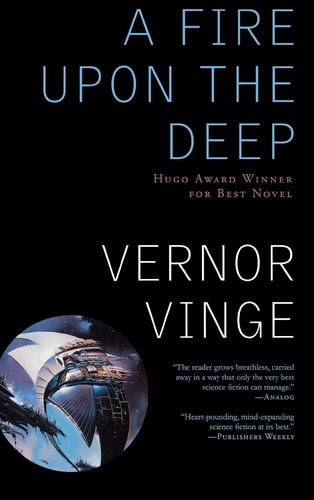
A Fire Upon the Deep
by Vernor Vinge
★ Top 10 book of 1992 · #10 on Best Books of 1992
In a far future where the galaxy is divided into zones that limit how intelligent a mind can be, a reckless weapon unleashes devastation across worlds. Ravna and a ship of frozen children crash among the Tines, an alien people in a medieval power struggle.
Best for: Space opera fans who like big ideas, alien societies, and galactic stakes
A Fire Upon the Deep is #10 on BookWard's Best Books of 1992, out of 43 1992 books that cleared our data bar.
What A Fire Upon the Deep is about
Vernor Vinge's space opera is set in a galaxy divided into zones of thought, from the Transcend, where superintelligent beings dwell, down to the Unthinking Depths, where only simple minds can function. When a human expedition at High Lab stirs up something it should have left alone, a superintelligence later called the Blight begins to spread.
One fleeing ship carrying children in cold sleep lands on a world of dog-like creatures called Tines, who think as groups and live at roughly medieval technology. The surviving children, Jefri and Johanna, are separated and taken in by rival Tine powers, one of them led by the ruthless Flenserists. Ravna Bergsndot, the only human working at Relay, becomes caught up in the effort to stop the Blight, helped by a being from the Transcend that has reconstituted a man named Pham Nuwen.
The novel won the Hugo Award in 1993. It mixes strange alien societies, tense betrayals, and big questions about intelligence and danger, and it has a direct sequel, The Children of the Sky, and a loose prequel, A Deepness in the Sky.
A Fire Upon the Deep on the Best Books of 1992
A Fire Upon the Deep came out in 1992. Of the 43 books first published in 1992 that met BookWard's data bar, it ranks #10 on our Best Books of 1992 list.
Why it made the list: 296 readers have shelved it on Open Library; readers rate it 4.3 out of 5 (72 ratings). The list ranks each year’s books on how many readers have picked them up, how highly readers rate them, and how many are reading them right now.
It earns Reader favorite.
Nearby on the 1992 list
- Your Money or Your Life Vicki Robin, #8
- Gerald's Game Stephen King, #9
- Wild Magic Tamora Pierce, #11
- Breaking Point Emma Darcy, #12
See all Best Books of 1992 Best books by year
More years: Best Books of 1991 Best Books of 1993.
The numbers behind it
- Readers: 185 want to read it, 9 are reading it now and 102 have read it, according to Open Library.
- Ratings: 4.3 out of 5 from 72 Open Library ratings.
| Signal | This book (0 to 100) | Weight |
|---|---|---|
| Reach | 70 | 55% |
| Reader love | 93 | 25% |
| Being read right now | 44 | 20% |
Questions about A Fire Upon the Deep
When was A Fire Upon the Deep published?
A Fire Upon the Deep by Vernor Vinge was first published in 1992.
Was A Fire Upon the Deep one of the best books of 1992?
A Fire Upon the Deep is #10 on BookWard's Best Books of 1992, out of 43 1992 books that cleared our data bar. 296 readers have shelved it on Open Library; readers rate it 4.3 out of 5 (72 ratings).
Why is A Fire Upon the Deep on the Best Books of 1992 list?
296 readers have shelved it on Open Library; readers rate it 4.3 out of 5 (72 ratings).
More of the best books of 1992
- Welcome to Dead House Robert Lawrence Stine, #1
- The Secret History Donna Tartt, #2
- Snow Crash Neal Stephenson, #3
- The Indispensable Calvin and Hobbes Bill Watterson, #4
- The Shadow Rising Robert Jordan, #5
- The Artist's Way Julia Cameron, #6
See the full Best Books of 1992, the Top 100, or new books on Rising.
How we know
This page uses public data: Open Library reader counts and ratings, and Wikipedia page views for recent years. The description is paraphrased from real source text. Rankings reflect reading interest, not quality or sales, and can be affected by data gaps. Lists update monthly.
Best for older teens and adults comfortable with dense science fiction concepts and a large cast.
Depends on the edition you pick.
Vinge's space opera where the laws of thought bend with location. 58% taste match
 BookWard’s take
Vinge's space opera where the laws of thought bend with location
A Fire Upon the Deep is idea-led science fiction that never forgets to tell a story. Its central conceit, a galaxy split into zones where minds can or cannot flourish, is original and worked out with real internal logic, which will please anyone who likes worldbuilding that holds together. It opens on a catastrophe and keeps moving, and the pace stays brisk across two storylines that cut between a doomed expedition and a medieval world of pack-minded aliens. The Tines are the standout: strange, convincing and carefully built. Vinge explains more than he shows in places, and the prose is functional rather than ornate. The Hugo-winning novel also rewards patience with a large canvas, many viewpoints and a mostly resolved ending, though it sets up a sequel.
It is a substantial, wide-ranging novel rather than a lean one, which pulls against BookWard's preference for tight and short.
Two intercut storylines and constant danger keep it moving, a touch slower overall than BookWard's quick preference.
Superintelligences bound by location and aliens who think as packs are fresh ideas, squarely what BookWard prizes.
The writing is clear and utilitarian rather than ornate, close to BookWard's plain-leaning taste.
Events and the unfolding premise lead, with character in service of the plot, away from BookWard's character-driven lean.
Dire odds hang over everything, but cooperation and rescue efforts give it a thread of hope, roughly where BookWard sits.
Intercut storylines and in-world network posts add some texture, but the telling stays conventional overall.
It is a serious, high-stakes novel with only light moments, more sober than BookWard's amused lean.
Genocide and enslavement of minds make for a heavy backdrop, somewhat darker than BookWard's middle.
Loss and fear register, but the book stays cerebral and measured, near BookWard's mid-range.
See all 50 dialsEvery position, side by side with this book
Where it lines up
- OriginalityBookWard 9 · book 9
- Internal logicBookWard 10 · book 9
- PaceBookWard 8 · book 7
Where it pulls apart
- LengthBookWard 1 · book 7
- Story or ideasBookWard 3 · book 7
- ExpositionBookWard 2 · book 6
It is a substantial, wide-ranging novel rather than a lean one, which pulls against BookWard's preference for tight and short.
It opens on a research expedition's disaster and the stakes escalate fast, close to BookWard's ideal of grabbing you at once.
Zones of thought, group-mind aliens and a Usenet-like galactic network sidestep stock space opera, which BookWard rewards.
The partitioned regions of thought impose firm rules, and the plot works within them, which matches BookWard's love of airtight systems.
Two intercut storylines and constant danger keep it moving, a touch slower overall than BookWard's quick preference.
Superintelligences bound by location and aliens who think as packs are fresh ideas, squarely what BookWard prizes.
The Tines and the stranded children are vividly drawn, though some human characters serve the premise more than they deepen.
The central threat reaches a real resolution, though the door stays open to a sequel, a little short of BookWard's full closure.
Loss and loyalty carry feeling, but Vinge mostly lets events speak instead of leaning on emotion, which BookWard likes.
Genocide and betrayal arise from the premise and consequences rather than being used for effect, which BookWard respects.
This is a novel, so the dial does not apply.
Vinge's coolly inventive, idea-forward style is recognizable, though it is more efficient than idiosyncratic.
The ideas drive the book, but a tense adventure carries them, placing it toward the idea-led side.
Concepts are sometimes explained outright, especially the zones, which sits higher than BookWard's show-it-in-scene preference.
The two narratives trade momentum well, with only the occasional lull, in line with BookWard's sustained-pace taste.
The writing is clear and utilitarian rather than ornate, close to BookWard's plain-leaning taste.
Events and the unfolding premise lead, with character in service of the plot, away from BookWard's character-driven lean.
Dire odds hang over everything, but cooperation and rescue efforts give it a thread of hope, roughly where BookWard sits.
Intercut storylines and in-world network posts add some texture, but the telling stays conventional overall.
It is a serious, high-stakes novel with only light moments, more sober than BookWard's amused lean.
The concepts need attention and a big cast to track, though the prose stays accessible, a bit more demanding than BookWard's mid-range.
Multiple perspectives across worlds and species give it a wide lens, close to BookWard's liking for many viewpoints.
Events unfold in a largely linear sequence across parallel strands, more straightforward than BookWard's shifting timelines.
Superintelligences and altered physics make this deeply fantastical, beyond BookWard's middle ground.
Humans, aliens and powerful beings fill a broad cast, bigger than BookWard's small-cast preference.
The story spans the galaxy with civilisation-level stakes, far more epic than BookWard's middle ground.
Space battles, escapes and political struggle push this toward outward action rather than inner thought.
Conversation carries a fair share of plot and worldbuilding, in line with BookWard's balance.
Love is part of the mix but remains a minor thread beside the larger threat, lighter than BookWard's middle.
Strange zones, alien physics and unfamiliar cultures make the setting about as unfamiliar as it gets, which BookWard enjoys.
A story set thousands of years in the future is as far from the present day as BookWard's era scale goes.
Its ideas about intelligence and networks have aged well since 1992, close to BookWard's taste for staying power.
The narration is straightforward and trustworthy, well below BookWard's unreliable lean.
Heroes and the Blight's villains are clear, with shades among the Tines, a bit less ambiguous than BookWard prefers.
Alien species and shifting physics get rich, careful description, somewhat above BookWard's middle.
This is fiction, so the dial does not apply.
This is fiction, so the dial does not apply.
A loose prequel and a direct sequel place it inside a larger sequence, though it stands well on its own.
Reveals about the Blight, the Tines and a resurrected agent arrive often, matching BookWard's surprise-friendly taste.
Big ideas and grim stakes push the reader rather than soothe, near BookWard's challenging side.
Genocide and enslavement of minds make for a heavy backdrop, somewhat darker than BookWard's middle.
Loss and fear register, but the book stays cerebral and measured, near BookWard's mid-range.
Light wry moments aside, humor is minimal and dry, leaning drier than BookWard's middle.
Battles, killings and massacres occur regularly but are not dwelt on luridly, slightly above BookWard's middle.
Sexual content is minimal and incidental, lower than BookWard's middle.
Power struggles among Tine kingdoms and galactic factions are woven in, around BookWard's middle.
Invented terms and concepts take some adjusting, though the language itself is plain, a notch under BookWard's middle.
Narration stays largely neutral, letting the setting and events carry the weight, leaning less opinionated than BookWard.
The story faces forward into a far future, a bit beyond BookWard's lean.
Cooperation and ingenuity counter a hostile universe, leaving a measured, middling worldview, close to BookWard's middle.
Review written by BookWard, dial version 1, November 2026.
Who is A Fire Upon the Deep right for?
Best for older teens and adults comfortable with dense science fiction concepts and a large cast. It includes warfare, genocide and the capture and endangerment of children, handled seriously but without lingering.
The concepts need attention and a big cast to track, though the prose stays accessible, a bit more demanding than BookWard's mid-range.
Genocide and enslavement of minds make for a heavy backdrop, somewhat darker than BookWard's middle.
Loss and fear register, but the book stays cerebral and measured, near BookWard's mid-range.
Battles, killings and massacres occur regularly but are not dwelt on luridly, slightly above BookWard's middle.
Book CompanionA Fire Upon the Deep: ideas, characters, themes
A galaxy where the capacity for thought depends on where you are lets Vinge pit superintelligence against ordinary lives in a tense double-stranded adventure.
- A disaster opens the story. A research expedition at High Lab awakens a superintelligence later called the Blight, and two ships try to flee.
- Children on a medieval world. The surviving ship lands among the Tines, pack-minded aliens, where captured children become pawns in a power struggle.
- A distant signal. Word of the crash reaches Relay, a hub of the galactic Net, setting rescue and countermeasures in motion.
- Zones of thought. The galaxy is divided into regions that set limits on intelligence, shaping what technology and minds are possible.
- Dual storylines. The narrative alternates between interstellar efforts and life on the Tines' world, building both toward the same crisis.
Characters
Ravna Bergsndot
Relay employee
The only human working at Relay, she traces the distress signal to the Tines' world.
Pham Nuwen
Reconstituted human agent
Brought back by a Transcendent being, he is unsure whether his memories are real.
Johanna Olnsdot
Surviving child
Rescued from the Flenserists, she is taken to a neighboring kingdom ruled by Woodcarver.
Jefri Olnsdot
Surviving child
Captured by the Flenserists along with his sister, he is held in their realm.
Woodcarver
Tine ruler
Rules the kingdom that shelters Johanna after her rescue.
Themes
How the place a mind exists constrains what it can know and do.
What identity and loyalty look like when a person is a pack.
How ambition and fanaticism drive both alien courts and galactic politics.
How a vast communication medium shapes rumor, trust and survival.
What happens when an artifact is used without understanding its dangers.
Discussion questions
- How does the idea of zones of thought change what kind of story Vinge can tell?
- What makes the Tines convincing as a non-human society?
- Is Pham Nuwen's uncertainty about his own memories a weakness or a strength for him?
- How do the two storylines reinforce or undercut each other's tension?
- Does the Usenet-like Net feel dated or still prescient?
Personalize your Book Companion
This is the general edition. In BookWard, the Companion is written for you: your reading profile, your notes, and spoiler-safe to the page you are on.
Buy, listen or borrow A Fire Upon the Deep
Each link opens a search for this book on that store, in a new tab.
Read on a device
Borrow
Reviews and community
If you liked A Fire Upon the Deep
Spiders build a civilization while humanity's last ark ship closes in
Blood of the Old KingsSung-Il KimAn empire that mines its dead sorcerers, seen through several fighters
ElantrisBrandon SandersonA fallen magic city, a widowed princess, and a zealot priest
Babylon’s ashesJames S. A. CoreySpace war on a grand scale, with Holden at the center
Find your own best books
Add what you have read, rate it, and BookWard will recommend what to read next.
Free to start. No credit card needed.