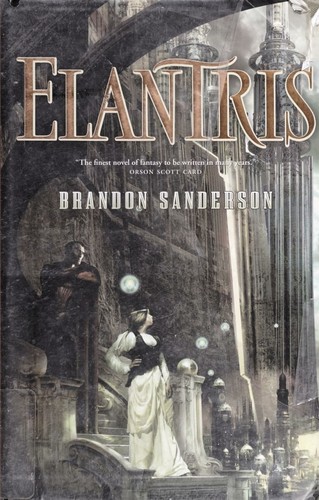
Elantris
by Brandon Sanderson
★ Top 10 book of 2005 · #9 on Best Books of 2005
Once a city of godlike magic users, Elantris fell into ruin when its power failed. Princess Sarene, the imprisoned Prince Raoden and the zealous priest Hrathen are drawn into a struggle over Arelon's fate.
Best for: Epic fantasy fans who enjoy new magic systems, political intrigue and several viewpoints
Elantris is #9 on BookWard's Best Books of 2005, out of 52 2005 books that cleared our data bar.
What Elantris is about
Elantris was once a shining city of near-gods, whose people drew on a strange gift to help the folk of Arelon. Then, a decade ago, the gift collapsed. The transformed became frail, ashen shadows of themselves, and their home decayed into a dark, crumbling ruin. Close by sits Kae, the kingdom's new capital, where Princess Sarene of Teod arrives expecting to wed Prince Raoden, only to be told she is already his widow. Meanwhile Fjordell, an empire with hungry ambitions, looms over both Teod and Arelon, and its priest Hrathen has come to win the land for his faith and his ruler. Sanderson's 2005 novel blends court politics, zealotry, and the question of what is left when a golden age falls. It suits readers who want an epic fantasy with a hopeful streak.
Elantris on the Best Books of 2005
Elantris came out in 2005. Of the 52 books first published in 2005 that met BookWard's data bar, it ranks #9 on our Best Books of 2005 list.
Why it made the list: 466 readers have shelved it on Open Library; readers rate it 4.1 out of 5 (101 ratings); 20 are reading it right now. The list ranks each year’s books on how many readers have picked them up, how highly readers rate them, and how many are reading them right now.
Nearby on the 2005 list
- A Feast for Crows George R. R. Martin, #7
- Twilight Stephenie Meyer, #8
- Never Let Me Go Kazuo Ishiguro, #10
- Llama Llama Red Pajama Anna Dewdney, #11
See all Best Books of 2005 Best books by year
More years: Best Books of 2004 Best Books of 2006.
The numbers behind it
- Readers: 294 want to read it, 20 are reading it now and 152 have read it, according to Open Library.
- Ratings: 4.1 out of 5 from 101 Open Library ratings.
| Signal | This book (0 to 100) | Weight |
|---|---|---|
| Reach | 77 | 55% |
| Reader love | 83 | 25% |
| Being read right now | 75 | 20% |
Questions about Elantris
When was Elantris published?
Elantris by Brandon Sanderson was first published in 2005.
Was Elantris one of the best books of 2005?
Elantris is #9 on BookWard's Best Books of 2005, out of 52 2005 books that cleared our data bar. 466 readers have shelved it on Open Library; readers rate it 4.1 out of 5 (101 ratings); 20 are reading it right now.
Why is Elantris on the Best Books of 2005 list?
466 readers have shelved it on Open Library; readers rate it 4.1 out of 5 (101 ratings); 20 are reading it right now.
More of the best books of 2005
- The Lightning Thief Rick Riordan, #1
- Harry Potter and the Half-Blood Prince J. K. Rowling, #2
- The Glass Castle Jeannette Walls, #3
- Looking for Alaska John Green, #4
- Eldest Christopher Paolini, #5
- Freakonomics Steven D. Levitt, #6
See the full Best Books of 2005, the Top 100, or new books on Rising.
How we know
This page uses public data: Open Library reader counts and ratings, and Wikipedia page views for recent years. The description is paraphrased from real source text. Rankings reflect reading interest, not quality or sales, and can be affected by data gaps. Lists update monthly.
Suits teens and adults who enjoy epic fantasy.
Depends on the edition you pick.
A fallen magic city, a widowed princess, and a zealot priest. 58% taste match
 BookWard’s take
A fallen magic city, a widowed princess, and a zealot priest
Elantris is Brandon Sanderson's 2005 debut, a standalone fantasy built around a city of former demigods gone rotten overnight. It alternates between three viewpoints, which suits my own taste for a story told from a few angles. The real draw is its internal logic: the magic has rules, and the mystery of its failure gets solved from within them rather than by a convenient rescue. The emotional register stays fairly restrained, and the ending resolves rather than trailing off. Where I part ways with it is size. This is a big, roomy fantasy, and I tend to prefer something tighter. The opening is a real strength, with a man waking into ruin that pulls you in at once, though the political and religious plotting leans on familiar tropes. Read it as a sturdy, clever first novel.
A full-sized epic fantasy with three storylines to carry, longer than BookWard's tight ideal.
Three threads keep things moving, though the political stretches move slower than BookWard's brisk preference.
A city of fallen demigods and a failed magic is a distinctive premise, if not a complete break from genre habit.
Plain, functional prose that stays out of the way, more workmanlike than ornate.
Plot and character share the load, with events pressing on the leads as much as they shape them.
The premise is grim, but the story is built around rebuilding and people helping one another.
A conventional alternating-viewpoint structure with no formal experiments.
Mostly earnest, with light, dry moments, especially around the princess.
See all 50 dialsEvery position, side by side with this book
Where it lines up
- Internal logicBookWard 10 · book 9
- EndingBookWard 8 · book 9
- Story or ideasBookWard 3 · book 4
Where it pulls apart
- LengthBookWard 1 · book 7
- Familiar tropesBookWard 10 · book 6
- OpeningBookWard 10 · book 8
A full-sized epic fantasy with three storylines to carry, longer than BookWard's tight ideal.
It opens on a man transformed and cast into a ruined city, which grabs quickly and suits BookWard.
The magic and ruined city feel fresh, but the court intrigue and zealot villain are well-worn fantasy ground.
The magic works by discoverable rules, and the central mystery is answerable from them, which BookWard rewards.
Three threads keep things moving, though the political stretches move slower than BookWard's brisk preference.
A city of fallen demigods and a failed magic is a distinctive premise, if not a complete break from genre habit.
The three leads have clear motives and some inner conflict, drawn with more care than types but short of deep.
The central mystery and its threats are brought to a decisive close, matching BookWard's taste for resolution.
There is open warmth and hope, with some pull toward uplift, a bit less restrained than BookWard likes.
The darkness comes from the setting's suffering and serves the plot rather than existing for effect.
Clean and capable, with a clear stylist's hand, though less singular than the most distinctive authors.
Story leads, driven by plot and mystery, with the magic system serving the narrative.
Much of the world is shown through events, with some explaining of rules and politics along the way.
Political maneuvering slows parts of the middle, but the mystery keeps pulling the story forward.
Plain, functional prose that stays out of the way, more workmanlike than ornate.
Plot and character share the load, with events pressing on the leads as much as they shape them.
The premise is grim, but the story is built around rebuilding and people helping one another.
A conventional alternating-viewpoint structure with no formal experiments.
Mostly earnest, with light, dry moments, especially around the princess.
Easy to follow, with clear stakes and rules, though the fantasy names take some settling in.
Three alternating perspectives drive the book, close to BookWard's liking for several.
The story moves forward in a straight line with no time jumps.
Built on an invented world, with magic as the engine of the plot.
A moderate cast of leads, courtiers and priests, larger than intimate but not sprawling.
Two nations and a religious empire hang in the balance, giving it a broad stage.
Leaning toward events and intrigue, with a good share of the leads' private struggle.
Plenty of conversation drives the political plot and the relationships.
A marriage of state and its feelings thread through the story without taking over.
A fully invented kingdom, religion and magic system, far from the familiar.
A secondary-world fantasy outside any real period, nowhere near the present day.
A fantasy mystery about hope and ruin that carries beyond the moment it was written.
A reliable third-person narrator who tells the story straight.
The zealot's faith is complicated, but the story leans clearly toward its heroes' side.
The ruined, once-radiant city is drawn in vivid detail alongside the courts of Kae.
Review written by BookWard, dial version 1, November 2026.
Who is Elantris right for?
Suits teens and adults who enjoy epic fantasy. It deals with disease, imprisonment, hunger and religious violence, though not graphically.
Easy to follow, with clear stakes and rules, though the fantasy names take some settling in.
Book CompanionElantris: ideas, characters, themes
A city of once-godlike beings falls into ruin, and three people on different sides must uncover why before an empire swallows their land.
- The fall of Elantris. Ten years ago the magic failed and the city's radiant inhabitants became withered, leper-like figures.
- A marriage of state. Princess Sarene of Teod arrives in Kae to wed Prince Raoden and learns he is dead and she is a widow.
- A zealot's campaign. Hrathen, a high priest of Fjordell, intends to convert Arelon and claim it for his emperor and god.
- The hidden prince. Raoden was struck by the same malady and secretly confined inside the dark city.
- Building from nothing. Raoden's effort to organize a society among the trapped wretches sets the book's events in motion.
Characters
Sarene
Princess of Teod
Arrives in Kae expecting marriage and finds herself a widow standing alone against Fjordell's ambitions.
Raoden
Crown Prince of Arelon
Taken by the Shaod and imprisoned in Elantris, he tries to build a community among its outcasts.
Hrathen
High priest of Fjordell
A fanatical churchman set on converting Arelon for his emperor and his god.
Themes
Whether people can rebuild purpose after catastrophe strips away what they were.
How belief can inspire devotion or justify conquest.
What a society can become when its members are written off and left to fend for themselves.
How people live after magic and status that defined them disappear.
Discussion questions
- Why does the city's fall change how the people of Kae treat Elantris?
- How do Sarene, Raoden and Hrathen each respond to losing what they expected from life?
- Does Hrathen read as a villain, a believer, or both?
- What does Raoden's effort to organize the outcasts say about leadership?
- How much does the magic system's logic add to the mystery?
Personalize your Book Companion
This is the general edition. In BookWard, the Companion is written for you: your reading profile, your notes, and spoiler-safe to the page you are on.
Buy, listen or borrow Elantris
Each link opens a search for this book on that store, in a new tab.
Read on a device
Borrow
Reviews and community
If you liked Elantris
A vast, dragon-filled epic that BookWard admires more than it is hooked
Blood of the Old KingsSung-Il KimAn empire that mines its dead sorcerers, seen through several fighters
Cinderella Is DeadKalynn BayronA fairy-tale retelling that turns Cinderella's legacy into a trap
A Fire Upon the DeepVernor VingeVinge's space opera where the laws of thought bend with location
Find your own best books
Add what you have read, rate it, and BookWard will recommend what to read next.
Free to start. No credit card needed.