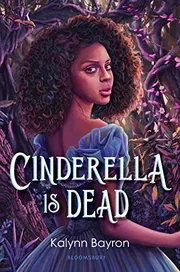
It suits teen readers and adults who enjoy YA fantasy and retellings.
395 pages, about 6.5 to 9 hours.
A fairy-tale retelling that turns Cinderella's legacy into a trap. 53% taste match
The story
Cinderella Is Dead is a young adult fantasy novel by Kalynn Bayron, first published in 2019. It is a fairy tale retelling with a romance at its center, following a queer teenager named Sophia Grimmins as she navigates a kingdom that grew out of the Cinderella story. The book runs about 395 pages in its typical edition.
The story is set two hundred years after Cinderella's death, in a society where young women must attend a yearly ball so that men can choose them as wives. Sophia is sixteen and would rather be with her childhood best friend, Erin, than face the suitors. When she flees the ball, she ends up in Cinderella's mausoleum and meets Constance, a descendant of Cinderella and her stepsisters. The two set out to challenge the king and uncover more about the tale they were raised on. Sexism, feminism, and the experiences of Black and queer characters run through the book, which draws on both lesbian romance and fantasy traditions.
Cinderella has been dead for two hundred years.
Themes
RomanceLesbiansLesbianSapphicLGBTQIAFairy TaleRetellingsFantasy
- Want to read 206
- Reading now 4
- Read 16
Most people shelving it are saving it for later.
Of 226 readers who put it on a shelf, 91% want to read it, 2% are reading it now, 7% have finished it and 0% stopped before the end.
By the numbers
- The median edition runs 395 pages. Counting about 275 words a page and an adult reading pace of 250 words a minute, that is about 7.2 hours of reading.
- Open Library tracks 8 editions from 4 publishers, the earliest dated 2019 and the latest 2021.
- On reader demand it ranks in the top 5% of the recent books in our catalog (6,647 of them).
- Libraries shelve it under Library of Congress class PZ-0007.10000000.B386.
 BookWard’s take
A fairy-tale retelling that turns Cinderella's legacy into a trap
Cinderella Is Dead sets its story two hundred years after the fairy tale ended, and the premise does real work: the happy ending became a law forcing girls into an annual ball. That makes for a strong opening, since Sophia is running from the ball almost at once, and the pace stays brisk across its 395 pages. Its originality is what earns attention, because it takes a story everyone knows and asks who it was built to serve. There are familiar tropes here, as in most YA fantasy, and the ending leans toward resolution rather than ambiguity. The mood is warm, and the book is openly hopeful and political. If you want a retelling with a purpose, this one has it.
At 395 pages it is mid-length for YA fantasy, longer than BookWard's taste for tight books.
The flight, the mausoleum and the quest move along steadily, close to BookWard's quick pace.
Asking what Cinderella's legacy cost is a fresh angle, though the retelling form itself is well worn.
Prose is accessible and clean, suited to its young adult readership rather than ornate.
Plot and character share the load, with Sophia's choices and relationships pushing the story slightly more.
Defiance and love run through the book, giving it a hopeful, resistant outlook.
It follows a straightforward quest-and-reveal shape, more conventional than experimental.
It is mostly earnest and serious, with only light moments.
Girls who vanish after the ball give it real menace, balanced by a young adult tone.
Love, fear and defiance run strong, giving it real emotional charge.
See all 50 dialsEvery position, side by side with this book
Where it lines up
- PaceBookWard 8 · book 7
- EndingBookWard 8 · book 7
- Story or ideasBookWard 3 · book 4
Where it pulls apart
- Familiar tropesBookWard 10 · book 5
- LengthBookWard 1 · book 5
- Internal logicBookWard 10 · book 6
At 395 pages it is mid-length for YA fantasy, longer than BookWard's taste for tight books.
Sophia is fleeing the ball early, so the stakes land fast, close to BookWard's liking for an immediate hook.
The oppressive ball system is clearly built, though a fairy-tale kingdom asks for some acceptance, so it is solid rather than airtight.
The flight, the mausoleum and the quest move along steadily, close to BookWard's quick pace.
Asking what Cinderella's legacy cost is a fresh angle, though the retelling form itself is well worn.
Sophia and Constance carry real feeling and motive, though it stays within YA conventions rather than the deepest drawing.
The book wears its feeling openly and warmly, more sentimental than BookWard's restrained taste.
The darkness serves the story's critique of the ball system rather than shock for its own sake, though it leans on reveals.
This is fiction, so rigor does not apply.
Bayron's voice is clear and purposeful, with a distinct stance, if not wildly idiosyncratic.
It is story-led, but the ideas about power and fairy tales drive each turn, so it sits just on the story side.
Backstory about the kingdom and Cinderella is explained fairly directly, more than BookWard's show-in-scene preference.
The quest structure keeps momentum fairly well, though a book this length can drift in its middle.
Prose is accessible and clean, suited to its young adult readership rather than ornate.
Plot and character share the load, with Sophia's choices and relationships pushing the story slightly more.
Defiance and love run through the book, giving it a hopeful, resistant outlook.
It follows a straightforward quest-and-reveal shape, more conventional than experimental.
It is mostly earnest and serious, with only light moments.
Easy to read and accessible, an approachable YA fantasy.
It stays with Sophia's single point of view, a narrower lens than BookWard's many-voiced taste.
The story moves forward in time, with the old tale only as backdrop.
Fairy-tale magic and a mausoleum mystery put it clearly in fantasy territory.
Sophia, Erin and Constance dominate, so the core cast stays small.
The stakes span a kingdom, yet the story stays close to a few people.
Sophia's feelings and her actions both get space, in roughly even balance.
Conversation between Sophia, Erin and Constance carries much of the plot and relationships.
A queer romance sits at the heart of the story, making it central rather than minor.
A fairy-tale kingdom built from a known story is new in detail, though it draws on familiar fairy-tale ground.
Set two hundred years after a fairy tale, it is a made-up past, not the present.
Its themes of choice and control can outlast the moment, though its YA retelling frame ties it to its time.
Sophia tells it plainly, with no sign of an unreliable narrator.
Right and wrong are fairly clear, with a plainly oppressive system and clear heroes.
Setting and atmosphere get moderate attention without heavy ornament.
This is fiction, so a nonfiction style does not apply.
This is fiction, so nonfiction perspective does not apply.
Discoveries about Cinderella's story drive several turns, giving it a fair share of surprises.
It questions inherited stories and gender expectations, but gently, with a hopeful frame.
Girls who vanish after the ball give it real menace, balanced by a young adult tone.
Love, fear and defiance run strong, giving it real emotional charge.
Humor is minor here, so this dial does not apply.
Sexism and who holds power drive the plot, putting politics near the front.
Language is plain and contemporary, with no heavy dialect.
The book argues its case openly, with a clear point of view on the tale and its costs.
It looks ahead, with characters trying to change what comes next.
The heroes believe change is possible, an idealistic, not cynical, stance.
Review written by BookWard, dial version 1, November 2026.
Who is Cinderella Is Dead right for?
It suits teen readers and adults who enjoy YA fantasy and retellings. It deals with forced marriage, girls disappearing and a threatening political system, alongside a queer romance.
Easy to read and accessible, an approachable YA fantasy.
Girls who vanish after the ball give it real menace, balanced by a young adult tone.
Love, fear and defiance run strong, giving it real emotional charge.
Book CompanionCinderella Is Dead: ideas, characters, themes
Two hundred years after Cinderella's story ended, her legend has hardened into a system that controls girls, and Sophia sets out to challenge it.
- The ball as a trap. Girls must attend a yearly ball to be chosen as wives, and those not chosen are never heard from again.
- Sophia's flight. At sixteen, Sophia refuses the ball and flees, hiding in Cinderella's mausoleum.
- An unexpected ally. In the mausoleum she meets Constance, a descendant of Cinderella and her stepsisters.
- Challenging the king. Sophia and Constance vow to bring down the king and the system he upholds.
- Rethinking the tale. They learn there is more to Cinderella's story than they were taught.
Characters
Sophia Grimmins
Protagonist
A sixteen-year-old who would rather be with her friend Erin than be chosen by a suitor.
Erin
Sophia's childhood best friend
The person Sophia would rather marry.
Constance
Ally
The last known descendant of Cinderella and her stepsisters, whom Sophia meets in the mausoleum.
Themes
How a society uses tradition to control what girls may choose.
Sophia's wish to be with Erin against a system built around marriage to men.
How a familiar tale can hide its costs and be read again.
Standing up to a king and a system that seems fixed.
Discussion questions
- Why might a story like Cinderella's be used to justify a rule like the ball?
- What does Sophia risk by running, and what does she gain?
- How does Constance's family history change how the story is told?
- Which parts of the fairy tale does the book keep, and which does it overturn?
- How does the book connect romance with the larger fight against the king?
Personalize your Book Companion
This is the general edition. In BookWard, the Companion is written for you: your reading profile, your notes, and spoiler-safe to the page you are on.
Buy, listen or borrow Cinderella Is Dead
Each link opens a search for this book on that store, in a new tab.
Read on a device
Borrow
Reviews and community
If you liked Cinderella Is Dead
A gothic fantasy where a cloistered Diviner meets a mocking knight
When the Tides Held the MoonVenessa Vida KelleyA captive merman, a Boricua blacksmith, and Coney Island's gilded cage
The Rose BargainSasha Peyton SmithVictorian fae court intrigue where a crown costs more than blood
BehoovedM. StevensonA cozy romantasy where the groom is a horse by day
Sources: Open Library.
Track Cinderella Is Dead and find your next favorite
Add it to your shelf, rate what you have read, and BookWard will recommend what fits you.
Free to start. No credit card needed.