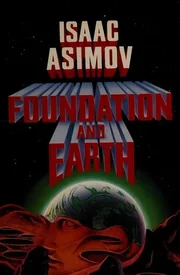
Foundation and Earth
by Isaac Asimov · 1986
Suits older teens and adults, especially readers comfortable with idea-heavy science fiction.
503 pages, about 8 to 11.5 hours.
Asimov's long galactic road trip ends the Foundation saga. 38% taste match
The story
Foundation and Earth is a science fiction novel by the American writer Isaac Asimov, first published in 1986. It is the fifth novel in the Foundation series and the last one in the series' internal chronology. It came out four years after Foundation's Edge, the first sequel to the original Foundation trilogy, and the story continues in the same far-future galaxy shaped by psychohistory and the legacy of Hari Seldon.
The book follows Golan Trevize and Janov Pelorat, who travel together with Bliss in search of Earth. Their journey takes them across a series of invented worlds, among them Gaia, Comporellon, Aurora, Solaria, Melpomenia and Alpha. Along the way the novel draws on the series' recurring interest in life on other planets and the long history of human settlement among the stars. Readers who have followed the Foundation books will recognize the setting and several of the names. The edition most commonly found runs to around 503 pages, and the novel has appeared in 48 editions.
Setting
Gaia (Fictitious place)Comporellon (Fictitious place)Aurora (Fictitious place)Solaria (Fictitious place)Melpomenia (Fictitious place)
Themes
PsychohistoryLife on other planetsLong Now Manual for Civilization
- Want to read 145
- Reading now 6
- Read 122
Readers are split between finishing it and saving it for later.
Of 273 readers who put it on a shelf, 53% want to read it, 2% are reading it now, 45% have finished it and 0% stopped before the end.
By the numbers
- The median edition runs 503 pages. Counting about 275 words a page and an adult reading pace of 250 words a minute, that is about 9.2 hours of reading.
- Open Library tracks 48 editions from 39 publishers, the earliest dated 1986 and the latest 2021, across 9 languages.
- On reader demand it ranks in the top 3% of the modern books in our catalog (15,152 of them).
- Libraries shelve it under Dewey 813.54 and Library of Congress class PS-3551.00000000.S5 F594 1986.
 BookWard’s take
Asimov's long galactic road trip ends the Foundation saga
Foundation and Earth is a quest novel: Golan Trevize, Janov Pelorat and Bliss go looking for Earth, hopping between invented worlds like Aurora, Solaria and Comporellon. It is driven by ideas more than incident, and conversation does most of the heavy lifting. Characters explain things to one another at length, which is the opposite of a book that dramatizes its material in scene. The pace is steady rather than urgent, and at 503 pages it runs well past tight. As the fifth Foundation novel and the last in the internal chronology, it is very much part of a series, and it pays off best for readers already invested in Hari Seldon's galaxy. For those readers, it delivers a real sense of closure.
At around 503 pages it runs long for a quest with a simple shape, a step away from BookWard's taste for tight books.
The journey moves along but stops often for talk and reflection, so it is steadier than BookWard's brisk preference.
The big ideas about humanity's origins are strong, yet the setting and framework are inherited from earlier books in the series.
Asimov writes in a clear, functional register without ornament, a little plainer than BookWard's middle position.
The structure is a plot-led search from world to world, with characters serving the quest more than the reverse.
The galaxy's long-term fate is treated with measured optimism, close to BookWard's mildly hopeful outlook.
It follows a conventional, linear travelogue structure, a touch more conventional than BookWard's balance.
It is mostly serious, with only occasional dry banter between the travelers, so it sits below BookWard's lighter side.
The tone is largely gentle and cerebral, lighter than BookWard's middle position.
Feeling is kept understated beside the intellectual puzzle, restrained against BookWard's moderate emotional pitch.
See all 50 dialsEvery position, side by side with this book
Where it lines up
- EndingBookWard 8 · book 7
- Internal logicBookWard 10 · book 8
- PaceBookWard 8 · book 5
Where it pulls apart
- Familiar tropesBookWard 10 · book 4
- LengthBookWard 1 · book 6
- OpeningBookWard 10 · book 5
At around 503 pages it runs long for a quest with a simple shape, a step away from BookWard's taste for tight books.
The search for Earth gives the book a clear aim from the start, but it builds gradually and does not grab at once.
It works within established space-opera conventions and the series' own machinery, so it is more familiar than fresh for BookWard.
The galaxy's rules follow from psychohistory and earlier books, and the plot is built on deduction and consistency, which suits BookWard well.
The journey moves along but stops often for talk and reflection, so it is steadier than BookWard's brisk preference.
The big ideas about humanity's origins are strong, yet the setting and framework are inherited from earlier books in the series.
Trevize, Pelorat and Bliss carry the journey, but the book is more about what they discover than who they are, short of BookWard's depth.
As the chronological close of the series it aims to resolve the larger questions, which BookWard values.
The tone is cerebral and mostly even, with little sentimentality, in line with BookWard's restraint.
Darkness is mild and tied to the plot, with little shock for effect, which BookWard welcomes.
Asimov's plain, conversational style is recognisable, though it prizes clarity over a strong personal stamp.
The quest is a vehicle for ideas about origins, humanity and the galaxy's future, far more idea-led than BookWard's story-led leaning.
Characters often explain situations and history outright, well away from BookWard's preference for showing in scene.
Episodic stops on different worlds can slow the middle, a mild mismatch with BookWard's wish for sustained momentum.
Asimov writes in a clear, functional register without ornament, a little plainer than BookWard's middle position.
The structure is a plot-led search from world to world, with characters serving the quest more than the reverse.
The galaxy's long-term fate is treated with measured optimism, close to BookWard's mildly hopeful outlook.
It follows a conventional, linear travelogue structure, a touch more conventional than BookWard's balance.
It is mostly serious, with only occasional dry banter between the travelers, so it sits below BookWard's lighter side.
The writing is accessible, though the ideas and series background ask for some attention, close to BookWard's easy-leaning comfort.
The story stays close to the traveling party, giving a narrow viewpoint compared with BookWard's taste for many voices.
The story moves forward in a straight line through its journey, more linear than BookWard's mix.
Invented worlds, advanced technology and far-future settings make it clearly speculative, well beyond BookWard's grounded-to-fantastical middle.
The core is a small traveling party, with new figures meeting them on each world, similar to BookWard's modest cast size.
The search spans a galaxy and the long history of human settlement, more epic than BookWard's usual scale.
Action and discussion are balanced, with a good deal of thinking aloud, which roughly matches BookWard's middle position.
Much of the story is carried by conversation between characters, which suits BookWard's liking for dialogue.
Romance is a minor thread beside the main search, matching BookWard's preference for little of it.
A series of invented planets gives the book a wide, unfamiliar canvas, which suits BookWard's liking for new settings.
A far-future galaxy set well beyond our time, written in 1986, sits at the past end of this dial, unlike BookWard's present-day lean.
Its big questions about origin and future feel enduring, though the style and framing show their period, near BookWard's staying-power mark.
The narration is plain and dependable, with no trickery about what is true, unlike BookWard's taste for unreliability.
Choices about the galaxy's future are weighed with some nuance but without deep moral murk, below BookWard's ambiguity-leaning side.
Settings are sketched efficiently rather than lavishly, giving less rich detail than BookWard's middle.
It is the fifth Foundation novel and chronologically the last, so it plays best with the earlier books behind it.
The search yields discoveries and reveals along the way, close to BookWard's liking for surprises.
It poses big questions without much emotional discomfort, a bit gentler than BookWard's challenging side.
The tone is largely gentle and cerebral, lighter than BookWard's middle position.
Feeling is kept understated beside the intellectual puzzle, restrained against BookWard's moderate emotional pitch.
Any humor is dry and low-key, slightly drier than BookWard's middle.
Danger exists on the journey but the book keeps violence limited and offstage, below BookWard's mid-range.
Sexual content is minimal, lighter than BookWard's middle position.
Galactic governance and the future of humanity shape the background, but politics is not the main driver, a little below BookWard's mid.
The language is plain and easy to follow, well under BookWard's mid-range.
The narration mostly lets events and discussion speak, only mildly opinionated compared with BookWard's lean.
The story concerns humanity's origins yet is driven by where the galaxy is heading, so it looks forward, as BookWard does.
It leans towards a hopeful, constructive view of humanity's prospects, in step with BookWard's mild idealism.
Review written by BookWard, dial version 1, November 2026.
Who is Foundation and Earth right for?
Suits older teens and adults, especially readers comfortable with idea-heavy science fiction. Content is mild overall, though it deals with large themes about humanity and the future.
The writing is accessible, though the ideas and series background ask for some attention, close to BookWard's easy-leaning comfort.
The tone is largely gentle and cerebral, lighter than BookWard's middle position.
Feeling is kept understated beside the intellectual puzzle, restrained against BookWard's moderate emotional pitch.
Danger exists on the journey but the book keeps violence limited and offstage, below BookWard's mid-range.
Book CompanionFoundation and Earth: ideas, characters, themes
Three travelers search the galaxy for humanity's lost homeworld, and the quest ties together the long Foundation story.
- The quest for Earth. Golan Trevize, Janov Pelorat and Bliss set out to find Earth, giving the novel a clear destination.
- A tour of invented worlds. The journey passes through places such as Gaia, Comporellon, Aurora, Solaria and Melpomenia, each with its own character.
- The legacy of Hari Seldon. Psychohistory and Seldon's influence remain the backdrop that gives the search its weight.
- Fifth in the series. It follows Foundation's Edge and is the last novel in the series' internal chronology.
- Ideas over action. Much of the story moves through conversation and reasoning, favoring thought over spectacle.
Characters
Golan Trevize
Traveler and searcher for Earth
One of the central figures of the journey, tied to the book's search for humanity's origin.
Janov Pelorat
Traveling companion
Travels with Trevize in the quest for Earth.
Bliss
Member of the traveling party
Joins Trevize and Pelorat on the search and is linked to Gaia.
Hari Seldon
Founder of psychohistory
The series' guiding figure, whose legacy frames the wider story.
Themes
Where humanity comes from and why that matters for its future.
A journey in which each world adds a piece to a larger answer.
The idea that large-scale history can be understood and guided.
Questions about what kind of civilization humanity should become.
Discussion questions
- Why might a story about the future be so concerned with finding the past?
- How does each world visited change the way the travelers think?
- Does the book work for someone who has not read the earlier Foundation novels?
- How much do ideas drive the story compared with the characters?
- What does the ending suggest about the series as a whole?
Personalize your Book Companion
This is the general edition. In BookWard, the Companion is written for you: your reading profile, your notes, and spoiler-safe to the page you are on.
Buy, listen or borrow Foundation and Earth
Each link opens a search for this book on that store, in a new tab.
Read on a device
Borrow
Reviews and community
If you liked Foundation and Earth
Hari Seldon's forty years, told as linked episodes of a life
XenocideOrson Scott CardIdea-heavy sequel where a doomed planet fights to survive
Foundation and EmpireIsaac AsimovTwo sharp novellas about empires, prophecy, and one thing the math missed
Robot DreamsIsaac AsimovAsimov's short fiction, from 1947 to 1986, in one volume
Sources: Open Library.
Track Foundation and Earth and find your next favorite
Add it to your shelf, rate what you have read, and BookWard will recommend what fits you.
Free to start. No credit card needed.