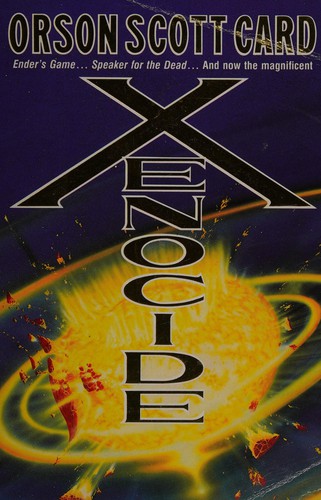
Xenocide
by Orson Scott Card
★ Top 10 book of 1991 · #9 on Best Books of 1991
On Lusitania, humans, pequeninos, and the Hive Queen might share a world, but a virus called the descolada threatens everyone. Fearing its spread, the Starways Congress sends a fleet to destroy the planet, making a second xenocide seem likely.
Best for: Science fiction readers who like high-stakes tales of coexistence between species
Xenocide is #9 on BookWard's Best Books of 1991, out of 23 1991 books that cleared our data bar.
What Xenocide is about
The planet Lusitania is a fragile meeting place. Humans, including Ender Wiggin and his family, live alongside the Pequeninos, an alien people, and the Hive Queen, a sentient insect. Their peace rests on an uneasy bargain with the descolada, a virus that kills every human it infects yet is the very thing the Pequeninos need in order to become adults.
Fear of that virus drives the Starways Congress to send a fleet carrying the Molecular Disruption Device, with orders to destroy the whole planet and everyone on it. Far away on Path, a world of genetically engineered people, devotion and mental conditioning shape lives in ways that slowly come to light. Meanwhile the Lusitanians begin to learn how faster-than-light travel works, through a mysterious force called the Outside. Third in the Ender's Game series, the novel asks what it takes for different species to understand one another, and what fear of the unknown can lead a government to do.
Xenocide on the Best Books of 1991
Xenocide came out in 1991. Of the 23 books first published in 1991 that met BookWard's data bar, it ranks #9 on our Best Books of 1991 list.
Why it made the list: 254 readers have shelved it on Open Library; readers rate it 3.8 out of 5 (97 ratings). The list ranks each year’s books on how many readers have picked them up, how highly readers rate them, and how many are reading them right now.
Nearby on the 1991 list
- Chrysanthemum Kevin Henkes, #7
- Witches Abroad Terry Pratchett, #8
- On Directing Film David Mamet, #10
- The Sum of All Fears Tom Clancy, #11
See all Best Books of 1991 Best books by year
More years: Best Books of 1990 Best Books of 1992.
The numbers behind it
- Readers: 94 want to read it, 7 are reading it now and 153 have read it, according to Open Library.
- Ratings: 3.8 out of 5 from 97 Open Library ratings.
| Signal | This book (0 to 100) | Weight |
|---|---|---|
| Reach | 70 | 55% |
| Reader love | 17 | 25% |
| Being read right now | 43 | 20% |
Questions about Xenocide
When was Xenocide published?
Xenocide by Orson Scott Card was first published in 1991.
Was Xenocide one of the best books of 1991?
Xenocide is #9 on BookWard's Best Books of 1991, out of 23 1991 books that cleared our data bar. 254 readers have shelved it on Open Library; readers rate it 3.8 out of 5 (97 ratings).
Why is Xenocide on the Best Books of 1991 list?
254 readers have shelved it on Open Library; readers rate it 3.8 out of 5 (97 ratings).
More of the best books of 1991
- Outlander Diana Gabaldon, #1
- Needful Things Stephen King, #2
- American Psycho Bret Easton Ellis, #3
- Shiloh Phyllis Reynolds Naylor, #4
- The Firm John Grisham, #5
- Reaper Man Terry Pratchett, #6
See the full Best Books of 1991, the Top 100, or new books on Rising.
How we know
This page uses public data: Open Library reader counts and ratings, and Wikipedia page views for recent years. The description is paraphrased from real source text. Rankings reflect reading interest, not quality or sales, and can be affected by data gaps. Lists update monthly.
Suits older teens and adults who enjoy idea-driven science fiction.
Depends on the edition you pick.
Idea-heavy sequel where a doomed planet fights to survive. 45% taste match
 BookWard’s take
Idea-heavy sequel where a doomed planet fights to survive
Xenocide trades the tight focus of Ender's Game for something far more sprawling: a doomed planet, a fleet on its way, and several species trying to find a way out. It is a book of ideas first and a story second, since long conversations about physics, religion and biology drive much of the narrative. Readers who prefer story-led work may find that wearing. It also runs long and leans on a large cast and many viewpoints, which makes it a demanding read and will not suit everyone. Where it earns its place is originality: the Hive Queen, the Pequeninos and the Descolada virus make a setting few books attempt. The effort of reading is real, but the stakes give the ideas a clock.
A long, multi-strand novel that takes its time, far from the short and tight end BookWard favors.
The threat of the approaching fleet keeps pressure on, but long debates slow the stretches between.
Hive Queens, Pequeninos and a virus the ecosystem depends on make a setting well beyond the usual, which BookWard rewards.
The prose is clear and workmanlike, with little ornament.
Plot and character share the load, with the survival plot setting the structure and personal arcs adding weight.
The situation is grim, but the book leans toward cooperation across species and a way out.
It follows a conventional multi-thread novel structure, with strands converging toward the finish.
This is a serious book with little room for humor.
The threat of planetary annihilation is serious, though the tone is not relentlessly grim.
The stakes and family bonds give it feeling, but long argument often cools it.
See all 50 dialsEvery position, side by side with this book
Where it lines up
- OriginalityBookWard 9 · book 8
- Character depthBookWard 8 · book 7
- EndingBookWard 8 · book 7
Where it pulls apart
- LengthBookWard 1 · book 8
- Familiar tropesBookWard 10 · book 3
- OpeningBookWard 10 · book 6
A long, multi-strand novel that takes its time, far from the short and tight end BookWard favors.
The doomed-planet premise gives it a pressing situation, though it opens in the middle of an ongoing saga rather than with a hard hook.
It builds on space-opera staples like fleets and doomsday weapons, but fills them with unusual species and ideas.
Its science and philosophy are worked through carefully, though the faster-than-light solution leans on a convenient concept.
The threat of the approaching fleet keeps pressure on, but long debates slow the stretches between.
Hive Queens, Pequeninos and a virus the ecosystem depends on make a setting well beyond the usual, which BookWard rewards.
Its characters carry real histories and inner conflict, though some serve mainly as vehicles for ideas.
The central crisis is resolved by the close, with the larger saga left to continue.
Family and loyalty run through it, with emotion sometimes stated outright rather than held back.
The darkness comes from the premise of annihilation and mostly serves the story rather than shocking for effect.
This is a novel, so the nonfiction rigor dial does not apply.
Card's plain, argumentative style is recognizable, though not strikingly distinctive on the page.
Much of the book is about big questions of communication, xenophobia and technology, which pulls it well toward ideas over story.
Characters often explain concepts to each other at length, where BookWard prefers things shown in scene.
The middle gives way to long discussion and parallel plotlines before the stakes tighten again.
The prose is clear and workmanlike, with little ornament.
Plot and character share the load, with the survival plot setting the structure and personal arcs adding weight.
The situation is grim, but the book leans toward cooperation across species and a way out.
It follows a conventional multi-thread novel structure, with strands converging toward the finish.
This is a serious book with little room for humor.
Dense philosophy, physics and theology make it a more demanding read than a typical space adventure.
Several threads on different worlds are followed, giving it many viewpoints.
The story moves forward in a largely linear way across its threads.
Alien species, a virus and faster-than-light travel place it firmly in the speculative.
Humans, Pequeninos, the Hive Queen and the people of Path add up to a large cast.
A planet's fate and the future of several species put it on an epic scale.
Much of the book is spent in conversation and reflection rather than in physical action.
Debates and discussions carry much of the book, making it dialogue-heavy.
Relationships matter to the characters, but romance is not what drives the book.
Lusitania, Path and the alien societies are far from everyday experience.
It is set in a distant future, far from the present day.
Its themes of xenophobia and understanding across difference still have force beyond its 1991 release.
The narration is third person and straightforward, with no sense of an unreliable teller.
The book wrestles with hard questions about when it is right to destroy or defend another species, without simple answers.
Setting is described functionally, with ideas taking priority over atmosphere.
This is a novel, so the nonfiction style dial does not apply.
This is a novel, so the nonfiction perspective dial does not apply.
It is the third book in the Ender's Game series and leans on what came before.
Several revelations about the virus, Path and faster-than-light travel keep the plot shifting.
It asks the reader to consider uncomfortable questions about survival and other minds.
The threat of planetary annihilation is serious, though the tone is not relentlessly grim.
The stakes and family bonds give it feeling, but long argument often cools it.
What humor there is stays dry and sparing.
The threat is destruction on a vast scale, but much of it stays off the page.
Sexual content is minimal.
Congress, colonial control and the question of who decides a world's fate give it a strong political thread.
The language is plain, though the concepts can be dense.
The narration stays fairly neutral, with the arguments carried by the characters.
It is oriented toward what comes next for several species and worlds.
It argues that understanding across species is possible, though it does not pretend that is easy.
Review written by BookWard, dial version 1, November 2026.
Who is Xenocide right for?
Suits older teens and adults who enjoy idea-driven science fiction. The central threat is planetary destruction, and the book engages with heavy themes of religion, control and genocide.
Dense philosophy, physics and theology make it a more demanding read than a typical space adventure.
The threat of planetary annihilation is serious, though the tone is not relentlessly grim.
The stakes and family bonds give it feeling, but long argument often cools it.
The threat is destruction on a vast scale, but much of it stays off the page.
Book CompanionXenocide: ideas, characters, themes
A planet of three intelligent species faces destruction from its own government, and the way out depends on understanding both a virus and the nature of faster-than-light travel.
- Annihilation is on the way. The Starways Congress sends a fleet armed with the Molecular Disruption Device to destroy Lusitania.
- Three species share one world. Humans, Pequeninos and the Hive Queen live on Lusitania, including Ender Wiggin and his family.
- The virus is both threat and need. The Descolada is vital to the ecosystem but deadly to humans, so neutralizing it is delicate.
- Path runs on devotion. The genetically engineered people of Path wrestle with religious devotion and mental conditioning as they uncover the secrets of their oppression.
- The Outside offers a way. Understanding faster-than-light travel through the Outside becomes the key to moving the endangered species to safety.
Characters
Ender Wiggin
Central figure on Lusitania
He lives on Lusitania with his family as the threat to the planet closes in.
The Hive Queen
Sentient insect species
One of the three intelligent species whose survival is at stake.
The Pequeninos
Native alien species
They depend on the Descolada virus in order to become adults.
Themes
The struggle to understand minds very different from our own.
The fear of the alien and what it leads a society to do.
How powerful tools can threaten the people who build them.
The line between belief and programming in the people of Path.
What a community will risk to keep its world and its neighbors alive.
Discussion questions
- Is Congress's fear of the Descolada reasonable, even if its response is not?
- How does the book treat the question of what counts as a person?
- What does the world of Path suggest about devotion and conditioning?
- Do the long philosophical conversations deepen the story or slow it?
- How well does the book stand without the earlier novels?
Personalize your Book Companion
This is the general edition. In BookWard, the Companion is written for you: your reading profile, your notes, and spoiler-safe to the page you are on.
Buy, listen or borrow Xenocide
Each link opens a search for this book on that store, in a new tab.
Read on a device
Borrow
Reviews and community
If you liked Xenocide
Rand unravels and Egwene holds the Tower in book twelve
The Hero of AgesBrandon SandersonA trilogy-closer where the enemy is entropy itself
DragonquestAnne McCaffreyPern's second Threadfall: dragons, politics, and a planet to save
The Great Hunt (the Wheel of Time Book 2)Robert JordanJordan's second Wheel of Time book widens the world and the stakes
Find your own best books
Add what you have read, rate it, and BookWard will recommend what to read next.
Free to start. No credit card needed.