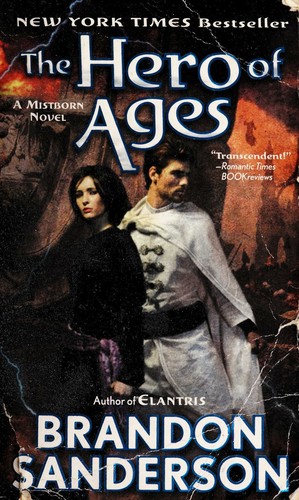
The Hero of Ages
by Brandon Sanderson
★ Top 10 book of 2008 · #8 on Best Books of 2008
The final Mistborn volume finds Vin, Elend and their friends discovering the real danger is bigger than they thought, as ash buries crops, deadly mists linger, and Ruin runs loose. It is about finding courage and faith against overwhelming odds.
Best for: Fantasy fans who have followed the Mistborn trilogy and want its finale
The Hero of Ages is #8 on BookWard's Best Books of 2008, out of 46 2008 books that cleared our data bar.
What The Hero of Ages is about
This is the third and final part of the Mistborn Trilogy. The heroes learn that the danger they believed they were fighting was never the real one. Now they struggle to save themselves and their world. The mists are killing people and lingering far longer than they should. The Ashmounts are pouring choking ash into the sky, burying the crops everyone needs to eat.
At the center of it all is Ruin, a creature Vin was tricked into freeing from a prison it held for a thousand years. It is no human Dark Lord but something closer to a force of nature, entropy given a will and a personality. Life under the Lord Ruler begins to look like paradise by comparison. The publisher notes that the book returns to fantasy tropes the first volume pushed against.
The Hero of Ages on the Best Books of 2008
The Hero of Ages came out in 2008. Of the 46 books first published in 2008 that met BookWard's data bar, it ranks #8 on our Best Books of 2008 list.
Why it made the list: 410 readers have shelved it on Open Library; readers rate it 4.6 out of 5 (130 ratings). The list ranks each year’s books on how many readers have picked them up, how highly readers rate them, and how many are reading them right now.
It earns Reader favorite.
Nearby on the 2008 list
- Michelle Obama in Her Own Words Michelle Obama, #6
- The Graveyard Book Neil Gaiman, #7
- Paper Towns John Green, #9
- Thinking in Systems Donella H. Meadows, #10
See all Best Books of 2008 Best books by year
More years: Best Books of 2007 Best Books of 2009.
The numbers behind it
- Readers: 200 want to read it, 12 are reading it now and 198 have read it, according to Open Library.
- Ratings: 4.6 out of 5 from 130 Open Library ratings.
| Signal | This book (0 to 100) | Weight |
|---|---|---|
| Reach | 74 | 55% |
| Reader love | 100 | 25% |
| Being read right now | 57 | 20% |
Questions about The Hero of Ages
When was The Hero of Ages published?
The Hero of Ages by Brandon Sanderson was first published in 2008.
Was The Hero of Ages one of the best books of 2008?
The Hero of Ages is #8 on BookWard's Best Books of 2008, out of 46 2008 books that cleared our data bar. 410 readers have shelved it on Open Library; readers rate it 4.6 out of 5 (130 ratings).
Why is The Hero of Ages on the Best Books of 2008 list?
410 readers have shelved it on Open Library; readers rate it 4.6 out of 5 (130 ratings).
More of the best books of 2008
- The Hunger Games Suzanne Collins, #1
- End of Days Sylvia Browne, #2
- The Last Straw Jeff Kinney, #3
- Amulet Kazu Kibuishi, #4
- Outliers Malcolm Gladwell, #5
- Michelle Obama in Her Own Words Michelle Obama, #6
See the full Best Books of 2008, the Top 100, or new books on Rising.
How we know
This page uses public data: Open Library reader counts and ratings, and Wikipedia page views for recent years. The description is paraphrased from real source text. Rankings reflect reading interest, not quality or sales, and can be affected by data gaps. Lists update monthly.
Suits older teens and adults who enjoy epic fantasy and have read the earlier books.
Depends on the edition you pick.
A trilogy-closer where the enemy is entropy itself. 52% taste match
 BookWard’s take
A trilogy-closer where the enemy is entropy itself
The Hero of Ages is the third act of the Mistborn trilogy, and it knows it. The stakes widen from one empire to the whole world: ash falls, the mists linger far too long, and Ruin is loose. This is no place to start, since it leans entirely on the two books before it. The cast is wide and the scale is epic. It also gives up some ground on freshness. The first book turned fantasy tropes on their head, and this one drifts back toward them, though an enemy built from entropy rather than a Dark Lord keeps it from feeling stale. The logic is a real strength, with magic that behaves by rules and never cheats. The ending is where it pays off, bringing a long arc to a firm resolution. Readers who want an airtight story that actually finishes will find it here, though the length is sprawling rather than tight.
A third volume closing a trilogy runs long and sprawling, well past BookWard's preference for tight.
Rising catastrophe keeps events moving, close to BookWard's brisk preference, though a large cast adds some drag.
An enemy that is entropy given a will is a distinctive idea, even as the frame is familiar fantasy.
The prose is plain and functional, close to BookWard's slightly plain lean.
Plot and character share the load here, with world-ending stakes pulling it a little more toward plot than BookWard's lean.
Courage and faith against overwhelming odds point toward hope, a fit with BookWard's mild optimism.
The structure is conventional trilogy-closing, a comfortable match for BookWard's middle position.
The tone is serious, shaped by famine, ash and impending collapse, so it is more solemn than BookWard's light touch.
Famine, ash and a world ending darken it, matching BookWard's middle position.
Loyalty, sacrifice and loss run high at the finale, a little more intense than BookWard's balance.
See all 50 dialsEvery position, side by side with this book
Where it lines up
- Internal logicBookWard 10 · book 9
- PaceBookWard 8 · book 7
- Character depthBookWard 8 · book 7
Where it pulls apart
- LengthBookWard 1 · book 9
- Familiar tropesBookWard 10 · book 5
- OpeningBookWard 10 · book 6
A third volume closing a trilogy runs long and sprawling, well past BookWard's preference for tight.
It assumes you arrive mid-story, so the opening builds on stakes already set rather than hooking cold.
It returns in part to the tropes the first book resisted, though entropy as the enemy keeps it from feeling stock.
The magic and the world run on consistent rules, which lines up closely with BookWard's love of airtight systems.
Rising catastrophe keeps events moving, close to BookWard's brisk preference, though a large cast adds some drag.
An enemy that is entropy given a will is a distinctive idea, even as the frame is familiar fantasy.
Characters carried across three books have real history, which gives their choices weight BookWard values.
As the closing act of a trilogy it brings its arcs to a firm resolution, matching BookWard's taste.
It leans on courage and faith in the face of loss, warmer than BookWard's restrained taste.
The darkness comes from escalating stakes to the world rather than shock for its own sake.
The voice is clear and workmanlike rather than strongly idiosyncratic, less distinctive than BookWard likes.
This is story-led, driven by survival and confrontation, in line with BookWard's lean toward narrative.
Series lore needs some explaining, so it tips toward telling more than BookWard's show-in-scene preference.
A big, many-threaded finale mostly sustains momentum, though its length invites some uneven stretches.
The prose is plain and functional, close to BookWard's slightly plain lean.
Plot and character share the load here, with world-ending stakes pulling it a little more toward plot than BookWard's lean.
Courage and faith against overwhelming odds point toward hope, a fit with BookWard's mild optimism.
The structure is conventional trilogy-closing, a comfortable match for BookWard's middle position.
The tone is serious, shaped by famine, ash and impending collapse, so it is more solemn than BookWard's light touch.
Series lore takes some keeping track of, but the storytelling is accessible rather than demanding.
Several beloved characters carry the story, which fits BookWard's appetite for multiple viewpoints.
The story moves forward in a straight line, more linear than BookWard's open attitude to shifting time.
An ensemble built over three books makes the cast large, beyond BookWard's smaller comfort zone.
The fate of the whole world is at stake, which makes it epic where BookWard is mid-range.
Survival and confrontation drive the action outward more than inward, though belief and courage matter.
Plans, arguments and debate between allies carry much of the story, close to BookWard's dialogue-heavy lean.
Relationships matter to the cast, but the world's survival is the main concern, leaving romance in a supporting role.
An invented world with its own magic and ash-choked landscape is deeply unfamiliar, which BookWard enjoys.
An invented fantasy world reads as removed from the present day, further back than BookWard's modern lean.
Epic fantasy endings tend to hold up, though its tropes tie it to a genre moment.
The narration is straightforward and trustworthy rather than the unreliable BookWard enjoys.
The conflict between survival and an indifferent destructive force is clearer than the ambiguity BookWard prefers.
The ash, mists and landscape are described with moderate richness, in line with BookWard's middle position.
It is the third book of a trilogy, firmly series, well past BookWard's standalone-friendly middle.
Sanderson-style reveals and reframings of what the real threat is suit BookWard's taste for surprise.
It entertains and resolves more than it challenges, slightly more comforting than BookWard's taste.
Famine, ash and a world ending darken it, matching BookWard's middle position.
Loyalty, sacrifice and loss run high at the finale, a little more intense than BookWard's balance.
Humor is occasional and light, close to BookWard's even balance.
Combat and mass suffering appear throughout, though handled with epic-fantasy restraint.
Sexual content is minimal, well below BookWard's middle position.
Ruling the empire and surviving its collapse bring politics in, close to BookWard's balance.
The language is plain, with invented terms for magic but no dense dialect.
Narration stays neutral and close to the characters rather than editorializing.
Facing a coming collapse and hoping for renewal points forward more than back.
Faith and courage against hopeless odds make it idealistic, beyond BookWard's mild lean.
Review written by BookWard, dial version 1, November 2026.
Who is The Hero of Ages right for?
Suits older teens and adults who enjoy epic fantasy and have read the earlier books. It contains war, large-scale suffering and the deaths of characters.
Series lore takes some keeping track of, but the storytelling is accessible rather than demanding.
Famine, ash and a world ending darken it, matching BookWard's middle position.
Loyalty, sacrifice and loss run high at the finale, a little more intense than BookWard's balance.
Combat and mass suffering appear throughout, though handled with epic-fantasy restraint.
Book CompanionThe Hero of Ages: ideas, characters, themes
The final book of the Mistborn trilogy pits its heroes against Ruin, a force of entropy given a will, as the world itself starts to fail.
- The true danger. The heroes learn that what they thought was the problem all along was not the real threat.
- A dying world. The mists are killing people, ash buries the crops, and life under the Lord Ruler begins to look better by comparison.
- Ruin loose. Vin was tricked into freeing Ruin from its prison of a millennium, and now it wreaks havoc on the land.
- An enemy beyond a Dark Lord. Rather than a human villain, the opposition is entropy itself with a guiding personality.
- Courage and faith. The cast must find the will to fight on against overwhelming odds, as Kelsier taught them.
Characters
Vin
Heroine who freed Ruin
She was tricked into freeing Ruin from its prison, and carries that weight into the finale.
Elend
Ally and leader
One of the beloved characters carried from earlier volumes, fighting to save a collapsing world.
Sazed
Longtime companion
A familiar figure who must find courage and faith as the odds worsen.
Ruin
Antagonist
A force of entropy given a will and a guiding personality, now loose in the world.
Themes
Fighting on when victory looks impossible.
Holding to belief when the world is failing.
The slow unmaking of things, here given a will.
Kelsier's lessons continuing to shape those he left behind.
Keeping people fed and alive as the land fails.
Discussion questions
- How does an enemy that is a force of nature, not a Dark Lord, change the kind of story being told?
- Does returning to classic fantasy tropes weaken or strengthen the trilogy's finale?
- What does Kelsier's teaching mean to the characters now that he is gone?
- Which character's courage did you find most convincing, and why?
- Does the ending resolve the trilogy the way the first book promised it would?
Personalize your Book Companion
This is the general edition. In BookWard, the Companion is written for you: your reading profile, your notes, and spoiler-safe to the page you are on.
Buy, listen or borrow The Hero of Ages
Each link opens a search for this book on that store, in a new tab.
Read on a device
Borrow
Reviews and community
If you liked The Hero of Ages
Jordan's second Wheel of Time book widens the world and the stakes
The Shadow RisingRobert JordanThe Wheel of Time's biggest installment, scattering its heroes in four directions
Wind and TruthBrandon SandersonThe huge, resolved finale of The Stormlight Archive's first half
WinterMarissa MeyerFour fairy-tale heroines converge for a vast, hopeful finale
Find your own best books
Add what you have read, rate it, and BookWard will recommend what to read next.
Free to start. No credit card needed.