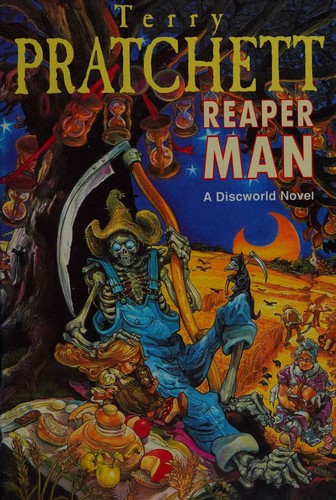
Reaper Man
by Terry Pratchett
★ Top 10 book of 1991 · #6 on Best Books of 1991
When Death grows weary of his duties, his Discworld bosses retire him, and he sets about enjoying life. With no Grim Reaper on the job, the dead refuse to stay dead, and the aging wizard Windle Poons joins the hunt to bring Death back.
Best for: Discworld fans who enjoy comic fantasy with wizards and an existential Death
Reaper Man is #6 on BookWard's Best Books of 1991, out of 23 1991 books that cleared our data bar.
What Reaper Man is about
Death has developed a personality, and the Auditors of Reality don't approve. They force him into retirement and hand him a timer of sand that counts down his own life. Calling himself Bill Door, he takes work as a farmhand for Miss Flitworth and learns what it is like to have only so much time. Meanwhile, with nobody doing his job, life force piles up and strange things start to happen. Windle Poons, a wizard of Unseen University, finds himself undead and joins a club for others in the same state. The eleventh Discworld novel is funny and kind-hearted, asking what makes a life worth having. It works well for newcomers to Terry Pratchett as well as longtime fans.
Reaper Man on the Best Books of 1991
Reaper Man came out in 1991. Of the 23 books first published in 1991 that met BookWard's data bar, it ranks #6 on our Best Books of 1991 list.
Why it made the list: 266 readers have shelved it on Open Library; readers rate it 4.3 out of 5 (71 ratings). The list ranks each year’s books on how many readers have picked them up, how highly readers rate them, and how many are reading them right now.
It earns Reader favorite.
Nearby on the 1991 list
- Shiloh Phyllis Reynolds Naylor, #4
- The Firm John Grisham, #5
- Chrysanthemum Kevin Henkes, #7
- Witches Abroad Terry Pratchett, #8
See all Best Books of 1991 Best books by year
More years: Best Books of 1990 Best Books of 1992.
The numbers behind it
- Readers: 140 want to read it, 2 are reading it now and 124 have read it, according to Open Library.
- Ratings: 4.3 out of 5 from 71 Open Library ratings.
| Signal | This book (0 to 100) | Weight |
|---|---|---|
| Reach | 74 | 55% |
| Reader love | 96 | 25% |
| Being read right now | 4 | 20% |
Questions about Reaper Man
When was Reaper Man published?
Reaper Man by Terry Pratchett was first published in 1991.
Was Reaper Man one of the best books of 1991?
Reaper Man is #6 on BookWard's Best Books of 1991, out of 23 1991 books that cleared our data bar. 266 readers have shelved it on Open Library; readers rate it 4.3 out of 5 (71 ratings).
Why is Reaper Man on the Best Books of 1991 list?
266 readers have shelved it on Open Library; readers rate it 4.3 out of 5 (71 ratings).
More of the best books of 1991
- Outlander Diana Gabaldon, #1
- Needful Things Stephen King, #2
- American Psycho Bret Easton Ellis, #3
- Shiloh Phyllis Reynolds Naylor, #4
- The Firm John Grisham, #5
- Chrysanthemum Kevin Henkes, #7
See the full Best Books of 1991, the Top 100, or new books on Rising.
How we know
This page uses public data: Open Library reader counts and ratings, and Wikipedia page views for recent years. The description is paraphrased from real source text. Rankings reflect reading interest, not quality or sales, and can be affected by data gaps. Lists update monthly.
Suitable for most teens and adults, and a good entry point for readers curious about Discworld.
Depends on the edition you pick.
Death takes early retirement and Discworld gets funnier and wiser. 67% taste match
 BookWard’s take
Death takes early retirement and Discworld gets funnier and wiser
Reaper Man is the eleventh Discworld novel and the second to centre on Death, and it is the one where the series starts asking what a life is worth. The Auditors of Reality force Death into retirement, and he takes a job as a farmhand under the name Bill Door. Meanwhile the dead have nowhere to go, and a recently deceased wizard named Windle Poons finds himself a zombie. On the Opening dial it hooks fast, with its premise set out almost at once. It scores high on Authorial voice, since Pratchett's comic register is unmistakable. It also sits well on Familiar tropes: the supernatural staples get turned over rather than recycled. Funny and humane in equal measure, it suits readers who like jokes with a pulse underneath.
A compact comic fantasy that never outstays its welcome, though a little longer than BookWard's tightest picks.
It moves briskly between Death's farm life and the chaos in Ankh-Morpork, keeping momentum without rushing.
A Grim Reaper learning to live is a distinctive idea, handled with wit rather than recycled from earlier fiction.
Clean and playful rather than ornate, with the occasional flourish for a punchline or a pang.
The plot is clever, but the real engine is Death and Windle discovering what they want.
For a book about death it ends up warm and affirming about life.
Two parallel storylines run side by side, a mild departure from straight narration.
It is a comedy first, with wordplay and absurd situations throughout.
The subject is death, but handled with humour and tenderness rather than dread.
It quietly moves the reader without turning melodramatic.
See all 50 dialsEvery position, side by side with this book
Where it lines up
- Character depthBookWard 8 · book 8
- EndingBookWard 8 · book 8
- Shock for effectBookWard 9 · book 9
Where it pulls apart
- Internal logicBookWard 10 · book 7
- LengthBookWard 1 · book 3
- OpeningBookWard 10 · book 8
A compact comic fantasy that never outstays its welcome, though a little longer than BookWard's tightest picks.
The central premise, Death forced into retirement, lands immediately, which suits BookWard's taste for instant hooks.
It plays with fantasy and horror staples such as zombies and the Grim Reaper, but twists them into something fresh.
Discworld rules hold together, and Death's absence has clear, escalating consequences for the dead and the living.
It moves briskly between Death's farm life and the chaos in Ankh-Morpork, keeping momentum without rushing.
A Grim Reaper learning to live is a distinctive idea, handled with wit rather than recycled from earlier fiction.
Death and Windle Poons are drawn with real warmth and growth, beyond what the genre usually asks for.
The central confrontation is resolved cleanly, which fits BookWard's preference for endings that land.
It carries real feeling about mortality, though the jokes keep it from tipping into sentimentality.
Its darkness serves the theme of death and meaning, never shock for its own sake.
Not applicable to a work of comic fantasy.
Pratchett's voice is unmistakable, with asides and comic timing no one else produces.
The story drives it, but an idea about what makes life valuable sits underneath every scene.
Information arrives through scenes and jokes rather than lectures, which BookWard values.
The two strands, Death on the farm and the undead in the city, keep the middle moving.
Clean and playful rather than ornate, with the occasional flourish for a punchline or a pang.
The plot is clever, but the real engine is Death and Windle discovering what they want.
For a book about death it ends up warm and affirming about life.
Two parallel storylines run side by side, a mild departure from straight narration.
It is a comedy first, with wordplay and absurd situations throughout.
Easy and quick to read, with jokes that reward attention but never require it.
The story moves among Death, Windle Poons, the wizards and other Ankh-Morpork residents.
The story proceeds in order without flashbacks or time jumps.
A fully realised fantasy world with a Grim Reaper, zombies and wizards.
Several storylines bring in a sizeable but manageable ensemble of wizards, undead and villagers.
The stakes are cosmic, but the story stays rooted in small communities and personal moments.
Events drive it, though Death's reflection on being alive adds a steady inner current.
Banter and comic exchanges carry much of the story.
Romance is not a driver here; the emotional weight lies elsewhere.
Discworld is invented and strange, though the series' regulars find it comfortably familiar.
A secondary world with no fixed time, though the satire feels modern.
Its themes of mortality and meaning keep it fresh decades after publication in 1991.
A trustworthy, omniscient narrator guides the reader, with plenty of wry commentary.
The book clearly values life and compassion, with little moral murk.
Rich, witty detail of Discworld places and people, used mostly for comic effect.
The eleventh Discworld novel, but it reads well with only light prior knowledge.
There are some turns, though the main arc is easy to follow.
Gently thoughtful about death without being heavy or difficult.
The subject is death, but handled with humour and tenderness rather than dread.
It quietly moves the reader without turning melodramatic.
Mostly dry and clever, with the occasional broad gag.
There is little violence on the page, and what appears is comic.
Practically no sexual content.
Satire of institutions and bureaucracy is present but light.
Plain language with the occasional comic flourish.
Pratchett's wry commentary shapes how everything is described.
It looks at how to live now, with no strong lean to past or future.
It believes in kindness and the value of ordinary life.
Review written by BookWard, dial version 1, November 2026.
Who is Reaper Man right for?
Suitable for most teens and adults, and a good entry point for readers curious about Discworld. It deals with death and mortality throughout, though gently and with humour.
Easy and quick to read, with jokes that reward attention but never require it.
The subject is death, but handled with humour and tenderness rather than dread.
It quietly moves the reader without turning melodramatic.
There is little violence on the page, and what appears is comic.
Book CompanionReaper Man: ideas, characters, themes
When Death is made to retire and learn what it means to live, both the dead and the living are forced to rethink what a life is for.
- The Auditors decide. Formless Auditors of Reality conclude that Death has developed too much personality and force him out.
- Bill Door on the farm. Death takes the name Bill Door and works for Miss Flitworth, discovering ordinary human life.
- The dead pile up. With no Death to usher them on, the life force of the dead builds and causes poltergeists and ghosts.
- Windle Poons rises. A recently deceased wizard finds himself a zombie and joins the Fresh Start Club for the undead.
- A new Death. Humankind's collective fear creates a New Death with no form or personality, setting up a final confrontation.
Characters
Death
Protagonist
Forced to retire, he becomes Bill Door and learns about humans and the value of life.
Windle Poons
Wizard turned zombie
An elderly Unseen University wizard who dies and returns, then joins the undead of Ankh-Morpork.
Miss Flitworth
Farmer
The elderly woman who employs Death as a farmhand in the Octarine Grass Country.
The Auditors of Reality
Antagonists
Formless beings who keep the universe efficient and dislike Death's growing personality.
Themes
What it means that life ends, and why that gives it value.
How personality and feeling make someone more than a function.
The cold efficiency of systems that ignore individual lives.
How friendship and belonging give life shape and meaning.
How collective dread can create something monstrous.
Discussion questions
- Why do the Auditors see personality as a flaw, and what does the book say they are missing?
- What does Death learn on the farm that he could not learn while working?
- How does the chaos from Death's absence show what his role provides?
- What does the Fresh Start Club suggest about how we treat the elderly or the unwanted?
- How does humour change the way the book handles death compared with a serious treatment?
Personalize your Book Companion
This is the general edition. In BookWard, the Companion is written for you: your reading profile, your notes, and spoiler-safe to the page you are on.
Buy, listen or borrow Reaper Man
Each link opens a search for this book on that store, in a new tab.
Read on a device
Borrow
Reviews and community
If you liked Reaper Man
Winter falls for the wrong girl, and Discworld bends
Witches AbroadTerry PratchettThree witches, one wand, and a fairy tale with teeth
HogfatherTerry PratchettDeath plays Father Christmas, and belief itself is at stake
Men at ArmsTerry PratchettPratchett's cop story: a city, a gonne, a rightful king
Find your own best books
Add what you have read, rate it, and BookWard will recommend what to read next.
Free to start. No credit card needed.