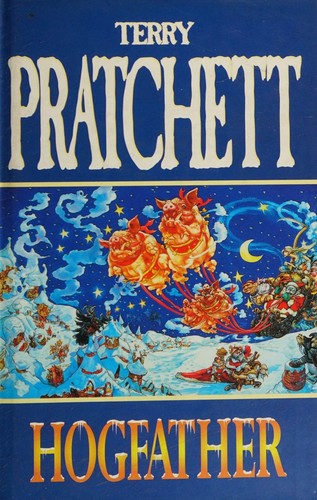
Hogfather
by Terry Pratchett
★ Top 25 book of 1996 · #22 on Best Books of 1996
On Hogswatchnight, the beloved Hogfather has vanished, and an Assassins' Guild member is up to something sinister. Death takes over the sleigh while his granddaughter Susan races to save the holiday and the world's myths.
Best for: Discworld fans who want a festive, darkly funny fantasy with Death at its heart
Hogfather is #22 on BookWard's Best Books of 1996, out of 39 1996 books that cleared our data bar.
What Hogfather is about
In Terry Pratchett's twentieth Discworld novel, first published in 1996, the Hogfather is a mythical figure much like Father Christmas, who brings children presents on Hogswatchnight, December 32. When he goes missing, Death steps into the red suit, helped by his servant Albert, while Death's granddaughter Susan Sto Helit sets out to find and rescue him. Behind it all are the Auditors of Reality, celestial bureaucrats barred by the Rules from acting directly, who instead pay the Assassins' Guild to remove him.
The job falls to Mr. Teatime, a man known for ruthlessness and creative solutions. His plan involves stealing the Tooth Fairy's collected teeth to make children stop believing. That matters more than it sounds, because the Hogfather is also responsible for the sun rising. The result is a funny, warmly philosophical satire of Christmas, built around belief, myth and mortality. It was a 1997 British Fantasy Award nominee.
Hogfather on the Best Books of 1996
Hogfather came out in 1996. Of the 39 books first published in 1996 that met BookWard's data bar, it ranks #22 on our Best Books of 1996 list.
Why it made the list: 235 readers have shelved it on Open Library; readers rate it 4.1 out of 5 (59 ratings). The list ranks each year’s books on how many readers have picked them up, how highly readers rate them, and how many are reading them right now.
Nearby on the 1996 list
- Frindle Andrew Clements, #20
- Exquisite Corpse Poppy Z. Brite, #21
See all Best Books of 1996 Best books by year
More years: Best Books of 1995 Best Books of 1997.
The numbers behind it
- Readers: 134 want to read it, 3 are reading it now and 98 have read it, according to Open Library.
- Ratings: 4.1 out of 5 from 59 Open Library ratings.
| Signal | This book (0 to 100) | Weight |
|---|---|---|
| Reach | 44 | 55% |
| Reader love | 67 | 25% |
| Being read right now | 8 | 20% |
Questions about Hogfather
When was Hogfather published?
Hogfather by Terry Pratchett was first published in 1996.
Was Hogfather one of the best books of 1996?
Hogfather is #22 on BookWard's Best Books of 1996, out of 39 1996 books that cleared our data bar. 235 readers have shelved it on Open Library; readers rate it 4.1 out of 5 (59 ratings).
Why is Hogfather on the Best Books of 1996 list?
235 readers have shelved it on Open Library; readers rate it 4.1 out of 5 (59 ratings).
More of the best books of 1996
- A Game of Thrones George R. R. Martin, #1
- The Green Mile Stephen King, #2
- Forbidden Knowledge Roger Shattuck, #3
- Fight Club Chuck Palahniuk, #4
- Push Sapphire, #5
- Neverwhere Neil Gaiman, #6
See the full Best Books of 1996, the Top 100, or new books on Rising.
How we know
This page uses public data: Open Library reader counts and ratings, and Wikipedia page views for recent years. The description is paraphrased from real source text. Rankings reflect reading interest, not quality or sales, and can be affected by data gaps. Lists update monthly.
Suits teens and adults who enjoy witty fantasy and does not need earlier Discworld books.
Depends on the edition you pick.
Death plays Father Christmas, and belief itself is at stake. 65% taste match
 BookWard’s take
Death plays Father Christmas, and belief itself is at stake
Hogfather is Terry Pratchett's twentieth Discworld novel, and it opens with a premise that hooks at once: the Hogfather has vanished on Hogswatchnight, an assassin is on the loose, and Death takes over the sleigh. The pace rarely lets up. It is also strikingly original, turning Father Christmas, the Tooth Fairy and the question of why we believe in anything into a comic mystery with real internal logic. The voice is unmistakable, with jokes that carry ideas. Susan Sto Helit gives it a sharp, grounded lead, and the characters hold up well. It is driven more by its ideas than by people, which may not suit every reader, and it belongs to a long series, though it stands comfortably alone.
A standard-sized comic fantasy that moves briskly; shorter than BookWard's full ideal of tight, but it never feels padded.
Several threads move at once and keep momentum high, close to BookWard's preference for speed.
A murder plot aimed at a Santa-like god, powered by belief itself, is a distinctive idea executed with confidence.
Clean and quick with a flair for the sharp simile; stylish without being ornate.
Plot and character share the load, as Susan's choices and the mystery's mechanics push each other forward.
It ends up affirming small human kindnesses and the value of belief, leaning clearly hopeful.
A conventional linear quest told with a wry narrator, with little formal experiment.
Comedy is central, from the satire of festive customs to Death's literal-mindedness, which BookWard enjoys.
An assassin and a murder plot bring real menace, balanced by comic fantasy and a warm center.
It touches the heart at moments without turning intense or heavy.
See all 50 dialsEvery position, side by side with this book
Where it lines up
- OriginalityBookWard 9 · book 9
- EndingBookWard 8 · book 8
- OpeningBookWard 10 · book 9
Where it pulls apart
- LengthBookWard 1 · book 4
- Story or ideasBookWard 3 · book 7
- Internal logicBookWard 10 · book 8
A standard-sized comic fantasy that moves briskly; shorter than BookWard's full ideal of tight, but it never feels padded.
The Hogfather is missing and Death takes his place within the opening stretch, which matches BookWard's love of an immediate pull.
It takes Christmas and fairy-tale figures and bends them into something fresh, which suits BookWard's dislike of stock tropes.
Belief, myth and the Auditors' scheme follow consistent rules, so the madness hangs together well.
Several threads move at once and keep momentum high, close to BookWard's preference for speed.
A murder plot aimed at a Santa-like god, powered by belief itself, is a distinctive idea executed with confidence.
Susan and Death are drawn with more care than comic fantasy often bothers with, though the wider cast leans on types.
The threads close satisfyingly, which sits well with BookWard's taste for resolution.
It is warm and has heart, but wit keeps it from tipping into the syrupy.
Its darker moments are tied to the plot and the theme rather than thrown in for effect.
Not applicable; this is a novel.
Pratchett's footnoted, ironic narration is among the most recognisable voices in fantasy, a strong match for BookWard.
The story drives the book, but it carries a big argument about belief and meaning, so ideas weigh in more than BookWard usually likes.
The narrator often steps in to explain the joke or the world, more than BookWard's show-in-scene preference.
Cutting between Death, Susan and the villains keeps the middle moving rather than letting it drift.
Clean and quick with a flair for the sharp simile; stylish without being ornate.
Plot and character share the load, as Susan's choices and the mystery's mechanics push each other forward.
It ends up affirming small human kindnesses and the value of belief, leaning clearly hopeful.
A conventional linear quest told with a wry narrator, with little formal experiment.
Comedy is central, from the satire of festive customs to Death's literal-mindedness, which BookWard enjoys.
Easy to read and quick to follow, though some of the satire rewards close attention.
The narrative hops between Death, Susan, the assassin and others, giving it a wide spread of perspectives.
Events run in order over one Hogswatchnight with no jumps in time.
A flat world carried by turtles, gods of hangovers and a Tooth Fairy realm: about as fantastical as it gets.
A sizeable ensemble of gods, wizards, assassins and gangsters crowds the story, and it holds them together.
The stakes are cosmic, since the sun's rising is on the line, but the action stays close to a few key figures.
Balanced between action and thought, with plenty of both, so BookWard's inward lean is only partly met.
Quick, quotable exchanges carry a lot of the humor and the plot.
Romance is not part of the story.
Discworld is invented, though its Ankh-Morpork streets echo familiar British life enough to feel at home.
A fantasy world in a timeless pseudo-Victorian mood, nowhere near the present day though it mirrors it.
Its jokes about belief, ritual and Christmas keep their bite, and it has earned a lasting following.
The narrator is knowing and trustworthy, guiding us through events with clear intent.
It argues plainly for kindness, imagination and the value of belief, so the moral compass is clear.
Vivid, inventive touches build the world without long passages of scene-setting.
It is the twentieth Discworld novel, though a new reader can follow it without the earlier ones.
The plot has its reveals, but the larger direction is fairly easy to follow.
A comforting read at heart, even as it tackles weighty ideas about belief and mortality.
An assassin and a murder plot bring real menace, balanced by comic fantasy and a warm center.
It touches the heart at moments without turning intense or heavy.
The humor is largely dry, built on irony and understatement rather than slapstick.
Some killings happen and the villain is chilling, but the book keeps most of it light.
There is essentially none.
Satirical jabs at institutions pop up, but politics is not the main subject.
The language is clear and plain, with no heavy dialect.
The narrator offers a steady stream of wry opinions and asides.
It is about the present moment and why we hold on to traditions, with no particular tilt toward past or future.
Beneath the satire, it believes in human goodness and the worth of small, kind acts.
Review written by BookWard, dial version 1, November 2026.
Who is Hogfather right for?
Suits teens and adults who enjoy witty fantasy and does not need earlier Discworld books. It contains an assassin, some killing and mortality themes, handled mostly with comic distance.
Easy to read and quick to follow, though some of the satire rewards close attention.
An assassin and a murder plot bring real menace, balanced by comic fantasy and a warm center.
It touches the heart at moments without turning intense or heavy.
Some killings happen and the villain is chilling, but the book keeps most of it light.
Book CompanionHogfather: ideas, characters, themes
Belief, even in comforting fictions like the Hogfather, helps hold the world together and makes us human.
- The Hogfather vanishes. On Hogswatchnight, the jolly gift-giver is missing, and Death steps in to fill his place.
- A contract on a god. The Auditors of Reality use the Assassins' Guild to remove the Hogfather, since they cannot act directly.
- Mr. Teatime's plan. A ruthless assassin sets out to turn children's belief against the Hogfather by going after the Tooth Fairy's collection.
- Death in a red suit. Death tries to keep belief alive by delivering presents, with his own literal view of what Hogswatch means.
- Susan investigates. Death's granddaughter, Susan Sto Helit, is drawn in and sets out to find what has happened to the Hogfather.
Characters
Death
Stand-in Hogfather
Takes up the sleigh and tries to keep the holiday going, sincere but puzzled by human customs.
Susan Sto Helit
Death's granddaughter
Sensible and sharp, she is drawn into the mystery and tries to rescue the Hogfather.
Mr. Teatime
Assassin
A ruthless Guild member with a reputation for creative solutions, hired to kill the Hogfather.
Albert
Death's servant
Helps Death and objects when his master's methods go too far.
Themes
What we choose to believe shapes the world, and comforting stories do real work.
Traditions like Hogswatch carry meaning beyond their surface.
Death as a character lets the book look at life and its limits with warmth.
Being human means imagination, kindness and a need for stories.
Festive customs and institutions are mocked, but affectionately.
Discussion questions
- Why does the book suggest that belief in small fictions matters?
- How does Death's literal-mindedness reveal what people value about Hogswatch?
- What makes Mr. Teatime a threat that Death cannot simply face himself?
- How does Susan's skepticism help and hinder her search?
- Which parts of Discworld's Hogswatch resemble our own holiday habits, and why?
Personalize your Book Companion
This is the general edition. In BookWard, the Companion is written for you: your reading profile, your notes, and spoiler-safe to the page you are on.
Buy, listen or borrow Hogfather
Each link opens a search for this book on that store, in a new tab.
Read on a device
Borrow
Reviews and community
If you liked Hogfather
Death takes early retirement and Discworld gets funnier and wiser
Witches AbroadTerry PratchettThree witches, one wand, and a fairy tale with teeth
Guards! Guards!Terry PratchettA dragon, a doomed Watch, and Pratchett's sharpest early satire
Feet of ClayTerry PratchettPratchett's Watch novel pairs a golem murder with a poisoned Patrician
Find your own best books
Add what you have read, rate it, and BookWard will recommend what to read next.
Free to start. No credit card needed.