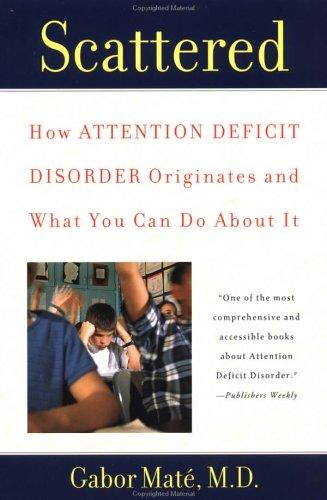
Scattered
by Gabor Maté
★ Top 25 book of 1999 · #20 on Best Books of 1999
Dr. Gabor Maté argues that social and emotional surroundings help cause and treat attention deficit disorder, even if genetics play a part. Drawing on personal experience, he covers its effects on children and adults, plus treatments.
Best for: Parents and adults seeking a thoughtful, experience-based look at ADD
Scattered is #20 on BookWard's Best Books of 1999, out of 52 1999 books that cleared our data bar.
What Scattered is about
Gabor Maté takes on Attention Deficit Disorder, a subject people argue about, and offers a different view from books that treat it mainly as inherited. He allows that genes may leave some people more prone to it, but he argues that social and emotional surroundings matter greatly, both in how ADD develops and in how it can be eased. His attention goes to what people can influence: the home environment, family dynamics and parenting choices.
He describes how hard ADD can be for children, and how it can shape careers and relationships in adulthood. He writes from personal experience, as someone with ADD and as the parent of three children who have been diagnosed. Alongside that, the book gives a thorough overview of the condition and its treatments. Parents, adults who recognize themselves in the description, and teachers or clinicians will find it useful and compassionate.
Scattered on the Best Books of 1999
Scattered came out in 1999. Of the 52 books first published in 1999 that met BookWard's data bar, it ranks #20 on our Best Books of 1999 list.
Why it made the list: 333 readers have shelved it on Open Library. The list ranks each year’s books on how many readers have picked them up, how highly readers rate them, and how many are reading them right now.
Nearby on the 1999 list
- The Reptile Room Lemony Snicket, #18
- Gardens of the Moon Steven Erikson, #19
- Hannibal Thomas Harris, #21
- Code Charles Petzold, #22
See all Best Books of 1999 Best books by year
More years: Best Books of 1998 Best Books of 2000.
The numbers behind it
- Readers: 317 want to read it, 7 are reading it now and 9 have read it, according to Open Library.
| Signal | This book (0 to 100) | Weight |
|---|---|---|
| Reach | 58 | 55% |
| Reader love | 71 | 25% |
| Being read right now | 15 | 20% |
Questions about Scattered
When was Scattered published?
Scattered by Gabor Maté was first published in 1999.
Was Scattered one of the best books of 1999?
Scattered is #20 on BookWard's Best Books of 1999, out of 52 1999 books that cleared our data bar. 333 readers have shelved it on Open Library.
Why is Scattered on the Best Books of 1999 list?
333 readers have shelved it on Open Library.
More of the best books of 1999
- Harry Potter and the Prisoner of Azkaban J. K. Rowling, #1
- Wings of Fire A. P. J. Abdul Kalam, #2
- The Perks of Being a Wallflower Stephen Chbosky, #3
- On Writing Stephen King, #4
- The Bad Beginning Lemony Snicket, #5
- The Coldest Winter Ever Sister Souljah, #6
See the full Best Books of 1999, the Top 100, or new books on Rising.
How we know
This page uses public data: Open Library reader counts and ratings, and Wikipedia page views for recent years. The description is paraphrased from real source text. Rankings reflect reading interest, not quality or sales, and can be affected by data gaps. Lists update monthly.
Suits adult readers, especially parents, educators and anyone living with attention difficulties.
Depends on the edition you pick.
A physician's personal, environment-first case about attention deficit disorder. 46% taste match
 BookWard’s take
A physician's personal, environment-first case about attention deficit disorder
Scattered argues that attention deficit disorder grows out of early emotional and family environments, not from genes alone. Maté writes as a physician and as someone with the condition himself, and he is also the parent of three diagnosed children, so the book carries real personal weight. Rigor is where it falls short of what we'd hope for: this is argument and lived experience rather than hard data, and that limits how firmly its claims can be trusted. The authorial voice is strong and distinctive, and the stance is personal rather than detached, which is much of the book's appeal. It is idea-led where we tend to prefer story-led, and it explains its points outright instead of letting them emerge from scenes. What works best is its outlook, because the book points toward what families and adults can actually change.
A full-length general-audience health book, neither slight nor sprawling; mid-range suits most readers.
Steady and explanatory, moving through causes, effects and treatments at a measured clip.
Putting emotional and social environment at the center of the cause was a distinct stance when it appeared.
Clear, accessible language aimed at general readers instead of ornate stylings.
No plot to speak of; people and their circumstances carry the argument.
Its core promise is that environment and parenting choices can change outcomes.
A serious, sympathetic treatment of a painful subject, with little humor.
The pain of the condition is real, but the tone stays compassionate.
Moving in places given its personal and family stakes, yet measured.
See all 50 dialsEvery position, side by side with this book
Where it lines up
- Shock for effectBookWard 9 · book 8
- Authorial voiceBookWard 9 · book 8
- OriginalityBookWard 9 · book 7
Where it pulls apart
- LengthBookWard 1 · book 5
- OpeningBookWard 10 · book 6
- Familiar tropesBookWard 10 · book 6
A full-length general-audience health book, neither slight nor sprawling; mid-range suits most readers.
Its environment-over-heredity argument runs against the standard genetic story, though the self-help frame is familiar.
The argument is coherent and internally consistent, but rests on a contested thesis rather than airtight proof.
Steady and explanatory, moving through causes, effects and treatments at a measured clip.
Putting emotional and social environment at the center of the cause was a distinct stance when it appeared.
Maté's own story and his family's experience give the book real human depth.
Warm and compassionate, but grounded in clinical observation rather than sweetness.
It does not trade on shock; it makes its case through explanation and experience.
A distinctive, empathetic physician's voice that is clearly his own.
The book is built around a thesis about causes and cures, with stories serving the argument.
Concepts and conclusions are explained directly instead of dramatized in scenes.
A thesis book can lag when it stacks examples, but the thread of argument holds throughout.
Clear, accessible language aimed at general readers instead of ornate stylings.
No plot to speak of; people and their circumstances carry the argument.
Its core promise is that environment and parenting choices can change outcomes.
A serious, sympathetic treatment of a painful subject, with little humor.
Accessible to a general reader, though some medical and psychological ideas take attention.
Organized by topic and argument, not by shifting through time.
Entirely grounded in clinical and family reality.
Intimate in focus: individual minds, families and homes.
Concerned with inner life: attention, feeling and emotional history.
Mostly exposition and reflection, with little back-and-forth dialogue.
Romance is not a concern of this book.
The setting is ordinary family and clinical life, familiar to most readers.
Written in 1999, so it reads as late-twentieth-century, though the questions persist.
Debates about attention and upbringing endure, though the science has moved on.
A straightforward first-person authorial voice, plainly telling its own story.
It takes a clear stand on cause and on what parents and families should do.
Descriptions of lived experience matter, but the book favors explanation over scenery.
Leans analytical and explanatory, with personal narrative woven through.
Maté writes openly from his own diagnosis and his role as a parent.
A standalone work, not part of a series.
An argument unfolds rather than surprises, so few turns.
It challenges the genetics-first view and asks parents to examine their own part.
The pain of the condition is real, but the tone stays compassionate.
Moving in places given its personal and family stakes, yet measured.
Touches social environment and parenting, but is not a political book.
Plain prose with some clinical terms, nothing dense.
Maté argues a position openly and does not pretend to neutrality.
Aimed at what can be changed going forward, in families and in adult lives.
Believes in change through understanding, which is hopeful without being naive.
Review written by BookWard, dial version 1, November 2026.
Who is Scattered right for?
Suits adult readers, especially parents, educators and anyone living with attention difficulties. It discusses the pain of ADD and family dynamics, which some readers may find personal or uncomfortable.
Accessible to a general reader, though some medical and psychological ideas take attention.
The pain of the condition is real, but the tone stays compassionate.
Moving in places given its personal and family stakes, yet measured.
Book CompanionScattered: ideas, characters, themes
Maté argues that attention deficit disorder, while possibly predisposed by genes, is shaped by emotional and social environment, and that changes in family life and parenting can help.
- Environment over heredity. The book argues that social and emotional surroundings play a key role in both the cause and the cure of ADD.
- Genes as predisposition. Maté acknowledges genetics may predispose a person, then moves on to what can be controlled.
- The lived reality. He describes the painful realities of ADD for children and its effects on adult careers and social lives.
- Author's own experience. He draws on his own experience with ADD and as parent of three diagnosed children.
- A practical focus. The emphasis falls on changes in environment, family dynamics and parenting choices, alongside an overview of treatments.
Themes
How much of attention difficulties comes from inheritance and how much from upbringing and surroundings.
The way relationships and parenting choices shape a child's emotional development.
The author's own diagnosis and parenting inform the argument.
Focusing on what individuals and families can actually do differently.
Its painful effect on childhood, careers and social paths.
Discussion questions
- Does the argument that environment shapes attention difficulties change how you think about family life?
- How does Maté's personal experience affect how persuasive you find the book?
- Where do you think genetics ends and upbringing begins?
- What practical changes does the book suggest, and which seem most realistic?
- How might a reader weigh a physician's experience against stricter research evidence?
Personalize your Book Companion
This is the general edition. In BookWard, the Companion is written for you: your reading profile, your notes, and spoiler-safe to the page you are on.
Buy, listen or borrow Scattered
Each link opens a search for this book on that store, in a new tab.
Read on a device
Borrow
Reviews and community
If you liked Scattered
Goleman's case that emotional skill can outweigh IQ, and can be taught
DriveDaniel H. PinkA lively case that autonomy, mastery and purpose beat carrots and sticks
The 7 Habits of Highly Effective PeopleStephen R. CoveySeven habits, laid out plainly, with ideas ahead of story
The Artist's WayJulia CameronA twelve-week creative recovery program built on daily writing
Find your own best books
Add what you have read, rate it, and BookWard will recommend what to read next.
Free to start. No credit card needed.