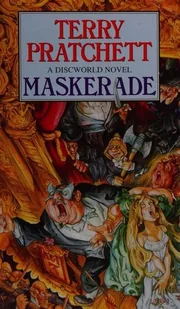
Suits adult and older teen readers who enjoy comic fantasy.
363 pages, about 5.5 to 8.5 hours.
Discworld's witches crash the opera in a witty Phantom spoof. 63% taste match
The story
Maskerade is a humorous fantasy novel by Terry Pratchett, first published in 1995 and the eighteenth book in the Discworld series. It is set in the city of Ankh-Morpork, with the witches of Lancre at its center. The story follows Granny Weatherwax and Nanny Ogg as they travel to the city and become involved with the Opera House, in a plot that draws on the tale of The Phantom of the Opera.
Agnes Nitt, a young woman from Lancre, has left home to pursue a singing career and joins the opera chorus, where she works alongside Christine. The witches have their own reasons for the trip, among them a matter concerning Nanny Ogg's cookbook and the question of who might fill the place left in their coven by Magrat Garlick. Meanwhile, a ghost is said to haunt the building, and a run of deadly accidents unsettles everyone who works there. Walter Plinge, Seldom Bucket, Dr. Undershaft, Henry Slugg and Enrico Basilica are among the people of the opera house, while Greebo, the Librarian and Death also appear. Readers of English-language fantasy and comic fiction will find a standalone adventure within the longer Discworld sequence.
The wind howled.
Themes
Discworld (Imaginary place)OperaFantasyWitchesEnglish literature
- Want to read 75
- Read 70
Readers are split between finishing it and saving it for later.
Of 145 readers who put it on a shelf, 52% want to read it, 0% are reading it now, 48% have finished it and 0% stopped before the end.
By the numbers
- The median edition runs 363 pages. Counting about 275 words a page and an adult reading pace of 250 words a minute, that is about 6.7 hours of reading.
- Open Library tracks 40 editions from 28 publishers, the earliest dated 1995 and the latest 2024, across 6 languages.
- On reader demand it ranks in the top 6% of the modern books in our catalog (15,152 of them).
- Libraries shelve it under Dewey 823.914 and Library of Congress class PR-6066.00000000.R34 M37 1998.
 BookWard’s take
Discworld's witches crash the opera in a witty Phantom spoof
Maskerade sends Granny Weatherwax and Nanny Ogg to the Ankh-Morpork Opera House, where a ghost is staging deadly accidents. It is a parody of The Phantom of the Opera, and it knows exactly which conventions it is poking at. It hooks fast, because a cast of Lancre witches and a haunted theatre need no warm-up. The voice is the real draw: Pratchett's narration is distinctive and funny, with jokes that carry real observation. The internal logic holds up well for a comic mystery, and the ending resolves cleanly. Familiar tropes are the book's raw material rather than its crutch, so it lands in the middle on that front, neither fresh nor lazy. It is the eighteenth Discworld novel but works as its own adventure, though the witches' history adds colour. Expect warmth over bleakness.
At 363 pages it is moderate, longer than BookWard's tight ideal but light on the page and brisk to read.
Short scenes and steady comic momentum keep it moving, close to BookWard's preferred quick pace.
Parody of a famous story is clever but built on borrowed bones, so less original than BookWard likes.
Clear, quick prose with comic flourishes and well-turned asides, plain enough to read at speed.
The mystery drives events, while the witches' personalities shape how it plays out.
Mostly warm and good-humoured, with villains beaten and decent people rewarded.
A conventional mystery arc told straight, with no structural experiments.
Comedy is the book's main mode, with wordplay, running gags and parody throughout.
Murders occur, but the tone stays light and the mood never turns grim.
Feeling shows up in small human moments, but laughter dominates over intensity.
See all 50 dialsEvery position, side by side with this book
Where it lines up
- EndingBookWard 8 · book 8
- PaceBookWard 8 · book 7
- Character depthBookWard 8 · book 7
Where it pulls apart
- Familiar tropesBookWard 10 · book 5
- LengthBookWard 1 · book 5
- OpeningBookWard 10 · book 8
At 363 pages it is moderate, longer than BookWard's tight ideal but light on the page and brisk to read.
A haunted opera house and two witches on a mission give it an instant engine, matching BookWard's taste for immediate hooks.
Phantom-style tropes are deliberately borrowed and spoofed, so it leans on familiar material more knowingly than BookWard prefers.
The ghost mystery and its theatre politics hold together, which suits BookWard's liking for airtight setups.
Short scenes and steady comic momentum keep it moving, close to BookWard's preferred quick pace.
Parody of a famous story is clever but built on borrowed bones, so less original than BookWard likes.
Granny, Nanny and Agnes are vivid and distinct, though comic archetypes sit near the surface.
The mystery resolves with a clear culprit and closure, in line with BookWard's preference for resolved endings.
Affection for its characters shows, but jokes undercut most sentimentality, so it stays fairly restrained.
The murders are staged accidents played mostly for mystery and comedy, never shock for its own sake.
Pratchett's narration is instantly recognisable and funny, exactly the distinctive voice BookWard rewards.
It is firmly a story with a mystery, though it carries sly observations about theatre and fame.
Some Discworld context is explained by the narrator, but most of it lands through scenes and banter.
Clear, quick prose with comic flourishes and well-turned asides, plain enough to read at speed.
The mystery drives events, while the witches' personalities shape how it plays out.
Mostly warm and good-humoured, with villains beaten and decent people rewarded.
A conventional mystery arc told straight, with no structural experiments.
Comedy is the book's main mode, with wordplay, running gags and parody throughout.
Easy to read and quick to follow, with little effort needed beyond enjoying the jokes.
The narration moves among the witches, Agnes and opera house staff, giving several angles on the plot.
Events run in a straight line from arrival in the city to the climax.
Witches, a ghost story and the invented Discworld place it well inside fantasy, though the tone stays comic.
Several witches, opera staff and suspects fill the stage, a moderately large ensemble.
The action stays within one opera house and city, so the stakes feel local rather than epic.
Mystery-solving action and social comedy balance the characters' private thoughts.
Banter between Granny and Nanny drives many scenes, so conversation carries a lot of the book.
Romance sits at the edges, with the mystery and the witches' mission firmly in front.
Ankh-Morpork and Lancre are invented places, though series readers will find them well-trodden.
It is a 1995 novel set in an invented world, so present day does not apply directly.
Comic character writing and opera satire age well, and the book still reads fresh.
The narrator is open, trustworthy and jokey, not hiding or distorting anything.
Heroes and villains are clearly drawn, with little moral murk.
Pratchett paints the opera house and its people with funny, vivid detail, without overloading the page.
It is the eighteenth Discworld novel, though it stands as a self-contained adventure.
Disguises, false suspects and a doubled ghost keep the mystery turning.
A comforting, entertaining read that rarely pushes the reader into discomfort.
Murders occur, but the tone stays light and the mood never turns grim.
Feeling shows up in small human moments, but laughter dominates over intensity.
Wit and wordplay lead, with some broad comic business thrown in.
A string of deadly accidents drives the plot, handled lightly and mostly offstage.
Mild innuendo only, especially around Nanny Ogg, with nothing explicit.
Satire of theatre culture and class is light and secondary to the mystery.
Language is plain and playful, with some regional witch speech.
Pratchett's narrator comments freely and wryly on people and customs throughout.
It is a parody that plays with an older tradition, looking back more than ahead.
It is cynical about fame and fraud but warm toward ordinary decent people.
Review written by BookWard, dial version 1, November 2026.
Who is Maskerade right for?
Suits adult and older teen readers who enjoy comic fantasy. It includes murders played lightly and some bawdy innuendo, mostly from Nanny Ogg.
Easy to read and quick to follow, with little effort needed beyond enjoying the jokes.
Murders occur, but the tone stays light and the mood never turns grim.
Feeling shows up in small human moments, but laughter dominates over intensity.
A string of deadly accidents drives the plot, handled lightly and mostly offstage.
Book CompanionMaskerade: ideas, characters, themes
Two sharp witches turn up at an opera house haunted by a ghost and find the real danger is human.
- A Phantom parody. The plot borrows the shape of The Phantom of the Opera and plays with its conventions for laughs.
- The witches abroad. Granny Weatherwax and Nanny Ogg leave Lancre for Ankh-Morpork, partly over Nanny's unpaid cookbook.
- A coven with a gap. The witches want to replace Magrat Garlick, which draws Agnes Nitt into their plans.
- Agnes in the chorus. Agnes joins the opera chorus and meets Christine, whose popularity outstrips her talent.
- Accidents that are not. A run of deadly mishaps makes the staff suspect the opera house ghost.
Characters
Granny Weatherwax
Lancre's formidable senior witch
She arrives in the city and joins the investigation at the opera house.
Nanny Ogg
Bawdy, sociable witch and cookbook author
Her unpaid book royalties help send the witches to Ankh-Morpork.
Agnes Nitt
Young singer from Lancre
She joins the opera chorus and is a possible recruit for the coven.
Walter Plinge
Opera house worker
He is one of the people connected to the ghost story.
Christine
Chorus singer
More popular than talented, she works alongside Agnes.
Themes
The opera world shows how appearances and performance can hide what is real.
Agnes and others wrestle with who they are against who they seem to be.
Social posturing and status get gently mocked across the story.
The witches' bond holds firm even as they bicker.
The ghost story plays on fear, then tests who can get past it.
Discussion questions
- Where does the book borrow from The Phantom of the Opera, and where does it depart?
- Why might the witches be right for solving a mystery set in a theatre?
- How does humour change the way the murders land?
- What does Agnes want, and what does the book say about her choices?
- Does the story work for readers new to Discworld?
Personalize your Book Companion
This is the general edition. In BookWard, the Companion is written for you: your reading profile, your notes, and spoiler-safe to the page you are on.
Buy, listen or borrow Maskerade
Each link opens a search for this book on that store, in a new tab.
Read on a device
Borrow
Reviews and community
If you liked Maskerade
Pratchett's Macbeth-flavored Discworld comedy, sharp and quick, with three unforgettable witches
Feet of ClayTerry PratchettPratchett's Watch novel pairs a golem murder with a poisoned Patrician
Men at ArmsTerry PratchettPratchett's cop story: a city, a gonne, a rightful king
Witches AbroadTerry PratchettThree witches, one wand, and a fairy tale with teeth
Sources: Open Library.
Track Maskerade and find your next favorite
Add it to your shelf, rate what you have read, and BookWard will recommend what fits you.
Free to start. No credit card needed.