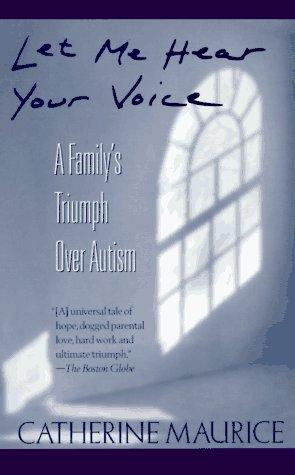
Let Me Hear Your Voice
by Catherine Maurice
★ Top 25 book of 1993 · #14 on Best Books of 1993
A mother recounts her daughter Anne-Marie's autism diagnosis after the child withdrew and lost words she had learned. The family endures false hopes and blame before intensive behavioral therapy helps their daughter.
Best for: Parents and caregivers seeking a personal account of facing a child's autism
Let Me Hear Your Voice is #14 on BookWard's Best Books of 1993, out of 36 1993 books that cleared our data bar.
What Let Me Hear Your Voice is about
Catherine Maurice tells the story of her daughter Anne-Marie, a delicate, graceful child who laughed, picked up words and learned to walk in her first year. Then she began to withdraw, lost some of her speech, cried without comfort and stopped noticing the people around her. Doctors diagnosed autism.
The family's search for help led through false hopes and so-called miracle cures, along with hints that they were somehow to blame. The book follows that struggle from a mother's point of view, ending with the intensive behavioral therapy that the publisher credits with saving her daughter. It will speak most to parents facing a new diagnosis, and to anyone who wants to understand what that experience feels like from the inside.
Let Me Hear Your Voice on the Best Books of 1993
Let Me Hear Your Voice came out in 1993. Of the 36 books first published in 1993 that met BookWard's data bar, it ranks #14 on our Best Books of 1993 list.
Why it made the list: 199 readers have shelved it on Open Library. The list ranks each year’s books on how many readers have picked them up, how highly readers rate them, and how many are reading them right now.
Nearby on the 1993 list
- The Fires of Heaven Robert Jordan, #12
- Nightmares & Dreamscapes Stephen King, #13
- Ageless Body, Timeless Mind Deepak Chopra, #15
- Mieko and the Fifth Treasure Eleanor Coerr, #16
See all Best Books of 1993 Best books by year
More years: Best Books of 1992 Best Books of 1994.
The numbers behind it
- Readers: 178 want to read it, 15 are reading it now and 6 have read it, according to Open Library.
| Signal | This book (0 to 100) | Weight |
|---|---|---|
| Reach | 47 | 55% |
| Reader love | 58 | 25% |
| Being read right now | 72 | 20% |
Questions about Let Me Hear Your Voice
When was Let Me Hear Your Voice published?
Let Me Hear Your Voice by Catherine Maurice was first published in 1993.
Was Let Me Hear Your Voice one of the best books of 1993?
Let Me Hear Your Voice is #14 on BookWard's Best Books of 1993, out of 36 1993 books that cleared our data bar. 199 readers have shelved it on Open Library.
Why is Let Me Hear Your Voice on the Best Books of 1993 list?
199 readers have shelved it on Open Library.
More of the best books of 1993
- The Giver Lois Lowry, #1
- The Scam Debashis Basu, #2
- Along Came a Spider James Patterson, #3
- A Suitable Boy Vikram Seth, #4
- Girl, Interrupted Susanna Kaysen, #5
- Understanding Comics Scott McCloud, #6
See the full Best Books of 1993, the Top 100, or new books on Rising.
How we know
This page uses public data: Open Library reader counts and ratings, and Wikipedia page views for recent years. The description is paraphrased from real source text. Rankings reflect reading interest, not quality or sales, and can be affected by data gaps. Lists update monthly.
Suited to adult readers and mature teens, especially parents, caregivers and anyone interested in autism.
Depends on the edition you pick.
A mother's urgent, unsparing account of fighting her daughter's autism. 51% taste match
 BookWard’s take
A mother's urgent, unsparing account of fighting her daughter's autism
Catherine Maurice writes about her daughter Anne-Marie's autism diagnosis and the long search for help that followed. This is a parent's own account, not a detached survey, and it reads more like a narrative than an analysis, which keeps it moving. The opening hooks fast: a bright toddler begins to withdraw, and the stakes are clear almost at once. The outlook is hopeful, since the book is framed around a family's progress, though it passes through real fear and false leads first. The rigor is mixed. It is firsthand testimony, so it is best read as a vivid case history that deserves checking against current autism research, not as settled science.
Short stretches of crisis and decision keep it moving, with calmer passages while therapy takes hold.
Plain, clear and emotionally direct, with moments of lyrical description around Anne-Marie.
The drive comes from a mother and daughter and what they go through, more than from plotting.
It is built around recovery and perseverance, though only after a long stretch of fear and disappointment.
A straightforward chronological memoir with no formal experiment.
The subject is grave and humor is scarce, with perhaps a flash of warmth at a family moment.
It deals with a child's suffering and a family's fear, handled with care and not exploited.
Fear, love, grief and determination run strongly through the book.
See all 50 dialsEvery position, side by side with this book
Where it lines up
- Character depthBookWard 8 · book 7
- EndingBookWard 8 · book 7
- Shock for effectBookWard 9 · book 8
Where it pulls apart
- Familiar tropesBookWard 10 · book 6
- Internal logicBookWard 10 · book 6
- Rigor (nonfiction)BookWard 9 · book 4
It opens on a thriving child who begins to retreat, so the central question is in front of you almost immediately.
Parent-memoir conventions such as the diagnosis scene and the quest for a cure are familiar, though the subject keeps them fresh.
The account follows a clear sequence of symptoms, doctors, treatments and outcomes, though it relies on one family's experience.
Short stretches of crisis and decision keep it moving, with calmer passages while therapy takes hold.
The story is framed around a family's progress and an answer to the diagnosis, so it closes with real resolution.
Maurice leans into feeling and a mother's love, so it runs warm, though the hard moments are not softened.
The darkness comes from real events, a devastating diagnosis and false hopes, not from effect-seeking.
It is one parent's testimony, valuable as lived experience, but not a controlled or systematic study of the condition.
The narration is intimate, urgent and unmistakably a particular mother's, not a generic case study.
It is led by the story of one child and her family, with ideas about treatment arising from that story.
A crisis-and-response structure keeps the stakes alive, though the therapy sections can settle into routine.
Plain, clear and emotionally direct, with moments of lyrical description around Anne-Marie.
The drive comes from a mother and daughter and what they go through, more than from plotting.
It is built around recovery and perseverance, though only after a long stretch of fear and disappointment.
A straightforward chronological memoir with no formal experiment.
The subject is grave and humor is scarce, with perhaps a flash of warmth at a family moment.
The language is accessible and the story easy to follow, though the subject matter weighs on you.
The story is told from the mother's perspective throughout.
It moves forward in time from early childhood through diagnosis and treatment.
This is a grounded, real-world account with nothing invented or otherworldly.
The focus stays on a small family circle, with doctors and therapists appearing as the story requires.
The scope is one household's struggle, though it speaks to a wider community of families.
Maurice's fears, guilt and resolve carry as much weight as the events around her.
The setting is the ordinary world of a family, doctors' offices and clinics, familiar to most readers.
Published in 1993, it is a record of an earlier period in autism care, not a present-day snapshot.
The parent's experience resonates widely, though treatment details reflect their time.
Maurice recounts her own experience plainly and does not set out to mislead.
The book argues for a position on treatment and against blaming parents, though it does not hide the stakes.
Anne-Marie and the family's daily struggles are rendered vividly without overdoing detail.
It reads as a story told in scenes, with analysis kept in the background.
This is first-person testimony from a parent living the events, with no pretense of distance.
A standalone memoir.
Some turns come through diagnoses and treatment, but it is not a book of reveals.
The material is emotionally hard and invites readers to question assumptions about autism and blame.
It deals with a child's suffering and a family's fear, handled with care and not exploited.
Fear, love, grief and determination run strongly through the book.
It touches on medical and professional controversy, though politics is not its focus.
The language is clear and standard throughout.
Maurice is openly opinionated about treatments and the people who offered them.
It tells a story set in the past, focused on what was done and what came of it.
Despite the setbacks, the book holds to belief in effort and the possibility of change.
Review written by BookWard, dial version 1, November 2026.
Who is Let Me Hear Your Voice right for?
Suited to adult readers and mature teens, especially parents, caregivers and anyone interested in autism. It deals with a young child's distress and a family's anguish, and its treatment views reflect the early 1990s.
The language is accessible and the story easy to follow, though the subject matter weighs on you.
It deals with a child's suffering and a family's fear, handled with care and not exploited.
Fear, love, grief and determination run strongly through the book.
Book CompanionLet Me Hear Your Voice: ideas, characters, themes
A mother recounts her daughter's autism diagnosis and her family's search for help, arguing for an intensive behavioral approach that she believes saved her child.
- A bright start, then withdrawal. Anne-Marie learns words, smiles and walks in her first year, then turns inward and loses some language.
- The diagnosis. Doctors give the family a devastating diagnosis of autism, which opens the long search for answers.
- False hopes and miracle cures. The family passes through a medical nightmare of false hopes and promised cures.
- Blame on parents. They face suggestions that Anne-Marie's autism was somehow their fault.
- Intensive behavioral therapy. The book presents intensive behavioral therapy as the approach that finally helped Anne-Marie.
Characters
Catherine Maurice
Narrator and mother
She tells the story in her own voice and drives the family's search for help.
Anne-Marie
Daughter
A beautiful, fragile child whose development changes and whose recovery is the book's center.
Themes
A parent pushing for answers and care when the system offers few.
The pain of being told, or fearing, that a child's condition is your fault.
The difficulty of telling real help from promises that fail.
The struggle to reach a child who has withdrawn, reflected in the title.
A family holding together and continuing through a long ordeal.
Discussion questions
- How does Maurice's position as a parent shape what she emphasizes and what she leaves out?
- What makes the difference between hope and false hope in her account?
- How does the book handle the question of parental blame?
- What should readers keep in mind when reading a 1993 account of treatment today?
- What does the title suggest about what the family wants most?
Personalize your Book Companion
This is the general edition. In BookWard, the Companion is written for you: your reading profile, your notes, and spoiler-safe to the page you are on.
Buy, listen or borrow Let Me Hear Your Voice
Each link opens a search for this book on that store, in a new tab.
Read on a device
Borrow
Reviews and community
If you liked Let Me Hear Your Voice
A former child star reclaims her story, on her terms
Diana, Her True StoryAndrew MortonThe 1992 biography that cracked open the royal fairy tale
John BarleycornJack LondonJack London's candid, argumentative memoir of drink and his long struggle
DemianHermann HesseA quiet boy, a mysterious classmate, and a search for self
Find your own best books
Add what you have read, rate it, and BookWard will recommend what to read next.
Free to start. No credit card needed.