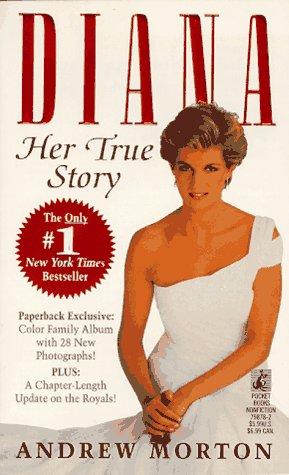
Diana, Her True Story
by Andrew Morton
★ Top 25 book of 1992 · #15 on Best Books of 1992
A royal biography that draws on cooperation from Diana's family and closest friends, plus private photographs. It sets her public image as a fairy-tale princess against an unhappy marriage, loneliness, illness, and her effort to build a new life.
Best for: Readers curious about the private struggles behind a famous public royal image
Diana, Her True Story is #15 on BookWard's Best Books of 1992, out of 43 1992 books that cleared our data bar.
What Diana, Her True Story is about
Andrew Morton's authorised biography of Diana, Princess of Wales, set out to show the distance between the woman the public adored and the life she was living in private. Published in 1992, it describes a marriage to Prince Charles that, it claims, was unhappy from the start, and it details her depression and her suicidal unhappiness. At publication Buckingham Palace denied any cooperation. It was later revealed that Diana herself was the main source behind the book's content.
The tone is intimate and sympathetic, with private photographs and the cooperation of family and close friends behind it. It suits readers curious about royal life, media image, and the loneliness that can sit inside great privilege.
Diana, Her True Story on the Best Books of 1992
Diana, Her True Story came out in 1992. Of the 43 books first published in 1992 that met BookWard's data bar, it ranks #15 on our Best Books of 1992 list.
Why it made the list: 228 readers have shelved it on Open Library. The list ranks each year’s books on how many readers have picked them up, how highly readers rate them, and how many are reading them right now.
Nearby on the 1992 list
- Monster Blood Robert Lawrence Stine, #13
- Band of Brothers Stephen E. Ambrose, #14
- Poor Things Alasdair Gray, #16
- All the Pretty Horses Cormac McCarthy, #17
See all Best Books of 1992 Best books by year
More years: Best Books of 1991 Best Books of 1993.
The numbers behind it
- Readers: 206 want to read it, 13 are reading it now and 9 have read it, according to Open Library.
| Signal | This book (0 to 100) | Weight |
|---|---|---|
| Reach | 51 | 55% |
| Reader love | 65 | 25% |
| Being read right now | 63 | 20% |
Questions about Diana, Her True Story
When was Diana, Her True Story published?
Diana, Her True Story by Andrew Morton was first published in 1992.
Was Diana, Her True Story one of the best books of 1992?
Diana, Her True Story is #15 on BookWard's Best Books of 1992, out of 43 1992 books that cleared our data bar. 228 readers have shelved it on Open Library.
Why is Diana, Her True Story on the Best Books of 1992 list?
228 readers have shelved it on Open Library.
More of the best books of 1992
- Welcome to Dead House Robert Lawrence Stine, #1
- The Secret History Donna Tartt, #2
- Snow Crash Neal Stephenson, #3
- The Indispensable Calvin and Hobbes Bill Watterson, #4
- The Shadow Rising Robert Jordan, #5
- The Artist's Way Julia Cameron, #6
See the full Best Books of 1992, the Top 100, or new books on Rising.
How we know
This page uses public data: Open Library reader counts and ratings, and Wikipedia page views for recent years. The description is paraphrased from real source text. Rankings reflect reading interest, not quality or sales, and can be affected by data gaps. Lists update monthly.
It suits adult readers and older teens interested in royal history and modern biography.
Depends on the edition you pick.
The 1992 biography that cracked open the royal fairy tale. 50% taste match
 BookWard’s take
The 1992 biography that cracked open the royal fairy tale
Andrew Morton's 1992 biography set out to replace the storybook image of Diana's marriage with a darker account, and it largely succeeded. It was later revealed that Diana herself was the main source, which gives the book its charge. It opens with a revelation rather than a slow build, and that immediacy is a real strength. The darkness feels earned, because the pain is tied to depression, loneliness and a marriage that was unhappy from the start. Rigor is where it is weakest: this is a sourced insider account, not a scholarly one, and a single voice shapes the whole telling. Morton writes with clear sympathy for his subject, and he doesn't pretend otherwise. Expect a sympathetic, fast-moving portrait that is as much a cultural event as a biography.
It moves briskly through marriage, illness and loneliness toward a reckoning, quicker than a typical biography.
It broke new ground by naming her unhappiness publicly, though the biography form itself is familiar.
The writing is plain and journalistic, built for clarity and momentum rather than ornament.
It is driven by one woman's inner life and relationships far more than by any external plot.
It is bleak in its depths of despair but ends on her courageous effort to build a new life.
A conventional biography that moves through her life in order, with no formal experiments.
The subject is painful and the tone serious, with little room for humour.
It deals with suicidal unhappiness and depression, which is dark but handled as fact.
Loneliness, despair and a struggle to recover make for an emotionally charged account.
See all 50 dialsEvery position, side by side with this book
Where it lines up
- Story or ideasBookWard 3 · book 3
- OpeningBookWard 10 · book 9
- PaceBookWard 8 · book 7
Where it pulls apart
- Familiar tropesBookWard 10 · book 4
- LengthBookWard 1 · book 5
- Internal logicBookWard 10 · book 6
It opens by promising shocking revelations behind the perfect image, which pulls the reader in at once and suits BookWard well.
The royal tell-all is a well-worn form, though this account's frankness about depression cuts against the usual fairy-tale gloss.
The account follows a clear life arc, but it rests on one principal source, so its internal consistency is only moderate.
It moves briskly through marriage, illness and loneliness toward a reckoning, quicker than a typical biography.
It broke new ground by naming her unhappiness publicly, though the biography form itself is familiar.
Diana is drawn in some depth through her illness, loneliness and struggle, though others appear mostly through her eyes.
It closes on her creating a new life for herself, a reasonably settled arc, though her story was still unfolding.
It leans sympathetic and emotional about her suffering, which is warmer than BookWard's restrained preference.
The darkness is tied to real events, depression and an unhappy marriage, so it feels earned rather than gratuitous.
It is sourced from family, friends and Diana herself, but it reads as an insider account rather than a rigorous investigation.
Morton writes clearly and sympathetically, a recognisable stance, though the prose is workmanlike rather than distinctive.
This is firmly story-led, following a life and a marriage rather than building an argument.
A biography tells events outright and explains feelings directly, so it sits far from scene-based showing.
Revelations keep arriving, but a long chronological account can slacken between the big disclosures.
The writing is plain and journalistic, built for clarity and momentum rather than ornament.
It is driven by one woman's inner life and relationships far more than by any external plot.
It is bleak in its depths of despair but ends on her courageous effort to build a new life.
A conventional biography that moves through her life in order, with no formal experiments.
The subject is painful and the tone serious, with little room for humour.
Accessible journalistic prose and a clear narrative make it an easy read.
The story is told largely through Diana's perspective, with friends and family offering supporting voices.
It follows her life broadly in sequence, from the wedding onward, with little time-shifting.
This is a real life told as fact, entirely grounded.
Family, friends and royal figures appear, giving it a moderately sized cast around one central person.
The focus stays on one marriage and one woman's private struggle, though the public stakes are large.
Its centre of gravity is Diana's feelings, illness and loneliness rather than outward action.
As a biography it relies on narration and reported accounts more than on dialogue.
The marriage is the heart of the book, though it is an unhappy one rather than a love story.
The royal household is a closed world most readers will find unfamiliar, though the figures are famous.
It is rooted in the early 1990s and the royal marriage of its day, not the present.
The story has endured as a cultural landmark, though the book is tied to its moment of publication.
Morton narrates plainly, but the account depends heavily on one interested source.
It draws a fairly clear line of sympathy toward Diana, with little weighing of the other side.
Descriptions serve the narrative and the people involved rather than rich scene-setting.
It reads as a narrative life story, not an analytical study.
Written in close sympathy with its subject, it is intimate rather than detached.
A standalone biography, later republished in a new edition.
The surprise comes in the revelations about the marriage, not in plot reversals.
It challenges the fairy-tale image of the royals, which unsettles rather than comforts.
It deals with suicidal unhappiness and depression, which is dark but handled as fact.
Loneliness, despair and a struggle to recover make for an emotionally charged account.
There is little humour here, and what exists is incidental.
Distress is largely emotional, with little physical violence on the page.
The marriage is examined mostly in terms of loneliness and unhappiness, not explicit content.
Royal institutions and public image are central, but this is not a political book in the usual sense.
The language is plain, clear journalism.
Morton takes Diana's side openly, so the narration is clearly opinionated.
It is mostly an account of what happened, with a modest glance toward her new life.
It punctures an idealised image yet ends on determination and renewal, landing near the middle.
Review written by BookWard, dial version 1, November 2026.
Who is Diana, Her True Story right for?
It suits adult readers and older teens interested in royal history and modern biography. It deals openly with suicidal unhappiness, depression and illness, which some readers may find distressing.
Accessible journalistic prose and a clear narrative make it an easy read.
It deals with suicidal unhappiness and depression, which is dark but handled as fact.
Loneliness, despair and a struggle to recover make for an emotionally charged account.
Distress is largely emotional, with little physical violence on the page.
Book CompanionDiana, Her True Story: ideas, characters, themes
Behind the polished public image of a storybook marriage lay a woman suffering from loneliness, illness and despair who fought to build a new life.
- The fairy tale cracks. The book contrasts Diana's celebrated public image with the unhappiness of her marriage from the very beginning.
- A source behind the curtain. Buckingham Palace denied any cooperation at publication, but it was later revealed that Diana was the main source.
- Depression and despair. It details her suicidal unhappiness and struggles with depression at a time when such things were rarely spoken of.
- The wedding day. Diana described her wedding day as the most emotionally confusing day of her life, a telling contrast with the public celebration.
- Building a new life. The account closes on her courageous effort to create a life for herself beyond the marriage.
Characters
Diana, Princess of Wales
Subject and principal source
The best-loved woman in the world, shown behind her smiling image as trapped, lonely and determined to recover.
Prince Charles
Diana's husband
The other half of the storybook marriage whose union the book presents as unhappy from the start.
Andrew Morton
Author
The writer who shaped Diana's account into a biography that became front-page news worldwide.
Themes
The gap between a public fairy tale and a private unhappiness.
Isolation experienced even at the centre of attention.
Depression and despair described openly and without euphemism.
How fame, institutions and the press shape what a person can say.
The effort to rebuild a life after despair.
Discussion questions
- Why do you think Diana chose to tell her story through a biographer rather than publicly?
- How does knowing she was the main source change how you read the book?
- Does the book's sympathy for Diana weaken or strengthen its claim to be the true story?
- What does it say about the era that these struggles were so shocking to the public?
- How does the contrast between public image and private reality still show up in celebrity today?
Personalize your Book Companion
This is the general edition. In BookWard, the Companion is written for you: your reading profile, your notes, and spoiler-safe to the page you are on.
Buy, listen or borrow Diana, Her True Story
Each link opens a search for this book on that store, in a new tab.
Read on a device
Borrow
Reviews and community
If you liked Diana, Her True Story
A mother's urgent, unsparing account of fighting her daughter's autism
Mercury and MeJim HuttonA partner's close-up of Freddie Mercury's private final years
This Is MeHayden PanettiereA former child star reclaims her story, on her terms
Lust for LifeIrving StoneA long, devoted life of Van Gogh, told as fiction
Find your own best books
Add what you have read, rate it, and BookWard will recommend what to read next.
Free to start. No credit card needed.