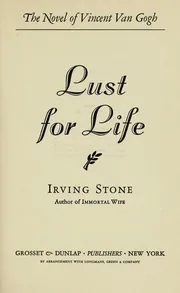
Lust for Life
by Irving Stone · 1934
Best suited to mature teens and adults who are comfortable with a long, serious book.
444 pages, about 7 to 10.5 hours.
A long, devoted life of Van Gogh, told as fiction. 46% taste match
The story
Lust for Life is a biographical novel by Irving Stone, first published in 1934. It follows the life of the painter Vincent van Gogh, who lived from 1853 to 1890, and presents his story as fiction built around the real events of his years. The book runs to roughly 444 pages in its typical edition, and it has appeared in more than a hundred editions since it first came out.
The story opens in the Netherlands, in the household of Vice-Admiral Johannes van Gogh, a senior officer in the Dutch Navy. From there it moves through the places that marked the painter's path, including Etten, The Hague, Nuenen, and Amsterdam, and then on to London and Paris. Later chapters take in Arles, St. Remy, and Auvers. Readers interested in novels about artists, in fiction drawn from the lives of real painters, or in the Dutch painter's world in the nineteenth century will find a long, place-by-place account of his life here.
Vice-admiral johannes van gogh, highest ranking officer in the dutch navy, stood on the stoep of his roomy, rent-free residence at the rear of the navy yard.
Characters
Vincent van Gogh
Setting
NetherlandsParisLondonAmsterdamEtten
Themes
PaintersBelletristische DarstellungFicciónVan Gogh, Vincent, 1853-1890Gogh, Vincent van (1853-1890)Malarze holenderscyPostimpresjonizm
- Want to read 141
- Reading now 16
- Read 15
Most people shelving it are saving it for later.
Of 172 readers who put it on a shelf, 82% want to read it, 9% are reading it now, 9% have finished it and 0% stopped before the end.
By the numbers
- The median edition runs 444 pages. Counting about 275 words a page and an adult reading pace of 250 words a minute, that is about 8.1 hours of reading.
- Open Library tracks 115 editions from 78 publishers, the earliest dated 1934 and the latest 2019, across 12 languages.
- On reader demand it ranks in the top 8% of the classic books in our catalog (8,749 of them).
- Libraries shelve it under Dewey 823.91 and Library of Congress class PS-3537.00000000.T669 Lu14.
 BookWard’s take
A long, devoted life of Van Gogh, told as fiction
Irving Stone's 1934 biographical novel follows Vincent van Gogh from the Netherlands through Etten, The Hague, Nuenen, London, Paris, Arles, St. Remy and Auvers. It is a long book, and the length is part of the deal: Stone walks the whole life place by place. The portrait of the man is its real strength. The painter is the entire subject, and his obsessions drive every chapter. The tone is warmer than I tend to like, with an openly sympathetic eye on its hero, and the telling leans on explanation and narration more than on scenes that play out on their own, where I would usually prefer to be shown. Still, a sustained, story-led account of a real artist's life gives the middle chapters a purpose that keeps them from drifting.
At 444 pages it covers an entire life across many cities, far longer than BookWard's taste for tight books.
It moves steadily from city to city, covering years at a measured clip, slower than BookWard's preference.
The subject is famous and the form is well worn, so the book is more devoted than inventive.
The prose leans rich and colorful, fitting a book about a painter, a bit more ornate than BookWard's middle position.
The events matter mainly because of what they do to one man, so character drives the book.
The arc follows struggle, poverty and isolation, so it leans bleak even with its devotion to art.
It runs in plain chronological order with no formal experiment.
It is a serious, intense book with little room for humor.
Poverty, isolation and mental anguish give the book a heavy, dark undertone.
The book is emotionally intense, with deep feeling attached to Vincent's work and struggles.
See all 50 dialsEvery position, side by side with this book
Where it lines up
- Character depthBookWard 8 · book 8
- EndingBookWard 8 · book 8
- Story or ideasBookWard 3 · book 3
Where it pulls apart
- LengthBookWard 1 · book 7
- Familiar tropesBookWard 10 · book 4
- OpeningBookWard 10 · book 6
At 444 pages it covers an entire life across many cities, far longer than BookWard's taste for tight books.
It builds into the story rather than grabbing at once, a gentler start than BookWard likes.
Biographical fiction about a tormented artist carries familiar shapes, though the real life keeps it from feeling formulaic.
The life follows one traceable path from place to place, so cause and effect stay clear and consistent.
It moves steadily from city to city, covering years at a measured clip, slower than BookWard's preference.
The subject is famous and the form is well worn, so the book is more devoted than inventive.
Van Gogh fills nearly every page, and his drives and failures are drawn in sustained, close detail that BookWard rewards.
A real life has a known end, and the book follows it through to a settled close, which suits BookWard.
The telling is openly sympathetic and emotional toward its hero, warmer than BookWard's taste for restraint.
Its dark moments come from the life itself and are tied to the painter's course, not added for effect.
It is a novel built on real events, so it dramatizes more than it documents.
Stone's committed, admiring narration has a recognizable stance, which BookWard values.
This is firmly story-led, a life told in sequence rather than an argument about art.
The narration tells readers what happened and what it meant more than it leaves to scene, against BookWard's grain.
A life told across many places can drift in the middle, though the changing settings keep renewing the story.
The prose leans rich and colorful, fitting a book about a painter, a bit more ornate than BookWard's middle position.
The events matter mainly because of what they do to one man, so character drives the book.
The arc follows struggle, poverty and isolation, so it leans bleak even with its devotion to art.
It runs in plain chronological order with no formal experiment.
It is a serious, intense book with little room for humor.
The writing is accessible, though the length and emotional weight ask for steady commitment.
The story stays with Vincent, giving a single point of view throughout.
It moves forward through the years in straight order.
It is grounded in real places, people and events.
Family, fellow artists and acquaintances across many cities widen the cast beyond a small circle.
The scope spans a lifetime and several countries, yet the focus stays on one man.
The book dwells on Vincent's drives, doubts and obsessions more than outward action.
Scenes carry a good deal of conversation between Vincent and those around him.
Relationships matter to the story but sit alongside art as a driving thread, not as the whole book.
A nineteenth-century Dutch, English and French artist's world will be unfamiliar to many readers.
It is set in the 1800s and published in 1934, so it looks firmly to the past.
Biographical novels about great artists tend to hold their audience across generations, and a life like Van Gogh's keeps drawing readers.
A straightforward narrator tells the life without playing games with the reader.
The book sides plainly with its painter, leaving little moral ambiguity.
Places and painting are rendered richly, which fits a book about seeing.
It is told as narrative fiction, not as analysis.
The telling is close and involved, not detached.
It stands alone as a single volume.
A real life offers few surprises, and the book follows its known course.
It asks readers to stay with suffering and obsession, which is more demanding than comforting.
Poverty, isolation and mental anguish give the book a heavy, dark undertone.
The book is emotionally intense, with deep feeling attached to Vincent's work and struggles.
Humor is minimal, so it reads as dry at most.
Violence is limited, with distress mostly turned inward.
Intimacy is part of a full life story but is not a focus.
Art and personal struggle drive the story, with politics in the background.
The language is plain and readable, with no heavy dialect.
The narration openly admires its subject, taking a clear stance rather than staying neutral.
It is a retrospective look at a life already lived.
Vincent's belief in his art and in people runs through the book, giving it an idealistic core.
Review written by BookWard, dial version 1, November 2026.
Who is Lust for Life right for?
Best suited to mature teens and adults who are comfortable with a long, serious book. It deals with mental anguish, poverty and isolation in a real life.
The writing is accessible, though the length and emotional weight ask for steady commitment.
Poverty, isolation and mental anguish give the book a heavy, dark undertone.
The book is emotionally intense, with deep feeling attached to Vincent's work and struggles.
Violence is limited, with distress mostly turned inward.
Book CompanionLust for Life: ideas, characters, themes
A biographical novel that retells Vincent van Gogh's life, place by place, as a story of devotion to art.
- A life told in places. The book moves through Etten, The Hague, Nuenen, Amsterdam, London, Paris, Arles, St. Remy and Auvers.
- Fiction built on fact. Stone dramatizes the real events of Van Gogh's years rather than writing a strict biography.
- A Dutch beginning. The story opens in the Netherlands, where Vincent's life begins.
- One subject, whole life. The novel covers the span from 1853 to 1890 centered on one painter.
- Long staying power. First published in 1934, it has appeared in more than a hundred editions.
Characters
Vincent van Gogh
Protagonist
The Dutch painter whose life the novel follows from the Netherlands to Auvers.
Themes
Painting as a calling that shapes and costs a whole life.
The distance between an artist and the people around him.
The material hardship that runs alongside creative work.
How each city leaves its mark on the painter's path.
Discussion questions
- How does moving from city to city shape the way Vincent's story feels?
- What does fiction add to a real life that a straight biography might not?
- Where does the novel invite sympathy for Vincent most strongly?
- How does the book show the link between hardship and creative work?
- Does the long, chronological telling help or slow the story?
Personalize your Book Companion
This is the general edition. In BookWard, the Companion is written for you: your reading profile, your notes, and spoiler-safe to the page you are on.
Buy, listen or borrow Lust for Life
Each link opens a search for this book on that store, in a new tab.
Read on a device
Borrow
Reviews and community
If you liked Lust for Life
A Vietnam nurse's war, and the homecoming that nearly breaks her
Mercury and MeJim HuttonA partner's close-up of Freddie Mercury's private final years
A tree grows in BrooklynBetty SmithA tender, unsentimental portrait of poverty and girlhood in Williamsburg
Memoirs of a GeishaArthur GoldenA geisha's life told in a rich, immersive, hard-won voice
Sources: Open Library.
Track Lust for Life and find your next favorite
Add it to your shelf, rate what you have read, and BookWard will recommend what fits you.
Free to start. No credit card needed.