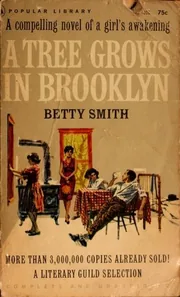
A tree grows in Brooklyn
by Betty Smith · 1943
It suits teen and adult readers who enjoy family stories and girlhood coming-of-age tales.
443 pages, about 7 to 10.5 hours.
A tender, unsentimental portrait of poverty and girlhood in Williamsburg. 51% taste match
The story
A Tree Grows in Brooklyn is a novel by Betty Smith, first published in 1943 and drawn in part from the author's own life. It is a coming-of-age story centered on Francie Nolan, a sensitive and idealistic girl growing up at the turn of the century. The book is shelved with young adult fiction and is regarded as a classic of American literature.
The story is set in the Williamsburg section of Brooklyn, New York, where the Nolan family lives in poverty. It follows Francie through her formative years and the everyday experiences of her family, with household life and the pressures of being poor running through the telling. The print edition runs to a median of 443 pages, and the book has appeared in 87 editions, including Spanish-language versions. Readers interested in family stories, girlhood, and the life of working-class neighborhoods in early twentieth-century New York will find a fitting match here.
Serene was a word you could put to Brooklyn, New York.
Setting
Brooklyn (New York, N.Y.)New York (State)New York
Themes
Teenage girlsGirlsClassic LiteraturePoor familiesBrooklyn (Nueva York, N.Y.)Muchachas adolescentesReading materialsPobres
- Want to read 302
- Reading now 19
- Read 64
Most people shelving it are saving it for later.
Of 385 readers who put it on a shelf, 78% want to read it, 5% are reading it now, 17% have finished it and 0% stopped before the end.
By the numbers
- The median edition runs 443 pages. Counting about 275 words a page and an adult reading pace of 250 words a minute, that is about 8.1 hours of reading.
- Open Library tracks 87 editions from 53 publishers, the earliest dated 1943 and the latest 2022, across 5 languages.
- On reader demand it ranks in the top 3% of the classic books in our catalog (8,749 of them).
- Libraries shelve it under Dewey 823.91 and Library of Congress class PS-3537.00000000.M326 T7.
 BookWard’s take
A tender, unsentimental portrait of poverty and girlhood in Williamsburg
Betty Smith's 1943 novel follows Francie Nolan, a sensitive, idealistic girl growing up poor in Williamsburg at the turn of the century. Its great strength is the depth of its characters: the Nolans feel lived-in, flawed and fully drawn. The reading is easy, and the prose stays plain and clear, which keeps the book warm and approachable. It is driven by character rather than plot, so the opening is a gentle immersion rather than a hook, and at 443 pages it sprawls well past what I tend to want from a tight book. It is also more hopeful and sentimental than I usually like, though the poverty is rendered with real honesty. A classic worth reading for the place and the people.
At 443 pages it is a long, unhurried novel, which sits well above BookWard's preference for tight, short books.
Told as a steady accumulation of formative years, it moves at a gentle pace, slower than BookWard's taste.
A semi-autobiographical coming-of-age story is a known shape, though its specific time and place feel fresh.
The prose is plain and clear rather than ornate, close to where BookWard sits.
It is driven by Francie's growth and her family's circumstances rather than plot mechanics, matching BookWard's lean toward character.
Despite poverty, the book is idealistic and ultimately uplifting, at or slightly above BookWard's hopeful lean.
It follows Francie's years in a conventional, chronological coming-of-age arc.
Moments of humor sit inside a mostly serious portrait of hardship, less funny than BookWard's leaning.
Poverty and cruelty are present but handled with tenderness, landing near BookWard's middle position.
Heartbreak and uplift run through the book, slightly more intense than BookWard's balance.
See all 50 dialsEvery position, side by side with this book
Where it lines up
- EndingBookWard 8 · book 7
- Shock for effectBookWard 9 · book 8
- Authorial voiceBookWard 9 · book 8
Where it pulls apart
- LengthBookWard 1 · book 7
- OpeningBookWard 10 · book 4
- Familiar tropesBookWard 10 · book 5
At 443 pages it is a long, unhurried novel, which sits well above BookWard's preference for tight, short books.
It opens by settling into a place and a family rather than grabbing you at once, a slower start than BookWard prefers.
Poverty and coming-of-age are familiar territory, but Williamsburg is rendered specifically, so it avoids tropes only partly.
The everyday world of the Nolans hangs together plainly and credibly, and BookWard values that consistency.
Told as a steady accumulation of formative years, it moves at a gentle pace, slower than BookWard's taste.
A semi-autobiographical coming-of-age story is a known shape, though its specific time and place feel fresh.
Francie and her family are drawn with real depth, which is exactly what BookWard rewards most.
A coming-of-age story that follows Francie through her formative years tends toward a settled close, resolved enough for BookWard.
It leans toward warmth and tenderness while staying honest about hardship, more sentimental than BookWard usually likes.
The hardship comes from the everyday pressures of being poor, not from darkness added for effect, which BookWard respects.
Smith's plain, humane telling gives the book a recognizable voice that BookWard appreciates.
This is a story-led novel built on a girl's years and her family, close to BookWard's story preference.
Life in Williamsburg is mostly conveyed through household scenes and incident rather than explained, in line with BookWard's taste.
Across its length, the episodic structure can drift in places, a little less sustained than BookWard likes.
The prose is plain and clear rather than ornate, close to where BookWard sits.
It is driven by Francie's growth and her family's circumstances rather than plot mechanics, matching BookWard's lean toward character.
Despite poverty, the book is idealistic and ultimately uplifting, at or slightly above BookWard's hopeful lean.
It follows Francie's years in a conventional, chronological coming-of-age arc.
Moments of humor sit inside a mostly serious portrait of hardship, less funny than BookWard's leaning.
The plain prose and clear storytelling make this an easy read, a touch easier than BookWard's middle position.
The story stays centered on Francie, giving it a mostly single viewpoint, narrower than BookWard's taste.
It moves forward through Francie's formative years in a linear way, more straightforward than BookWard's taste.
Grounded entirely in the real slums of Brooklyn, it is more realistic than BookWard's middle position.
The Nolan family and the neighborhood make for a moderate cast, a bit larger than BookWard's small-to-mid preference.
The focus is one girl, one family and one neighborhood, a more intimate scale than BookWard's middle position.
Francie's inner life and sensibility sit at the heart of the book, more inward than BookWard's balance.
Family life brings a fair amount of talk, though the book is balanced between speech and narration.
Romance is a minor thread beside family and girlhood, in line with BookWard's lighter preference.
Early twentieth-century Williamsburg will be unfamiliar to most readers, close to where BookWard sits.
A story of the turn of the century is firmly of the past, far from the present-day lean BookWard holds.
Its universal moments of family and growing up have kept it a classic, in line with BookWard's staying-power taste.
A straightforward, trustworthy telling of Francie's life, more reliable than BookWard's taste for the unreliable.
Poverty, family and resilience are rendered with compassion, giving it a fairly clear moral footing.
Rich evocation of time and place lifts the book above BookWard's middle position on description.
A single self-contained novel, more standalone than BookWard's middle position.
The pleasure is in living alongside the Nolans rather than in plot surprises, fewer twists than BookWard likes.
Poverty and hardship give it some weight, but its tone is humane and approachable, less challenging than BookWard's taste.
Poverty and cruelty are present but handled with tenderness, landing near BookWard's middle position.
Heartbreak and uplift run through the book, slightly more intense than BookWard's balance.
Humor is gentle and humane rather than broad, near BookWard's middle position.
Hardship is shown mostly through the daily pressures of poverty rather than violence, a little less than BookWard's middle.
Sexual content is minimal in this classic, below BookWard's middle position.
Poverty is part of the setting, but the book is not driven by politics, so it sits below BookWard's middle.
The language is fairly plain, with a touch of period and neighborhood flavor, near BookWard's middle position.
Narration leans on a neutral, observant telling more than commentary, a bit below BookWard's lean.
It looks back to a vanished era, which sits a little behind BookWard's forward-looking taste.
Francie's idealism and the book's hopeful spirit make it more idealistic than BookWard's middle.
Review written by BookWard, dial version 1, November 2026.
Who is A tree grows in Brooklyn right for?
It suits teen and adult readers who enjoy family stories and girlhood coming-of-age tales. It treats poverty and hardship honestly, so some readers may find parts of it sad.
The plain prose and clear storytelling make this an easy read, a touch easier than BookWard's middle position.
Poverty and cruelty are present but handled with tenderness, landing near BookWard's middle position.
Heartbreak and uplift run through the book, slightly more intense than BookWard's balance.
Hardship is shown mostly through the daily pressures of poverty rather than violence, a little less than BookWard's middle.
Book CompanionA tree grows in Brooklyn: ideas, characters, themes
A sensitive, idealistic girl comes of age in the poverty of Williamsburg, finding meaning in family and the life of her neighborhood.
- A girl at the center. The novel follows Francie Nolan through her formative years, so her growth gives the book its shape.
- Poverty as texture. The Nolan family lives in poverty, and household life and the pressures of being poor run through the telling.
- A specific time and place. It is set in the Williamsburg section of Brooklyn at the turn of the century, and the setting is a character in itself.
- Semi-autobiographical roots. Betty Smith drew the story in part from her own life, which lends it a lived-in honesty.
- A lasting classic. First published in 1943, it is regarded as a classic of American literature and has appeared in many editions.
Characters
Francie Nolan
Protagonist
A sensitive, idealistic girl whose formative years the novel follows.
The Nolan family
Francie's family
A poor family in Williamsburg whose daily experiences anchor the story.
Themes
Francie's growth from childhood toward adulthood across her formative years.
How being poor shapes daily life, choices and dignity for the Nolans.
The bonds and tensions that hold the Nolan household together.
Francie's sensitivity and hope in the face of hardship.
How Williamsburg and Brooklyn shape the people who live there.
Discussion questions
- How does the novel's setting in Williamsburg shape who Francie becomes?
- In what ways does poverty color the everyday life of the Nolan family?
- What makes Francie's idealism both a strength and a vulnerability?
- How does the book balance compassion with cruelty?
- Why has this story endured as a classic for so many readers?
Personalize your Book Companion
This is the general edition. In BookWard, the Companion is written for you: your reading profile, your notes, and spoiler-safe to the page you are on.
Buy, listen or borrow A tree grows in Brooklyn
Each link opens a search for this book on that store, in a new tab.
Read on a device
Borrow
Reviews and community
If you liked A tree grows in Brooklyn
A long, devoted life of Van Gogh, told as fiction
To Kill a MockingbirdHarper LeeWarm, funny and morally clear: a classic that earns its reputation
A Beautiful MindSylvia NasarA mathematician's genius and illness, told with a reporter's patience
I Shall Never Fall in LoveHari ConnerA Regency romance where two friends rethink what is expected of them
Sources: Open Library.
Track A tree grows in Brooklyn and find your next favorite
Add it to your shelf, rate what you have read, and BookWard will recommend what fits you.
Free to start. No credit card needed.