It is aimed at teen readers and has been widely read by them, but it suits older teens and adults better than young readers.
185 pages, about 3 to 4.5 hours.
A fake diary that has outlived its own claim to be real. 43% taste match
What it covers
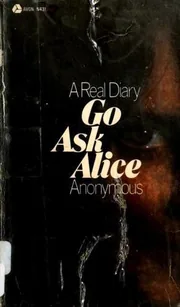
Go Ask Alice, first published in 1971, is a diary-format book credited to Beatrice Sparks. It follows an unnamed teenage girl, called Alice in the character list, whose entries span 1968 to 1970. At fifteen she begins using drugs, and her life shifts from an ordinary family home to running away and living on her own.
Her story moves through California, Colorado, Oregon, New York City, San Francisco, Berkeley and Coos Bay. Along the way the entries touch on LSD and heroin, bad trips, hitchhiking, homelessness, probation, a psychiatric hospital, and sexual abuse and rape. Friends and acquaintances such as Beth, Chris, Richie, Ted, Shelia, Doris and Babbie appear in her accounts. The diary opens with the writer describing herself as the happiest person alive.
The book was originally presented as a real diary kept by a teenager, but it is now generally regarded as a work of fiction written by Sparks, with Linda Glovach named by some as a co-author. Sparks later wrote other books styled as the diaries of troubled young people. Shelved with biography and memoir but also classed as young adult fiction, it has stayed in print since it first appeared and exists in dozens of editions of roughly 185 pages.
Yesterday I remember thinking I was the happiest person in the whole earth, in the whole galaxy, in all of God's creation.
Characters
AliceBethChrisRichieTedShelia
Setting
United StatesCaliforniaColoradoOregonNew York City
Period
196819691970
Themes
homelessnessbad tripspsychiatric hospitalschild prostitutionprobationhitchhikingchild sexual abuseheroin
- Want to read 681
- Reading now 47
- Read 124
Most people shelving it are saving it for later.
Of 852 readers who put it on a shelf, 80% want to read it, 6% are reading it now, 15% have finished it and 0% stopped before the end.
By the numbers
- The median edition runs 185 pages. Counting about 275 words a page and an adult reading pace of 250 words a minute, that is about 3.4 hours of reading.
- Open Library tracks 41 editions from 29 publishers, the earliest dated 1971 and the latest 2020, across 3 languages.
- On reader demand it ranks in the top 1% of the classic books in our catalog (8,749 of them).
- Libraries shelve it under Dewey 813.54 and Library of Congress class HV-5805.00000000.A.
 BookWard’s take
A fake diary that has outlived its own claim to be real
Go Ask Alice opens with a girl declaring herself the happiest person in the galaxy, and the diary form keeps you close to her voice from the first page. It was sold as a real teenager's diary, but it is now generally regarded as fiction written by Beatrice Sparks, which matters for how you read it. At 185 pages it is short and moves quickly, which suits a reader who likes a brisk, compact book. Where it strains is in how familiar it feels: the cautionary-tale shape is well worn, and the shock can seem engineered rather than earned. There is also little ambiguity here, since the book wants you to reach one conclusion and steers you firmly toward it. Read it as a document of its era's anxieties.
At about 185 pages it is brief and quick to get through, which fits BookWard's taste for tight books.
Short diary entries and a steady slide into trouble keep it moving at a fair clip, close to BookWard's liking.
The diary-of-a-doomed-teen format was striking in 1971, but its beats now read as well worn.
The diary style is plain and conversational, closer to everyday speech than ornament.
The downward slide is the engine, though Alice's changing state of mind is what you follow.
The book is bleak throughout, with the downward spiral outweighing any flicker of recovery.
Dated diary entries are a familiar format, with no real formal experiment beyond that.
There are light teenage moments early on, but the book is serious and grim overall.
Addiction, homelessness, abuse and rape make this a very dark book.
The diary is charged with panic, shame and longing, and it asks you to feel along with her.
See all 50 dialsEvery position, side by side with this book
Where it lines up
- PaceBookWard 8 · book 8
- LengthBookWard 1 · book 2
- EndingBookWard 8 · book 7
Where it pulls apart
- Familiar tropesBookWard 10 · book 2
- Internal logicBookWard 10 · book 4
- Rigor (nonfiction)BookWard 9 · book 2
At about 185 pages it is brief and quick to get through, which fits BookWard's taste for tight books.
The first entry opens on a girl calling herself the happiest person in the galaxy, a bright start that pulls you in.
The cautionary-tale arc of innocence, drugs and ruin is a familiar template, which sits poorly with BookWard.
Events follow a clear chain, but the book's claim to be a real diary undercuts how far its logic can be trusted.
Short diary entries and a steady slide into trouble keep it moving at a fair clip, close to BookWard's liking.
The diary-of-a-doomed-teen format was striking in 1971, but its beats now read as well worn.
Alice's voice is vivid, yet the people around her are sketched lightly, short of the depth BookWard prefers.
The diary builds to a firm close, which BookWard likes, though it is delivered with a heavy hand.
The book leans toward warning and pathos rather than restraint, so it sits on the sentimental side.
The abuse, overdoses and street life are there partly to alarm, which is the opposite of earned darkness.
Presented as a real diary but regarded as fiction, it is not a rigorous account of anything.
The teenage diary voice is distinct and chatty, though it reads as constructed rather than lived.
The story carries the book, but a clear message about drugs is plainly steering it.
Alice often states feelings and lessons outright in her entries, more than the book dramatizes them.
Short entries and constant escalation keep the middle from drifting.
The diary style is plain and conversational, closer to everyday speech than ornament.
The downward slide is the engine, though Alice's changing state of mind is what you follow.
The book is bleak throughout, with the downward spiral outweighing any flicker of recovery.
Dated diary entries are a familiar format, with no real formal experiment beyond that.
There are light teenage moments early on, but the book is serious and grim overall.
Short entries and plain language make it an easy read, though the subject is heavy.
Everything comes through Alice's own diary entries, so it is a single viewpoint.
Entries run in date order across 1968 to 1970, a straightforward line.
It is set in the ordinary world, with only hallucinations from drug use breaking from the real.
Alice dominates, with a handful of friends and acquaintances such as Beth, Chris and Richie around her.
It stays close to one girl's life, though her travels span several states and cities.
The diary dwells on Alice's feelings and fears at least as much as on what happens around her.
As a diary it mostly reports events and thoughts, with only occasional conversation.
Boyfriends and crushes appear, but romance is not the center of the story.
The drug scene, street life and psychiatric hospital are unfamiliar to most readers, which gives it pull.
It is rooted in the late 1960s and early 1970s, not the present day.
It has stayed in print for decades, yet its period details and questioned authenticity date it.
Alice is sincere on the page, but the book's claim to be a real diary makes the whole voice suspect.
The book wants you to reach one conclusion about drugs, leaving little ambiguity.
Entries stay light on scene-setting, favoring Alice's reactions over detailed surroundings.
Filed as memoir, it reads as personal narrative rather than analysis.
Written in the first person as one girl's private diary, it is as personal as a book gets.
It stands on its own, though Sparks later wrote other books styled as troubled teens' diaries.
Events turn sharply as Alice's life unravels, but the overall direction is easy to see coming.
The subject matter is hard to sit with, though the message itself is not subtle or provocative.
Addiction, homelessness, abuse and rape make this a very dark book.
The diary is charged with panic, shame and longing, and it asks you to feel along with her.
Humor is rare and mostly teenage lightness early in the diary.
Assault and abuse appear on the page, though not as relentless spectacle.
Rape, abuse and child prostitution are part of the story, treated as harm rather than titillation.
Social and political questions sit in the background behind the personal story.
The language is plain teenage speech, with no dialect or dense passages.
Alice's views and fears color every entry, and the book steers you toward a clear stance.
The book looks back at a spiral already unfolding, with little sense of a future to build.
The tone is dark and warning, with little belief that things will turn out well.
Review written by BookWard, dial version 1, November 2026.
Who is Go Ask Alice right for?
It is aimed at teen readers and has been widely read by them, but it suits older teens and adults better than young readers. It contains drug use, sexual abuse, rape and child prostitution, so it needs care.
Short entries and plain language make it an easy read, though the subject is heavy.
Addiction, homelessness, abuse and rape make this a very dark book.
The diary is charged with panic, shame and longing, and it asks you to feel along with her.
Assault and abuse appear on the page, though not as relentless spectacle.
Book CompanionGo Ask Alice: ideas, characters, themes
A teenage girl's diary charts her slide from an ordinary home into drug use, running away and ruin.
- A bright opening. The diary begins with Alice describing herself as the happiest person alive.
- The first dose. Her drug use starts after a soft drink laced with LSD is served in a dangerous party game.
- Running away. Alice leaves her family home and ends up living on her own across several states and cities.
- Deeper trouble. The entries touch on heroin, bad trips, hitchhiking, homelessness, probation and a psychiatric hospital.
- A contested origin. Presented as a real diary, it is now generally viewed as fiction written by Beatrice Sparks.
Characters
Alice
Diarist and narrator
An unnamed teenage girl whose entries record her spiral from comfortable home life into addiction.
Beth
Friend
One of the friends and acquaintances who appear in Alice's accounts.
Chris
Friend
A figure from Alice's circle who turns up in her diary.
Richie
Acquaintance
Another person from Alice's world who features in her entries.
Themes
How quickly a single choice can grow into dependence and take over a life.
The distance between the happy girl of the first entry and what she becomes.
Why it matters that a diary sold as real is now regarded as fiction.
How a book can use fear and example to push a message at young readers.
What leaving a loving home means, and what it costs.
Discussion questions
- Does it change how you read the diary to know it is regarded as fiction?
- How does the opening line set up everything that follows?
- Does the book persuade you through story, or does it feel like a lecture?
- What would a more restrained version of this story look like?
- Why do you think it has stayed in print for so long?
Personalize your Book Companion
This is the general edition. In BookWard, the Companion is written for you: your reading profile, your notes, and spoiler-safe to the page you are on.
Buy, listen or borrow Go Ask Alice
Each link opens a search for this book on that store, in a new tab.
Read on a device
Borrow
Reviews and community
If you liked Go Ask Alice
A child's-eye Holocaust fable that divides readers and historians
I Fell in Love with HopeLancaliA hospital heist, a found family, and a girl with sun eyes
Mercury and MeJim HuttonA partner's close-up of Freddie Mercury's private final years
Diana, Her True StoryAndrew MortonThe 1992 biography that cracked open the royal fairy tale
Sources: Open Library.
Track Go Ask Alice and find your next favorite
Add it to your shelf, rate what you have read, and BookWard will recommend what fits you.
Free to start. No credit card needed.