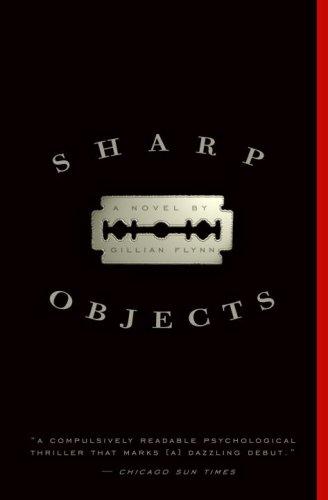
Sharp Objects
by Gillian Flynn
★ Top 25 book of 2006 · #14 on Best Books of 2006
Reporter Camille Preaker, just out of a psychiatric hospital, returns to her hometown to cover the murders of two preteen girls. Staying with her difficult family, she must face her own painful past while chasing the truth about the crimes.
Best for: Readers who like dark psychological mysteries with a haunted, troubled narrator
Sharp Objects is #14 on BookWard's Best Books of 2006, out of 47 2006 books that cleared our data bar.
What Sharp Objects is about
Camille Preaker is a journalist at a small Chicago newspaper, and she carries a history of carving words into her skin. Just out of the hospital after a bout of self-harm, she is sent by her editor, Frank Curry, to her hometown of Wind Gap, Missouri, to cover the murder of one girl and the disappearance of another.
She stays in her mother's Victorian mansion, with her stepfather and her 13-year-old half-sister, Amma. Her mother, Adora, is heiress to the town's pork-farming fortune, and the family's old wounds, including the early death of Camille's younger sister, begin to surface. A Kansas City detective investigating a possible serial killer draws her closer to the case. Gillian Flynn's 2006 debut is dark, claustrophobic and unsettling, a Southern Gothic mystery about trauma, abuse and the violence women can carry.
Sharp Objects on the Best Books of 2006
Sharp Objects came out in 2006. Of the 47 books first published in 2006 that met BookWard's data bar, it ranks #14 on our Best Books of 2006 list.
Why it made the list: 539 readers have shelved it on Open Library; readers rate it 3.8 out of 5 (33 ratings); 28 are reading it right now. The list ranks each year’s books on how many readers have picked them up, how highly readers rate them, and how many are reading them right now.
Nearby on the 2006 list
- Horus Rising Dan Abnett, #12
- The Road Cormac McCarthy, #13
- Cell Stephen King, #15
- Fablehaven Brandon Mull, #16
See all Best Books of 2006 Best books by year
More years: Best Books of 2005 Best Books of 2007.
The numbers behind it
- Readers: 436 want to read it, 28 are reading it now and 75 have read it, according to Open Library.
- Ratings: 3.8 out of 5 from 33 Open Library ratings.
| Signal | This book (0 to 100) | Weight |
|---|---|---|
| Reach | 79 | 55% |
| Reader love | 28 | 25% |
| Being read right now | 77 | 20% |
Questions about Sharp Objects
When was Sharp Objects published?
Sharp Objects by Gillian Flynn was first published in 2006.
Was Sharp Objects one of the best books of 2006?
Sharp Objects is #14 on BookWard's Best Books of 2006, out of 47 2006 books that cleared our data bar. 539 readers have shelved it on Open Library; readers rate it 3.8 out of 5 (33 ratings); 28 are reading it right now.
Why is Sharp Objects on the Best Books of 2006 list?
539 readers have shelved it on Open Library; readers rate it 3.8 out of 5 (33 ratings); 28 are reading it right now.
More of the best books of 2006
- The Sea of Monsters Rick Riordan, #1
- The Book Thief Markus Zusak, #2
- Half of a Yellow Sun Chimamanda Ngozi Adichie, #3
- The Boy in the Striped Pyjamas John Boyne, #4
- The Secret Rhonda Byrne, #5
- Mindset Carol S. Dweck, #6
See the full Best Books of 2006, the Top 100, or new books on Rising.
How we know
This page uses public data: Open Library reader counts and ratings, and Wikipedia page views for recent years. The description is paraphrased from real source text. Rankings reflect reading interest, not quality or sales, and can be affected by data gaps. Lists update monthly.
Best suited to adult readers and mature older teens.
Depends on the edition you pick.
A journalist goes home to Wind Gap and her own wounds. 71% taste match
 BookWard’s take
A journalist goes home to Wind Gap and her own wounds
Camille Preaker, a Chicago reporter with words carved into her skin, is sent back to Wind Gap, Missouri to cover the murders of two girls. The book gets going fast: the hook is immediate, and it stays on its feet through the middle without any real sag. The darkness feels earned rather than decorative, and the Southern Gothic domestic noir setting feels fresh against the usual thriller furniture. Camille is drawn with real depth, and her unreliable, wounded narration gives the book a distinct voice. It is bleaker and more claustrophobic than the hopeful stories I usually lean toward, and its restraint with sentiment is a strength.
A compact debut thriller that moves briskly without padding, which suits BookWard's preference for tight books.
Short chapters and a steady stream of revelations keep it moving, though the mood stays brooding rather than breathless.
Its focus on female violence and damaged femininity set it apart from the crime fiction and chick lit of its time.
The language is sharp and image-rich without turning ornate, somewhat more stylized than BookWard's middle.
The mystery drives events, but Camille's inner damage is what gives it weight.
The outlook is bleak, which sits well below BookWard's leaning toward hope.
The structure is a conventional investigation told in order, with memories threaded in.
There is dry, bitter wit in the narration, but the book is serious at heart.
Murder, self-harm and abuse make it a decidedly dark book.
The emotional register runs hot beneath a controlled surface.
See all 50 dialsEvery position, side by side with this book
Where it lines up
- SentimentBookWard 8 · book 8
- Authorial voiceBookWard 9 · book 9
- Story or ideasBookWard 3 · book 3
Where it pulls apart
- Familiar tropesBookWard 10 · book 7
- LengthBookWard 1 · book 3
- Internal logicBookWard 10 · book 8
A compact debut thriller that moves briskly without padding, which suits BookWard's preference for tight books.
A reporter with carved skin is sent to a town of murdered girls, so the pull starts at once, matching BookWard.
It works inside domestic noir and small-town mystery conventions but bends them with its Southern Gothic mood and female violence.
The mystery holds together on its own terms, with clues and motives that fit the story's psychology.
Short chapters and a steady stream of revelations keep it moving, though the mood stays brooding rather than breathless.
Its focus on female violence and damaged femininity set it apart from the crime fiction and chick lit of its time.
Camille and her family are drawn with real psychological detail, which BookWard rates highly.
The central mystery is resolved, though the emotional aftermath lingers, close to BookWard's taste for resolution.
It resists comfort and softness, treating family and trauma with a cold eye that BookWard admires.
The dark material serves the themes of abuse and trauma instead of existing only to disturb.
Camille's sardonic, self-lacerating narration gives the book a recognizable and distinctive voice.
This is firmly story-led, driven by a murder investigation and a family secret.
Backstory comes out through scenes, memories and encounters rather than lectures, in line with BookWard's taste.
The investigation and the family drama keep tightening, so the middle holds up.
The language is sharp and image-rich without turning ornate, somewhat more stylized than BookWard's middle.
The mystery drives events, but Camille's inner damage is what gives it weight.
The outlook is bleak, which sits well below BookWard's leaning toward hope.
The structure is a conventional investigation told in order, with memories threaded in.
There is dry, bitter wit in the narration, but the book is serious at heart.
It reads easily and quickly, though the subject matter is heavy.
Everything is filtered through Camille alone.
The story moves forward in time, with flashes of childhood memory along the way.
It is grounded in a realistic small Missouri town.
A manageable circle of family, townspeople and investigators, with a few central figures.
It stays intimate, centered on one family and one town.
Camille's thoughts, memories and self-image matter more than the external action.
Conversations carry much of the investigation and the family tension.
A relationship with the detective exists but is a minor thread beside the mystery and family.
A Southern Gothic Missouri pork town will be unfamiliar to many readers.
Set around the time it was written, so it reads as roughly contemporary.
Its themes of family, trauma and secrets give it lasting relevance.
Camille's damaged state and self-deception make her an unreliable guide.
Victims and perpetrators blur, and nobody is simply good or evil.
The heat, the mansion and the town are rendered in rich atmospheric detail.
It stands entirely on its own.
The mystery builds toward surprises that reframe what came before.
It is unsettling reading that pushes on discomfort rather than offering reassurance.
Murder, self-harm and abuse make it a decidedly dark book.
The emotional register runs hot beneath a controlled surface.
Any humor is dry and bitter, not broad.
There is sexual content connected to Camille's history and relationships.
Social issues sit in the background but are not the point.
The language is plain and accessible throughout.
Camille's narration is judgmental and colored by her bitter perspective.
The book is preoccupied with the past and how it still holds her.
It takes a cynical view of family, community and healing.
Review written by BookWard, dial version 1, November 2026.
Who is Sharp Objects right for?
Best suited to adult readers and mature older teens. It deals directly with child murder, self-harm, abuse and sexual content, which some readers may find distressing.
It reads easily and quickly, though the subject matter is heavy.
Murder, self-harm and abuse make it a decidedly dark book.
The emotional register runs hot beneath a controlled surface.
Book CompanionSharp Objects: ideas, characters, themes
A wounded journalist returns to her hometown to report on murdered girls and is forced to face the family history that scarred her.
- The assignment. Camille is sent from Chicago to Wind Gap to cover the death of one girl and the disappearance of another.
- The homecoming. She stays in her mother's Victorian mansion with her stepfather and young half-sister, among old tensions.
- The town. Wind Gap is dominated by Adora's family and its pork industry, and locals offer guarded information.
- The investigation. A Kansas City detective arrives to look into a possible serial killer, and Camille works alongside him.
- The personal stakes. Camille's own history of self-harm and loss shapes how she sees the victims and her family.
Characters
Camille Preaker
Narrator and journalist
A reporter at a small Chicago paper who returns to her hometown and carries a history of self-harm.
Adora
Camille's mother
The wealthy heiress of Wind Gap's central industry, with a troubled relationship to Camille.
Amma
Camille's half-sister
A 13-year-old who is manipulative and hides rebellious behavior from her mother.
Richard Willis
Detective
A Kansas City detective investigating the possibility of a serial killer.
Frank Curry
Camille's editor
Her boss, who supported her after her hospitalization and sends her to Wind Gap.
Themes
How women are shaped, judged and damaged by expectations and by other women.
How past pain lingers in the body and behavior long after the events themselves.
How harm can be hidden inside families and communities.
The pull and danger of returning to a place that formed you.
The way Camille's scars act as a private language of her history.
Discussion questions
- Why does Camille identify so strongly with the victims?
- How does the Wind Gap setting shape the mood and the mystery?
- What does the novel say about the bond between mothers and daughters?
- How reliable is Camille as a narrator, and where does she mislead herself?
- Why might Flynn have chosen to focus on female violence?
Personalize your Book Companion
This is the general edition. In BookWard, the Companion is written for you: your reading profile, your notes, and spoiler-safe to the page you are on.
Buy, listen or borrow Sharp Objects
Each link opens a search for this book on that store, in a new tab.
Read on a device
Borrow
Reviews and community
If you liked Sharp Objects
Four tight novellas about retribution, with no comfort offered
The Secret HistoryDonna TarttA murder told up front, and why it still grips
Dark PlacesGillian FlynnA cold-case thriller where a child survivor must question her memory
TweakNic SheffA raw, first-person account of meth addiction and relapse
Find your own best books
Add what you have read, rate it, and BookWard will recommend what to read next.
Free to start. No credit card needed.