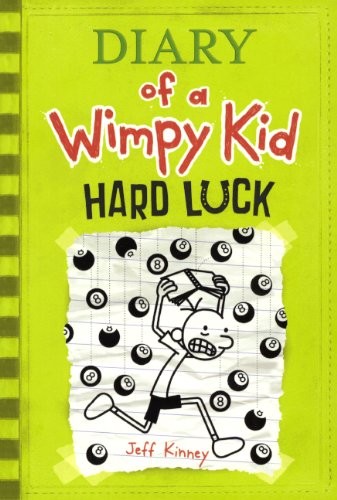
Hard Luck
by Jeff Kinney
★ Top 5 book of 2013 · #2 on Best Books of 2013
Greg Heffley is on a losing streak after his best friend Rowley ditches him, and making new middle school friends proves hard. He decides to let chance guide his choices, but may just end up with another hard-luck story.
Best for: Middle schoolers and reluctant readers who like funny diary-style stories
Hard Luck is #2 on BookWard's Best Books of 2013, out of 46 2013 books that cleared our data bar.
What Hard Luck is about
Greg Heffley is having a rotten run. His best friend, Rowley Jefferson, has dropped him, and making new friends in middle school is turning out to be much harder than Greg hoped. Rather than keep fighting his bad luck, he tries something different: he hands his decisions over to chance and sees where the dice land.
The story asks whether a roll of the dice can turn things around, or whether Greg is simply fated to be a hard-luck case. This is the eighth Diary of a Wimpy Kid book, from a series with more than 85 million books in print. It is a light, funny read for anyone who has ever felt that nothing is going their way.
Hard Luck on the Best Books of 2013
Hard Luck came out in 2013. Of the 46 books first published in 2013 that met BookWard's data bar, it ranks #2 on our Best Books of 2013 list.
Why it made the list: 1,068 readers have shelved it on Open Library; readers rate it 4.1 out of 5 (87 ratings); 65 are reading it right now. The list ranks each year’s books on how many readers have picked them up, how highly readers rate them, and how many are reading them right now.
It earns Being read right now.
Nearby on the 2013 list
- House of Hades Rick Riordan, #1
- Crown of Midnight Sarah J. Maas, #3
- The Screaming Staircase Jonathan Stroud, #4
See all Best Books of 2013 Best books by year
More years: Best Books of 2012 Best Books of 2014.
The numbers behind it
- Readers: 871 want to read it, 65 are reading it now and 132 have read it, according to Open Library.
- Ratings: 4.1 out of 5 from 87 Open Library ratings.
| Signal | This book (0 to 100) | Weight |
|---|---|---|
| Reach | 96 | 55% |
| Reader love | 70 | 25% |
| Being read right now | 96 | 20% |
Questions about Hard Luck
When was Hard Luck published?
Hard Luck by Jeff Kinney was first published in 2013.
Was Hard Luck one of the best books of 2013?
Hard Luck is #2 on BookWard's Best Books of 2013, out of 46 2013 books that cleared our data bar. 1,068 readers have shelved it on Open Library; readers rate it 4.1 out of 5 (87 ratings); 65 are reading it right now.
Why is Hard Luck on the Best Books of 2013 list?
1,068 readers have shelved it on Open Library; readers rate it 4.1 out of 5 (87 ratings); 65 are reading it right now.
More of the best books of 2013
- House of Hades Rick Riordan, #1
- Crown of Midnight Sarah J. Maas, #3
- The Screaming Staircase Jonathan Stroud, #4
- Unravel Me Tahereh Mafi, #5
- The Goldfinch Donna Tartt, #6
- Hopeless Colleen Hoover, #7
See the full Best Books of 2013, the Top 100, or new books on Rising.
How we know
This page uses public data: Open Library reader counts and ratings, and Wikipedia page views for recent years. The description is paraphrased from real source text. Rankings reflect reading interest, not quality or sales, and can be affected by data gaps. Lists update monthly.
It suits young readers, roughly the upper elementary and middle-school years, and reluctant readers in particular.
Depends on the edition you pick.
Greg Heffley bets his middle school luck on dice. 53% taste match
 BookWard’s take
Greg Heffley bets his middle school luck on dice
Hard Luck is the eighth Diary of a Wimpy Kid book, and it finds Greg without his best friend Rowley and scrambling for new company in middle school. His fix is to hand his decisions to chance. That premise keeps the book moving, and the pace is brisk: short diary entries, quick gags and cartoons carry the reader along, and it's about as tight a read as a book gets. The voice is the real draw. Greg's self-serving, oblivious narration is unmistakable, and he is an unreliable narrator in the best comic sense, never the hero he thinks he is. Familiar tropes are the weak spot, since the series formula and the middle-school humor feel well worn here. What's original lives in the format and the voice, not the plot. It rarely goes dark or heavy, so nothing in it is likely to shock anyone.
A short, fast-turning diary with drawings; it matches BookWard's love of tight books.
Brief entries and cartoons keep things moving at speed, edging past BookWard's already quick preference.
The diary-and-cartoon format is distinctive, but the eighth book in a series leans on its established formula.
The writing is plain and conversational, plainer than BookWard's middle-ground taste.
Greg's choices drive events, but they are the kind of schemes that fuel plot more than inner growth.
Greg's setbacks are comic and the tone is cheerful overall, matching BookWard's mild optimism.
A diary format with cartoons is a mild departure from convention, about on par with BookWard.
It is built to be funny from the first page, above even BookWard's humor-friendly taste.
The trouble is social embarrassment and bad luck, with nothing grim, so it is gentle.
Feelings stay light and comic, so it is more restrained than BookWard's moderate intensity.
See all 50 dialsEvery position, side by side with this book
Where it lines up
- LengthBookWard 1 · book 1
- Shock for effectBookWard 9 · book 9
- Authorial voiceBookWard 9 · book 9
Where it pulls apart
- Familiar tropesBookWard 10 · book 4
- Internal logicBookWard 10 · book 6
- OriginalityBookWard 9 · book 5
A short, fast-turning diary with drawings; it matches BookWard's love of tight books.
Greg's friendless start and the dice gimmick set the stakes in the first pages, a little short of BookWard's instant grab.
Middle-school friendship troubles and a scheming kid narrator are well-trodden ground, which cuts against BookWard's wish to avoid tropes.
Greg's chance-driven plan follows its own comic rules well enough, though it is not airtight like BookWard prefers.
Brief entries and cartoons keep things moving at speed, edging past BookWard's already quick preference.
The diary-and-cartoon format is distinctive, but the eighth book in a series leans on its established formula.
Greg is vivid but deliberately a self-centered type, so he is not drawn deeply the way BookWard likes.
Mostly played for laughs with only light warmth, so it stays fairly restrained, near BookWard's taste.
Nothing here leans on shock; the trouble comes from comic mishaps, which suits BookWard.
Greg's smug, oblivious narration is instantly recognizable and is the series' main strength, matching BookWard.
It is entirely story-led, built on Greg's schemes and mishaps, in line with BookWard's story preference.
Greg tells events in his own words, but gags are mostly shown in scenes and drawings, close to BookWard.
Short entries keep momentum through the whole book, close to BookWard's liking for sustained pace.
The writing is plain and conversational, plainer than BookWard's middle-ground taste.
Greg's choices drive events, but they are the kind of schemes that fuel plot more than inner growth.
Greg's setbacks are comic and the tone is cheerful overall, matching BookWard's mild optimism.
A diary format with cartoons is a mild departure from convention, about on par with BookWard.
It is built to be funny from the first page, above even BookWard's humor-friendly taste.
Large type, short entries and drawings make it very easy to read, easier than BookWard's usual pick.
Everything is seen through Greg alone, well below BookWard's taste for several viewpoints.
Diary entries run in a simple linear order, more straightforward than BookWard's mixed preference.
It is firmly grounded in everyday school and family life, more so than BookWard's balanced taste.
A modest circle of family and schoolmates surrounds Greg, in line with BookWard's smaller casts.
The stakes are one boy's social life and school days, far more intimate than BookWard's middle ground.
Greg narrates his own schemes and what happens around him, leaning toward outer action, a bit above BookWard.
The diary format means summaries and captions carry much of the story, so dialogue is lighter than BookWard likes.
Romance barely registers; the book's concern is friendship, so it sits below BookWard's middle.
A familiar suburban middle-school setting, more known than the unfamiliar settings BookWard enjoys.
It is set in the present day of its 2013 publication, in line with BookWard.
Kid humor and school anxieties age gently, though the book is anchored to its era, near BookWard's mid-high lean.
Greg misreads himself and others constantly, making him a strongly unreliable narrator, above BookWard's taste.
Right and wrong stay fairly clear even as Greg bends them, clearer than BookWard's preference for ambiguity.
Drawings do the describing and the text stays spare, much sparser than BookWard's middle ground.
Told in the first person through one boy's private journal, it is as personal as a book gets.
This is the eighth entry in a long-running series, though each volume reads as its own episode.
A light, comforting read that asks little of the reader, well toward the comfort end.
The trouble is social embarrassment and bad luck, with nothing grim, so it is gentle.
Feelings stay light and comic, so it is more restrained than BookWard's moderate intensity.
Gags are exaggerated and cartoonish, leaning broad compared with BookWard's mix of dry and broad.
Slapstick mishaps at most, so there is almost nothing of note on the page.
No sexual content in a book written for young readers.
Politics do not enter the picture; the book is about friends and school.
Plain, simple language throughout, making it far easier than BookWard's usual middle.
Greg's slanted, self-serving view colors everything he narrates, well above BookWard.
It is rooted in Greg's present-day troubles with little eye to past or future, near the middle.
Greg is self-interested and sly, though the book is not bitter, leaning a little cynical.
Review written by BookWard, dial version 1, November 2026.
Who is Hard Luck right for?
It suits young readers, roughly the upper elementary and middle-school years, and reluctant readers in particular. Content is mild, with slapstick mishaps and social embarrassment rather than anything heavy.
Large type, short entries and drawings make it very easy to read, easier than BookWard's usual pick.
The trouble is social embarrassment and bad luck, with nothing grim, so it is gentle.
Feelings stay light and comic, so it is more restrained than BookWard's moderate intensity.
Slapstick mishaps at most, so there is almost nothing of note on the page.
Book CompanionHard Luck: ideas, characters, themes
After losing his best friend, Greg Heffley tries to rebuild his luck and his social life by letting chance make his decisions.
- A friendship gone. Greg's best friend Rowley has ditched him, and the book opens with Greg adrift in middle school.
- The search for new friends. Finding a new circle in middle school proves hard, which drives much of Greg's behavior.
- Letting chance decide. Greg takes a leap of faith and turns his choices over to a roll of the dice.
- Diary format. The story comes as Greg's journal entries mixed with his own cartoon drawings.
- Part of a long series. This is book eight in the bestselling Diary of a Wimpy Kid series.
Characters
Greg Heffley
Narrator and main character
A middle schooler who is on a losing streak and tries to fix his fortunes.
Rowley Jefferson
Greg's former best friend
The friend who has ditched Greg, setting the book's problem in motion.
Themes
What it costs to lose a close friend and how hard it is to replace one.
Whether outcomes come from fate, dice or our own choices.
The pressure to find a place among classmates in middle school.
How Greg's view of himself differs from what the reader sees.
Discussion questions
- Is Greg's bad luck really luck, or does he cause it?
- Why might turning decisions over to chance feel appealing?
- How does the diary format shape how much we trust Greg?
- What makes finding new friends in middle school so hard?
- Would you want to see Greg and Rowley reconcile, and why?
Personalize your Book Companion
This is the general edition. In BookWard, the Companion is written for you: your reading profile, your notes, and spoiler-safe to the page you are on.
Buy, listen or borrow Hard Luck
Each link opens a search for this book on that store, in a new tab.
Read on a device
Borrow
Reviews and community
If you liked Hard Luck
Greg Heffley turns a Halloween bag of gummy worms into a film
Cabin FeverJeff KinneyGreg Heffley, a blizzard, and a very long holiday indoors
Big Nate Strikes AgainLincoln PeirceBig Nate's middle-school mayhem: fast, funny, and made for reluctant readers
The Ugly TruthJeff KinneyGreg Heffley meets puberty, and nobody laughs harder than the reader
Find your own best books
Add what you have read, rate it, and BookWard will recommend what to read next.
Free to start. No credit card needed.