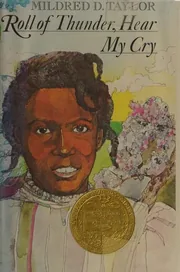
Roll of Thunder, Hear My Cry
by Mildred D. Taylor · 1976
It suits upper elementary and middle-grade readers and is widely used in classrooms.
276 pages, about 4.5 to 6.5 hours.
A Newbery-winning Depression-era story of one Black family's pride. 66% taste match
About the book
Roll of Thunder, Hear My Cry is a children's novel by Mildred D. Taylor, first published in 1976. It belongs to her series about the Logan family and follows her earlier novella Song of the Trees. The book won the Newbery Medal.
The story takes place in Mississippi during the Depression years of the 1930s. Cassie Logan is a young Black girl raised in a family that prizes independence and holds land of its own, which sets it apart from the sharecropper families nearby. Over one year marked by night riders, burnings, and a public humiliation inflicted on Cassie by a white girl, she comes to understand how race shapes life in the rural South and why her family's land matters so much to them. The novel deals with prejudice, race relations, and a family's effort to keep its pride and dignity. It runs about 276 pages and has appeared in around 70 editions.
"Little Man, would you come on? You keep it up and you're gonna make us late."
Setting
MississippiSouthern StatesEstados del Sur (Estados Unidos)
Period
1929
Themes
African AmericansRace relationsDepressionsPrejudicesBlacksChildren's storiesFicciónSouthern States
- Want to read 328
- Reading now 32
- Read 44
Most people shelving it are saving it for later.
Of 404 readers who put it on a shelf, 81% want to read it, 8% are reading it now, 11% have finished it and 0% stopped before the end.
By the numbers
- The median edition runs 276 pages. Counting about 275 words a page and an adult reading pace of 250 words a minute, that is about 5.1 hours of reading.
- Open Library tracks 70 editions from 43 publishers, the earliest dated 1976 and the latest 2023, across 4 languages.
- On reader demand it ranks in the top 1% of the modern books in our catalog (15,152 of them).
- Libraries shelve it under Dewey 808.0683 and Library of Congress class PZ-0007.00000000.T21723 Ro 1987.
Read it
A digital copy can be borrowed for free.
1 ebook provider carry it and a scanned copy is on the Internet Archive.
 BookWard’s take
A Newbery-winning Depression-era story of one Black family's pride
Roll of Thunder, Hear My Cry is a short, character-led novel that earns its weight. Set in 1930s Mississippi, it follows Cassie Logan through one year in which night riders, burnings and a public humiliation teach her what her family's land means. The characters are its great strength: the Logans feel like a real household, not a lesson. It avoids easy formulas by letting the stakes build from daily life rather than from set-piece drama. Sentiment stays restrained, since the book trusts events to carry feeling, and the shocks are earned rather than used for effect. At 276 pages it is modest in length, and the ending feels more settled than open. The pace is steadier than urgent, which suits a story that grows out of ordinary days, and in most respects it is the kind of book I'd happily recommend.
At 276 pages it is compact and lean, close to BookWard's taste for tight books.
The year unfolds at a measured, steady clip, slower than BookWard's preference for fast.
The subject is familiar territory, but the child's-eye view and the family's land at its heart give it its own shape.
The prose is clear and direct rather than ornate, a little plainer than BookWard's middle setting.
What happens matters because of who it happens to, so it leans character-driven, as BookWard does.
It is sober about the injustices it shows but holds onto the family's pride and endurance, edging hopeful.
It moves forward in a conventional year-long arc, plainer in form than BookWard's mild lean toward the unusual.
It is serious at heart, with warm moments, so it sits well toward the serious end, below BookWard's lighter lean.
It includes night riders and burnings, serious but handled for younger readers, a touch heavier than BookWard's middle.
The family's pride, fear and love give the book real emotional force, a notch above BookWard's setting.
See all 50 dialsEvery position, side by side with this book
Where it lines up
- SentimentBookWard 8 · book 8
- Shock for effectBookWard 9 · book 9
- Sagging middleBookWard 8 · book 8
Where it pulls apart
- OpeningBookWard 10 · book 6
- LengthBookWard 1 · book 3
- Familiar tropesBookWard 10 · book 8
At 276 pages it is compact and lean, close to BookWard's taste for tight books.
It opens on a family and a place rather than a jolt, building its pull gradually, which is gentler than BookWard prefers.
It handles a well-known historical subject through specific characters and daily detail, avoiding stock beats, which BookWard values.
Events follow cleanly from the family's circumstances and the town's tensions, so the cause and effect hold together as BookWard likes.
The year unfolds at a measured, steady clip, slower than BookWard's preference for fast.
The subject is familiar territory, but the child's-eye view and the family's land at its heart give it its own shape.
Cassie and the Logans are drawn as a fully lived-in family, matching BookWard's love of deeply drawn people.
The year closes with its central threads resolved, in line with BookWard's liking for resolution.
The book keeps feeling in check and lets events carry the weight, in step with BookWard's restraint.
Its darker moments come from the history it depicts and serve the story, which is exactly the earned darkness BookWard wants.
This is a novel, so the nonfiction rigor dial does not apply.
Taylor's plain, assured storytelling is recognizably hers, close to BookWard's taste for distinctive voice.
It is story-led, built on a family's year, and sits on BookWard's story side, though the ideas run deep.
Meaning is shown through scenes and what the family does, which suits BookWard's preference for showing.
The year-long structure keeps tension building without a slack stretch, as BookWard prefers.
The prose is clear and direct rather than ornate, a little plainer than BookWard's middle setting.
What happens matters because of who it happens to, so it leans character-driven, as BookWard does.
It is sober about the injustices it shows but holds onto the family's pride and endurance, edging hopeful.
It moves forward in a conventional year-long arc, plainer in form than BookWard's mild lean toward the unusual.
It is serious at heart, with warm moments, so it sits well toward the serious end, below BookWard's lighter lean.
Easy to follow and written for younger readers, though the subject asks for thought, so it sits a little below BookWard's mid-level effort.
The story stays with Cassie's perspective throughout, narrower than BookWard's taste for many viewpoints.
The story moves forward in order through one year, more linear than BookWard's middle position.
It is firmly grounded in the real, historical South.
The Logan family and their neighbors make a moderate, manageable cast, a bit larger than BookWard's middle.
The focus stays on one family and one community, keeping it intimate rather than epic.
Cassie's understanding grows alongside the events that shape it, balancing thought and action as BookWard does.
Conversation carries much of the story and the family's relationships, matching BookWard's liking for dialogue.
Romance plays no real part in this family story.
Depression-era Mississippi will be unfamiliar to many young readers, a setting BookWard enjoys.
The story is set in the 1930s, firmly in the past, unlike BookWard's lean toward the present.
Its themes of dignity, land and injustice keep it relevant decades after publication, which BookWard rates highly.
The narration is straightforward and trustworthy, well on the reliable side.
The book is clear about right and wrong in the injustice it shows, less ambiguous than BookWard's lean.
Setting and daily life are drawn with enough detail to feel real without lingering, near BookWard's middle.
This is fiction, so the nonfiction style dial does not apply.
The story is told close to Cassie's experience, more personal than detached.
It is part of Taylor's Logan family series, which suits BookWard's higher setting for series.
The tension comes from rising events rather than reversals, so surprises are few.
It confronts racism directly and asks readers to sit with it, leaning challenging as BookWard does.
It includes night riders and burnings, serious but handled for younger readers, a touch heavier than BookWard's middle.
The family's pride, fear and love give the book real emotional force, a notch above BookWard's setting.
Warm, gentle humor appears in family moments and stays on the dry, quiet side.
Violence and threat are present but handled with care for a young audience, near BookWard's middle.
There is no sexual content.
Race and power in the Jim Crow South are central to the story, so it is strongly political.
Period speech and Southern dialect appear in the dialogue, a little above BookWard's middle.
Taylor lets events speak and keeps the narration neutral, less opinionated than BookWard's lean.
It looks back at the 1930s, while speaking to later struggles over justice, so it faces the past more than forward.
The Logans keep their ideals under pressure, an idealist streak that fits BookWard.
Review written by BookWard, dial version 1, November 2026.
Who is Roll of Thunder, Hear My Cry right for?
It suits upper elementary and middle-grade readers and is widely used in classrooms. It deals directly with racism, humiliation, night riders and burnings, so younger readers may want an adult to talk it through with.
Easy to follow and written for younger readers, though the subject asks for thought, so it sits a little below BookWard's mid-level effort.
It includes night riders and burnings, serious but handled for younger readers, a touch heavier than BookWard's middle.
The family's pride, fear and love give the book real emotional force, a notch above BookWard's setting.
Violence and threat are present but handled with care for a young audience, near BookWard's middle.
Book CompanionRoll of Thunder, Hear My Cry: ideas, characters, themes
One Black family in 1930s Mississippi holds to its land, pride and independence while the people around it try to break them.
- A year that changes Cassie. The story spans one turbulent year in which Cassie learns how race shapes the world she lives in.
- Land as independence. The Logans own their land, which gives them a freedom their sharecropper neighbors cannot afford.
- Protected, then exposed. Cassie has grown up strong and sheltered, unaware that a white person could demand she act untrue to herself.
- Public humiliation. A white girl humiliates Cassie in public because she is Black, a moment that sharpens her understanding of prejudice.
- Part of a series. It follows the novella Song of the Trees and belongs to Taylor's Logan family series.
Characters
Cassie Logan
Young protagonist
An independent girl raised by a proud family, she comes to see what prejudice means over one hard year.
The Logan family
Cassie's family
A family determined to keep its integrity, pride and independence as Black landowners in the South.
Themes
Holding onto self-respect and humanity in the face of those who deny it.
Why owning a place of their own lets the Logans answer to no one.
How injustice shapes daily life in the rural South of the 1930s.
The love and shared resolve that help the Logans endure.
How Cassie moves from sheltered confidence to a clearer view of the world.
Discussion questions
- Why does owning land matter so much to the Logans, and how does it set them apart from their neighbors?
- How does the public humiliation change the way Cassie sees herself and the world?
- What does the book suggest about the difference between physical survival and the survival of the spirit?
- How does telling the story through a child's eyes shape what we notice and feel?
- Which moments show the Logans refusing to give up their humanity, and what do those choices cost them?
Personalize your Book Companion
This is the general edition. In BookWard, the Companion is written for you: your reading profile, your notes, and spoiler-safe to the page you are on.
Buy, listen or borrow Roll of Thunder, Hear My Cry
Each link opens a search for this book on that store, in a new tab.
Read on a device
Borrow
Reviews and community
If you liked Roll of Thunder, Hear My Cry
A quiet dystopia where art and truth collide
The War That Saved My LifeKimberly Brubaker BradleyA child's wartime escape from cruelty, told with quiet force
When I Was Puerto RicanEsmeralda SantiagoA Puerto Rican girlhood, and the move that rewrote it
Black BoyRichard WrightA hungry boy in the Jim Crow South, told without flinching
Sources: Open Library.
Track Roll of Thunder, Hear My Cry and find your next favorite
Add it to your shelf, rate what you have read, and BookWard will recommend what fits you.
Free to start. No credit card needed.