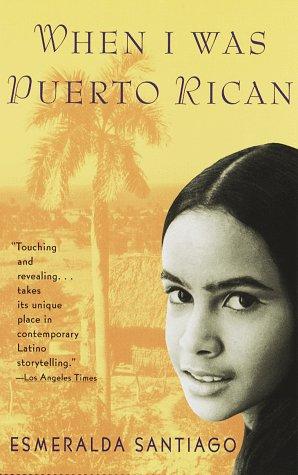
When I Was Puerto Rican
by Esmeralda Santiago
★ Top 25 book of 1994 · #16 on Best Books of 1994
Esmeralda Santiago recalls her childhood in rural Puerto Rico, filled with tenderness, poverty and family strife. When her mother moves the children to New York, she adapts to a new language and identity, eventually reaching Harvard.
Best for: Readers interested in immigrant coming-of-age memoirs and Puerto Rican culture
When I Was Puerto Rican is #16 on BookWard's Best Books of 1994, out of 42 1994 books that cleared our data bar.
What When I Was Puerto Rican is about
Esmeralda Santiago begins her memoir in Macún, a rural corner of Toa Baja, Puerto Rico, where she is the eldest child of parents whose relationship is under strain. When her brother Raymond is badly hurt in a bicycle accident, her mother moves the family to New York in search of better medical care. There Santiago meets racism, a new language, and the embarrassment of translating for her mother at the welfare center, while her mother, working in a factory, insists the children study.
The tone is warm, candid, and reflective, and the book is as much about identity and belonging as about migration. It will speak to readers interested in immigrant experience, family life under financial pressure, or growing up between two cultures.
When I Was Puerto Rican on the Best Books of 1994
When I Was Puerto Rican came out in 1994. Of the 42 books first published in 1994 that met BookWard's data bar, it ranks #16 on our Best Books of 1994 list.
Why it made the list: 296 readers have shelved it on Open Library. The list ranks each year’s books on how many readers have picked them up, how highly readers rate them, and how many are reading them right now.
Nearby on the 1994 list
- Lord of Chaos Robert Jordan, #14
- Six Easy Pieces Richard Phillips Feynman, #15
- Snow Falling on Cedars David Guterson, #17
- Walk Two Moons Sharon Creech, #18
See all Best Books of 1994 Best books by year
More years: Best Books of 1993 Best Books of 1995.
The numbers behind it
- Readers: 271 want to read it, 13 are reading it now and 12 have read it, according to Open Library.
| Signal | This book (0 to 100) | Weight |
|---|---|---|
| Reach | 64 | 55% |
| Reader love | 19 | 25% |
| Being read right now | 48 | 20% |
Questions about When I Was Puerto Rican
When was When I Was Puerto Rican published?
When I Was Puerto Rican by Esmeralda Santiago was first published in 1994.
Was When I Was Puerto Rican one of the best books of 1994?
When I Was Puerto Rican is #16 on BookWard's Best Books of 1994, out of 42 1994 books that cleared our data bar. 296 readers have shelved it on Open Library.
Why is When I Was Puerto Rican on the Best Books of 1994 list?
296 readers have shelved it on Open Library.
More of the best books of 1994
- Guess How Much I Love You Sam McBratney, #1
- Artificial Intelligence Stuart J. Russell, #2
- The Six Pillars of Self-esteem Nathaniel Branden, #3
- Long Walk to Freedom Nelson Mandela, #4
- Mercury and Me Jim Hutton, #5
- Men Are from Mars, Women Are from Venus John Gray, #6
See the full Best Books of 1994, the Top 100, or new books on Rising.
How we know
This page uses public data: Open Library reader counts and ratings, and Wikipedia page views for recent years. The description is paraphrased from real source text. Rankings reflect reading interest, not quality or sales, and can be affected by data gaps. Lists update monthly.
Suits teens and adults, and is often read in schools and book groups.
Depends on the edition you pick.
A Puerto Rican girlhood, and the move that rewrote it. 59% taste match
 BookWard’s take
A Puerto Rican girlhood, and the move that rewrote it
Santiago's memoir of childhood in rural Puerto Rico and her family's move to New York is a book about two kinds of belonging. The opening is a strong one, because the sensory world of Macún pulls you in from the first pages. The characters are rich as well: Mami, a force of nature, is drawn with real complexity alongside the narrator herself. The voice is distinctive, warm and unhurried, though I tend to prefer a brisker pace. The familiar tropes are where it gets most interesting. Immigrant stories lean on a known arc, yet the specific details here, from food to school humiliations to translating at the welfare office, keep it fresh. It closes with the Performing Arts High School audition, a clean landing for a first volume.
A single childhood volume, moderate in size, and not a sprawl; BookWard likes it economical.
A steady, episodic tempo that favors scenes and atmosphere over drive, a little slower than BookWard likes.
The material is common in the genre, yet the particulars and voice feel personal and fresh.
Clear and sensuous without being ornate, a little richer than BookWard's usual.
The book is driven by the narrator's growth and her bond with her mother more than plot.
Hardship is real, but the ending turns toward possibility and ambition.
A conventional chronological memoir arc from childhood to adolescence.
Moments of humor, especially in the culture clash, soften a mostly earnest tone.
Poverty and family strain appear, but the tone stays humane.
Emotionally rich, especially around family and displacement.
See all 50 dialsEvery position, side by side with this book
Where it lines up
- Authorial voiceBookWard 9 · book 9
- Story or ideasBookWard 3 · book 3
- Character depthBookWard 8 · book 9
Where it pulls apart
- Familiar tropesBookWard 10 · book 6
- Rigor (nonfiction)BookWard 9 · book 4
- LengthBookWard 1 · book 4
A single childhood volume, moderate in size, and not a sprawl; BookWard likes it economical.
The sights, sounds and tastes of rural Puerto Rico draw you in quickly, which suits BookWard.
Immigrant coming-of-age has a known shape, but specific detail keeps it from feeling stock, a near match for BookWard.
Events follow cause and effect cleanly, from family strain to the move to New York.
A steady, episodic tempo that favors scenes and atmosphere over drive, a little slower than BookWard likes.
The material is common in the genre, yet the particulars and voice feel personal and fresh.
Mami and the narrator are drawn with nuance and contradiction, which BookWard rewards.
The audition gives a defined close to this volume while leaving the larger story ahead.
Warm and affectionate, with some nostalgia, though it does not turn syrupy.
Hardship and humiliation come from lived circumstance rather than shock for effect, which BookWard values.
This is memoir, so it rests on memory and personal account rather than documentation.
A warm, recognizable narrative voice carries the whole book, matching BookWard's taste.
Story-led: life in scene and episode, with ideas surfacing through events, as BookWard prefers.
Culture and circumstance are shown through scenes rather than lectured, close to BookWard's taste.
Episodic structure holds interest across both the Puerto Rico and New York halves.
Clear and sensuous without being ornate, a little richer than BookWard's usual.
The book is driven by the narrator's growth and her bond with her mother more than plot.
Hardship is real, but the ending turns toward possibility and ambition.
A conventional chronological memoir arc from childhood to adolescence.
Moments of humor, especially in the culture clash, soften a mostly earnest tone.
Accessible and readable, an easy book to enter; BookWard is happy with that.
One narrator throughout, telling her own story.
Told in straightforward chronological order.
Firmly grounded, a real childhood in real places.
A sizable family and community, but centered on a few people.
Intimate: one girl, one family, one household's upheaval.
Leans toward the narrator's inner experience of change and displacement.
Spoken exchanges appear regularly but the telling is mostly narrated.
Romance is minor here; family is the center.
Rural Puerto Rico and 1960s-era New York are unfamiliar to many readers, rendered vividly.
Set in the past, in the narrator's childhood decades ago.
Themes of migration, language and identity keep it relevant years after publication.
A memoirist telling her own story, reliable in intent.
Judgments about family and circumstance are mostly clear, with some complexity around her parents.
Rich sensory detail of food, landscape and sound is a hallmark.
Narrative memoir rather than analysis.
Deeply personal, first-person account from within.
The first of three installments, so it opens a larger story.
Events unfold naturally rather than through surprises.
Touches poverty, racism and displacement without being punishing.
Poverty and family strain appear, but the tone stays humane.
Emotionally rich, especially around family and displacement.
Humor tends to be gentle and observational.
Little on-page violence beyond a sibling's serious accident.
Minimal sexual content in this volume.
Colonial and cultural tension are present but not the focus.
Mostly plain English, with some Spanish flavor woven in.
The narrator's perspective and feelings color the telling.
A backward look at childhood, with an eye toward a future opening up.
Rooted in realism about hardship, but leaning toward belief in education and ambition.
Review written by BookWard, dial version 1, November 2026.
Who is When I Was Puerto Rican right for?
Suits teens and adults, and is often read in schools and book groups. It touches poverty, racism, family conflict and a child's serious injury.
Accessible and readable, an easy book to enter; BookWard is happy with that.
Poverty and family strain appear, but the tone stays humane.
Emotionally rich, especially around family and displacement.
Little on-page violence beyond a sibling's serious accident.
Book CompanionWhen I Was Puerto Rican: ideas, characters, themes
A girl's childhood in rural Puerto Rico and her family's move to New York show how identity bends when language, home and expectation change.
- Life in Macún. The book opens in a rural sector of Toa Baja, rich in sensory detail and family tension.
- A family under strain. Her parents' relationship is damaged by suspicion, setting up the household's upheaval.
- The reason to move. After her brother Raymond is badly injured in a bicycle accident, her mother decides to move to New York for better medical care.
- Learning a new world. In New York the children face racism and a new language, and the narrator sometimes translates for her mother.
- Education as a way out. Their mother insists they study so they will not have to work in a factory, leading to the closing audition for Performing Arts High School.
Characters
Esmeralda
Narrator and eldest child
The girl whose growth from Puerto Rico to New York anchors the book.
Mami
Her mother
A strong-willed force who uproots the family and presses her children to study.
Raymond
Her sibling
His serious bicycle injury prompts the move to New York.
Themes
Who she is changes as language, place and culture shift around her.
English is both barrier and tool, especially when she translates for her mother.
Love, strain and sacrifice shape every major decision.
Schooling is framed as the route to a different life.
She moves between two cultures without fully fitting either.
Discussion questions
- How does the narrator's sense of home change from Macún to New York?
- What does it cost a child to translate for a parent?
- How does Mami's insistence on education shape the children's choices?
- Which details of rural life stayed with you, and why?
- What does the audition ending suggest about her future?
Personalize your Book Companion
This is the general edition. In BookWard, the Companion is written for you: your reading profile, your notes, and spoiler-safe to the page you are on.
Buy, listen or borrow When I Was Puerto Rican
Each link opens a search for this book on that store, in a new tab.
Read on a device
Borrow
Reviews and community
If you liked When I Was Puerto Rican
A Limerick childhood told with a child's eyes and no self-pity
The War That Saved My LifeKimberly Brubaker BradleyA child's wartime escape from cruelty, told with quiet force
All Creatures Great and Small (All Creatures Great and Small #1-2)James HerriotA country vet's Yorkshire rounds, funny and tender in turns
Roll of Thunder, Hear My CryMildred D. TaylorA Newbery-winning Depression-era story of one Black family's pride
Find your own best books
Add what you have read, rate it, and BookWard will recommend what to read next.
Free to start. No credit card needed.