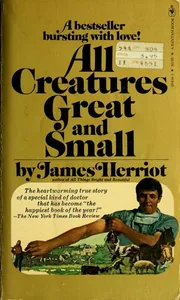
All Creatures Great and Small (All Creatures Great and Small #1-2)
by James Herriot · 1972
Suits adults and older children who enjoy gentle, animal-centered stories.
445 pages, about 7 to 10.5 hours.
A country vet's Yorkshire rounds, funny and tender in turns. 49% taste match
What it covers
All Creatures Great and Small is a memoir by James Herriot, first published in 1972. It follows the author as a young veterinarian beginning his working life in rural Yorkshire, England. The book belongs to the biography and memoir shelf and takes veterinary medicine as its subject, drawing on Herriot's own years of practice.
Herriot treats animals of every size across the remote Yorkshire Dales, from the smallest pets to the largest farm stock, and the stories come from the daily rounds of a country vet. Some visits are sad, such as a call on an elderly man whose ailing dog is his only companion. Others are lighter, such as the repeated visits to Tricki Woo, a pampered Pekinese who gives parties and has his own stationery. The farmers he serves, many of them poor, also appear throughout.
The book opens with Herriot standing in a snowy doorway, discovering that practice in the field has little in common with what his training described. This volume collects the first two books in the All Creatures Great and Small series, and it runs to roughly 445 pages in its typical edition.
They didn't say anything about this in the books, I thought, as the snow blew in through the gaping doorway and settled on my naked back.
Characters
James Herriot
Setting
EnglandYorkshire
Themes
VeterinariansBiographyHerriot, james, 1916-1995VétérinairesBiographiesVeterinarians, biographyVeterinary medicine
- Want to read 259
- Reading now 22
- Read 22
Most people shelving it are saving it for later.
Of 303 readers who put it on a shelf, 85% want to read it, 7% are reading it now, 7% have finished it and 0% stopped before the end.
By the numbers
- The median edition runs 445 pages. Counting about 275 words a page and an adult reading pace of 250 words a minute, that is about 8.2 hours of reading.
- Open Library tracks 30 editions from 17 publishers, the earliest dated 1972 and the latest 2004, across 2 languages.
- On reader demand it ranks in the top 5% of the classic books in our catalog (8,749 of them).
- Libraries shelve it under Dewey 636.0890924 and Library of Congress class SF-0613.00000000.H44 A3 1992b.
 BookWard’s take
A country vet's Yorkshire rounds, funny and tender in turns
Herriot's memoir gathers a young vet's early years in the Yorkshire Dales, and its pull is the voice. The warmth and dry amusement are unmistakably his. The sentiment runs a little more tender than I usually like, though the farm stories stay grounded. At 445 pages it is long, a stretch for a book I'd prefer tight, but the episodic structure keeps any one visit short. The snowy doorway opening pulls you in right away. It is an easygoing, humane read about work, animals and the farmers who depend on them, and it earns its affection without much strain.
At 445 pages it is long for a run of short anecdotes, well past the tight length BookWard prefers.
Vignettes move at a gentle, unhurried clip, slower than BookWard's brisk preference.
A vet's memoir of Yorkshire practice is a familiar form, though Herriot's stories feel fresh and his own.
The writing is clear and conversational with occasional vivid description, plain-leaning and near BookWard's middle.
Stories hinge on the people and animals Herriot meets more than on a driving plot, a good fit.
Even the sad visits sit inside an affectionate, life-loving outlook, more hopeful than BookWard's measured view.
A conventional run of anecdotes in order, simpler in form than BookWard's mildly adventurous leaning.
Pampered Tricki Woo, with parties and his own stationery, shows how much humor runs through it, above BookWard's level.
Some visits are sad, but the overall tone stays gentle, about at or below BookWard's middle.
Affection, grief and humor all come through, producing real feeling without melodrama, near BookWard's range.
See all 50 dialsEvery position, side by side with this book
Where it lines up
- Authorial voiceBookWard 9 · book 9
- Character depthBookWard 8 · book 7
- Shock for effectBookWard 9 · book 8
Where it pulls apart
- Familiar tropesBookWard 10 · book 4
- LengthBookWard 1 · book 6
- Rigor (nonfiction)BookWard 9 · book 3
At 445 pages it is long for a run of short anecdotes, well past the tight length BookWard prefers.
It opens on Herriot in a snowy doorway, a scene that draws you in quickly, close to BookWard's taste.
The country-vet-among-farmers setup is familiar territory, so it leans on well-worn rural charm more than BookWard likes.
The episodes follow the plain cause and effect of veterinary work, coherent and easy to trust.
Vignettes move at a gentle, unhurried clip, slower than BookWard's brisk preference.
A vet's memoir of Yorkshire practice is a familiar form, though Herriot's stories feel fresh and his own.
Farmers, owners and animals are drawn with affection and quirks, giving the cast real depth, in line with BookWard.
Episodic stories close their own visits neatly, giving satisfying resolution without one grand climax.
Warmth and tenderness are central, so it runs more sentimental than BookWard's restrained taste, though it avoids mush.
The sad scenes, like the old man's dying dog, feel earned rather than staged, matching BookWard.
This is memoir and anecdote, not argument or evidence, so it is anecdotal where BookWard wants rigor.
Herriot's wry, affectionate narration is distinctive and instantly recognizable, squarely what BookWard prizes.
It is entirely story-led, built from incidents and encounters rather than ideas, matching BookWard's preference.
Things are shown through visits and scenes rather than lectured, close to BookWard's taste.
Episodic structure keeps each visit fresh, though the length means some stretches feel gentler than others.
The writing is clear and conversational with occasional vivid description, plain-leaning and near BookWard's middle.
Stories hinge on the people and animals Herriot meets more than on a driving plot, a good fit.
Even the sad visits sit inside an affectionate, life-loving outlook, more hopeful than BookWard's measured view.
A conventional run of anecdotes in order, simpler in form than BookWard's mildly adventurous leaning.
Pampered Tricki Woo, with parties and his own stationery, shows how much humor runs through it, above BookWard's level.
Plain, readable and welcoming, it asks little effort, easier than BookWard typically seeks.
Everything is told through Herriot alone, a single viewpoint where BookWard enjoys more.
The stories follow his early practice in order, linear compared with BookWard's occasional taste for shifting time.
It is a real memoir of ordinary working life, firmly grounded.
A steady stream of farmers, owners and animals fills the pages, a somewhat larger cast than BookWard's usual.
Life is confined to daily rounds in the Dales, intimate rather than epic.
Most of the book is visits, treatments and encounters, leaning toward outer action over inner reflection.
Talk with farmers and owners carries many scenes, close to BookWard's lean toward dialogue.
Romance is not the subject here, which stays on practice, animals and the people he serves.
A 1930s-era Yorkshire farming world will feel unfamiliar to most readers, close to BookWard's taste for the new.
It looks back on a vanished rural way of life, far from the present day BookWard leans toward.
Its warmth and affection for animals have kept it loved for decades, matching BookWard's taste.
Herriot tells his own story plainly and honestly, a reliable guide where BookWard allows more doubt.
Right and wrong are rarely murky here; kindness and care for animals are clear, plainer than BookWard's taste.
Dales landscape, weather and animals are described with generous, vivid detail, richer than BookWard's mid-point.
It is told as story and anecdote rather than analysis, firmly narrative.
Everything is filtered through Herriot's own experience, as personal as nonfiction gets.
This volume collects the first two books of a continuing series, so it sits inside a larger run.
Episodes are charming but rarely turn on surprises, fewer twists than BookWard likes.
It is a comforting read, easing you along rather than testing you, more reassuring than BookWard's usual.
Some visits are sad, but the overall tone stays gentle, about at or below BookWard's middle.
Affection, grief and humor all come through, producing real feeling without melodrama, near BookWard's range.
The humor is good-natured and gentle, leaning a little dry in its understatement.
Animal illness and veterinary work appear, but little violence is dwelt upon.
Sexual content is essentially absent from this warm, family-friendly memoir.
Politics barely registers; the focus stays on animals, farmers and daily work.
Yorkshire speech adds flavor in places but the book stays easy to read, near BookWard's middle.
Herriot's own views and affections are woven through the telling, more opinionated than neutral.
It looks back to a bygone rural life rather than forward, as memoir typically does.
Its love of animals and decent working people is warm and idealistic, a bit above BookWard's level.
Review written by BookWard, dial version 1, November 2026.
Who is All Creatures Great and Small (All Creatures Great and Small #1-2) right for?
Suits adults and older children who enjoy gentle, animal-centered stories. It includes animal illness, suffering and death, which may upset sensitive young readers.
Plain, readable and welcoming, it asks little effort, easier than BookWard typically seeks.
Some visits are sad, but the overall tone stays gentle, about at or below BookWard's middle.
Affection, grief and humor all come through, producing real feeling without melodrama, near BookWard's range.
Animal illness and veterinary work appear, but little violence is dwelt upon.
Book CompanionAll Creatures Great and Small (All Creatures Great and Small #1-2): ideas, characters, themes
A young vet learns that real country practice looks nothing like his training, and comes to love the animals and farmers it serves.
- Training meets reality. The opening scene in a snowy doorway shows how far veterinary school sits from rural Yorkshire practice.
- Animals of every size. Herriot treats everything from small pets to large farm stock across the remote Dales.
- Sad calls. Some visits are heartbreaking, such as the elderly man whose very ill dog is his only companion.
- Lighter calls. Tricki Woo, a pampered Pekinese who gives parties and has his own stationery, brings comic relief.
- Poor but devoted farmers. Farmers scrape together meager earnings to get proper care for their working animals.
Characters
James Herriot
Narrator and young veterinarian
He recounts his early working life treating animals across the Yorkshire Dales.
Tricki Woo
Pampered Pekinese
An overfed dog who throws parties and has his own stationery, visited repeatedly by Herriot.
The old man in the village
Owner of an ailing dog
An elderly man whose very ill dog is his only friend and companion.
Themes
Care for animals and the people who depend on them drives nearly every story.
The rhythms and hardships of Yorkshire farming shape each visit.
Herriot discovers what his calling demands in practice rather than theory.
Comic and sad episodes sit side by side, making both land harder.
Vet, farmers and villagers rely on one another in a small country world.
Discussion questions
- How does the gap between veterinary school and real practice shape Herriot's early experience?
- Why do the sad visits, like the old man and his dog, hit as hard as they do?
- What role does humor, including Tricki Woo, play in balancing the heavier stories?
- How does Herriot portray the farmers who stretch their money to care for their animals?
- Does the episodic structure strengthen or weaken the book over 445 pages?
Personalize your Book Companion
This is the general edition. In BookWard, the Companion is written for you: your reading profile, your notes, and spoiler-safe to the page you are on.
Buy, listen or borrow All Creatures Great and Small (All Creatures Great and Small #1-2)
Each link opens a search for this book on that store, in a new tab.
Read on a device
Borrow
Reviews and community
If you liked All Creatures Great and Small (All Creatures Great and Small #1-2)
A chatty orphan girl, a mistaken arrival, and a farm that changes
BoyRoald DahlDahl's boyhood, told as sharp, funny, unsentimental anecdotes
When I Was Puerto RicanEsmeralda SantiagoA Puerto Rican girlhood, and the move that rewrote it
The Quiet GentlemanGeorgette HeyerA Regency homecoming where the charming surface hides a murder plot
Sources: Open Library.
Track All Creatures Great and Small (All Creatures Great and Small #1-2) and find your next favorite
Add it to your shelf, rate what you have read, and BookWard will recommend what fits you.
Free to start. No credit card needed.