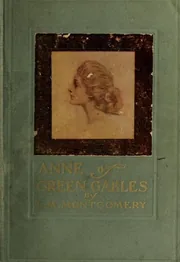
Anne of Green Gables
by Lucy Maud Montgomery · 1908
It suits children and adults alike, and reads comfortably from the middle grades up.
309 pages, about 5 to 7 hours.
A chatty orphan girl, a mistaken arrival, and a farm that changes. 53% taste match
The story
Anne of Green Gables is a children's novel by the Canadian author Lucy Maud Montgomery, first published in 1908. Though written with young readers in mind, it has long been read by people of every age. The story is set in the late nineteenth century in the fictional town of Avonlea on Prince Edward Island, Canada, a rural community of farms, a main road, and close neighbours such as Mrs. Rachel Lynde.
At its center is Anne Shirley, an eleven-year-old orphan who is sent to live with Matthew and Marilla Cuthbert, a middle-aged brother and sister on a farm. The Cuthberts had meant to take in a boy to help with the work, so her arrival is a mistake. The book follows Anne as she settles into life with them, goes to school, and finds her place among the people of the town. Friendship, country life, and foster care run through the story. The edition most readers pick up runs to roughly 309 pages, and the novel has appeared in well over a thousand editions since it first came out.
Wo die von Erlen und Springkraut gesäumte Hauptstraße von Avonlea durch eine kleine Senke führt, stand das Haus von Mrs Rachel Lynde.
Setting
Prince Edward IslandCanadaJia na daJin daiXian dai
Period
1867-1914
Themes
Country lifeFriendshipOrphansFoster home careGirlsAnne Shirley (Fictitious character)HistoryTeachers
- Want to read 1,144
- Reading now 141
- Read 221
Most people shelving it are saving it for later.
Of 1506 readers who put it on a shelf, 76% want to read it, 9% are reading it now, 15% have finished it and 0% stopped before the end.
By the numbers
- The median edition runs 309 pages. Counting about 275 words a page and an adult reading pace of 250 words a minute, that is about 5.7 hours of reading.
- Open Library tracks 1299 editions from 397 publishers, the earliest dated 1908 and the latest 2024, across 15 languages.
- On reader demand it ranks in the top 1% of the classic books in our catalog (8,749 of them).
- Libraries shelve it under Dewey 813.5203 and Library of Congress class PS-8526.00000000.O55 A52 1942.
Read it
The text of this edition is free to read online.
3 ebook providers carry it and a scanned copy is on the Internet Archive.
 BookWard’s take
A chatty orphan girl, a mistaken arrival, and a farm that changes
Anne of Green Gables opens on Mrs. Rachel Lynde and her watchful window, and the voice is unmistakable from the first long sentence, a treat for anyone who loves a strong authorial presence. It is driven by character rather than plot: an eleven-year-old orphan sent by mistake to Matthew and Marilla Cuthbert, then school, neighbours and friendships in Avonlea. It is far more sentimental and hopeful than I usually go for, and it moves at a gentle pace rather than a quick one. The tropes will look familiar to modern eyes, mostly because so many books borrowed them later. At 309 pages it stays short, and the humour and heart are the reason to read it.
At 309 pages it is compact for its richness, close to BookWard's preference for short books.
It moves at the unhurried rhythm of country seasons and small events, slower than BookWard's taste.
Anne's voice and imagination feel fresh within the genre, even where the premise is familiar.
The prose is lyrical and playful, more ornate than plain without becoming heavy.
What happens grows out of who Anne is, making it character-driven, as BookWard enjoys.
It is warm and optimistic at heart, brighter than BookWard's already hopeful lean.
Told in a conventional, chronological run of chapters with no formal experiments.
Anne's talk and mishaps keep it light and amusing, in step with BookWard's liking for humour.
See all 50 dialsEvery position, side by side with this book
Where it lines up
- Character depthBookWard 8 · book 8
- EndingBookWard 8 · book 8
- Shock for effectBookWard 9 · book 9
Where it pulls apart
- Familiar tropesBookWard 10 · book 5
- OpeningBookWard 10 · book 6
- SentimentBookWard 8 · book 2
At 309 pages it is compact for its richness, close to BookWard's preference for short books.
Its first sentence is a long, amused portrait of a neighbour rather than an instant jolt, so it builds charm before pull.
The orphan-finds-a-home shape is well worn now, though Anne herself keeps it from feeling stock.
The mistaken-boy setup and its consequences follow plainly from character and circumstance, with nothing that contradicts itself.
It moves at the unhurried rhythm of country seasons and small events, slower than BookWard's taste.
Anne's voice and imagination feel fresh within the genre, even where the premise is familiar.
Anne, Marilla and Matthew are drawn with real texture, which matches what BookWard values.
Its threads close with satisfying resolution rather than leaving things open, in line with BookWard.
It leans warm and openly affectionate, well on the sentimental side where BookWard prefers restraint.
There is no shock for effect; its gentler troubles are small, honest and kept in proportion.
This is a novel, so the rigor dial does not apply.
Montgomery's arch, affectionate narration is unmistakable from the opening paragraph, a clear strength for BookWard.
It is firmly story-led, built on a girl's days and friendships rather than an argument.
Much is shown in scene and conversation, which suits BookWard's liking for showing over explaining.
Episodes are charming but loosely strung, so the middle can feel like a run of anecdotes.
The prose is lyrical and playful, more ornate than plain without becoming heavy.
What happens grows out of who Anne is, making it character-driven, as BookWard enjoys.
It is warm and optimistic at heart, brighter than BookWard's already hopeful lean.
Told in a conventional, chronological run of chapters with no formal experiments.
Anne's talk and mishaps keep it light and amusing, in step with BookWard's liking for humour.
Easy to read and open to all ages, a little lighter than BookWard's usual effort level.
The story stays closely with Anne, a single viewpoint where BookWard enjoys more.
It follows one orderly stretch of Anne's life without jumping around.
The setting is a realistic rural farming community, with imagination only inside Anne's head.
A small circle of Avonlea neighbours and schoolmates, centred on the Cuthbert household.
The stakes are domestic and local, an intimate story set on a farm and in a town.
Anne's thoughts and daydreams carry much of the book alongside everyday events.
Anne's chatter drives many scenes, so conversation carries a lot of the book.
Friendship and belonging matter far more here than romance.
Late-nineteenth-century Prince Edward Island is a distinct place, unfamiliar to many modern readers.
Published in 1908 and set in the late nineteenth century, it looks firmly to the past.
The narrator is a trustworthy, genial guide with no tricks.
Right and wrong are fairly clear, with Anne's mistakes forgiven and lessons plainly drawn.
Montgomery lingers on the island's landscape and seasons, giving it rich, loving description.
Review written by BookWard, dial version 1, November 2026.
Who is Anne of Green Gables right for?
It suits children and adults alike, and reads comfortably from the middle grades up. Its main sensitive element is Anne's orphan background, handled gently.
Easy to read and open to all ages, a little lighter than BookWard's usual effort level.
Book CompanionAnne of Green Gables: ideas, characters, themes
A talkative orphan sent to the wrong home by mistake slowly changes the lives of the people who nearly sent her back.
- A mistaken arrival. Matthew and Marilla Cuthbert expected a boy to help on the farm, and the girl who arrives instead sets the story going.
- Avonlea as a community. The town of Avonlea, with neighbours like Mrs. Rachel Lynde, shapes how Anne is judged and welcomed.
- School and friendship. Anne's days at school and the bonds she forms there give the book much of its everyday life.
- Life on the farm. Country routines on Prince Edward Island give the story its grounded, seasonal rhythm.
- Belonging through foster care. The book follows an orphan finding a place in a household that did not plan for her.
Characters
Anne Shirley
Eleven-year-old orphan and heart of the story
Her imagination and constant talk make a deep impression on everyone around her.
Matthew Cuthbert
Middle-aged farmer and Marilla's brother
One half of the pair who had meant to adopt a boy.
Marilla Cuthbert
Matthew's sister and head of the household
A practical, middle-aged woman who takes Anne in.
Mrs. Rachel Lynde
Watchful Avonlea neighbour
Introduced at her window, keeping an eye on everything that passes.
Themes
Finding a home and a place among people who did not expect you.
The bonds that grow between Anne and the people of Avonlea.
What it is to be taken in by strangers and to want to be kept.
The rhythms, neighbours and landscape of a rural island community.
How Anne turns the world into something bigger and brighter through her talk and daydreams.
Discussion questions
- Why does a mistake make such a good starting point for this story?
- How does Avonlea's watchful community help or hinder Anne?
- What does Anne's imagination give her, and what does it cost her?
- How do Matthew and Marilla each change over the course of the book?
- Why do you think this story has stayed loved for over a century?
Personalize your Book Companion
This is the general edition. In BookWard, the Companion is written for you: your reading profile, your notes, and spoiler-safe to the page you are on.
Buy, listen or borrow Anne of Green Gables
Each link opens a search for this book on that store, in a new tab.
Read on a device
Borrow
Reviews and community
If you liked Anne of Green Gables
A country vet's Yorkshire rounds, funny and tender in turns
Anne of AvonleaLucy Maud MontgomeryAnne Shirley grows up, teaching school on Prince Edward Island
When I Was Puerto RicanEsmeralda SantiagoA Puerto Rican girlhood, and the move that rewrote it
A Little PrincessFrances Hodgson BurnettA kind girl keeps her dignity when fortune turns against her
Sources: Open Library.
Track Anne of Green Gables and find your next favorite
Add it to your shelf, rate what you have read, and BookWard will recommend what fits you.
Free to start. No credit card needed.