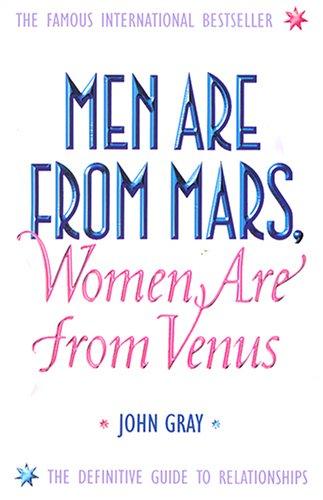
Men Are from Mars, Women Are from Venus
by John Gray
★ Top 10 book of 1994 · #6 on Best Books of 1994
Using a playful image of Martians and Venusians who forgot their differences, this counselor-written guide explains how men and women are unlike each other. It offers ways to voice needs, reduce conflict, and nurture intimacy.
Best for: Couples seeking practical help communicating and understanding each other's differences
Men Are from Mars, Women Are from Venus is #6 on BookWard's Best Books of 1994, out of 42 1994 books that cleared our data bar.
What Men Are from Mars, Women Are from Venus is about
John Gray, an American relationship counselor, argues that most of the common troubles between men and women come from deep psychological differences between the sexes. His central image is that men are from Mars and women from Venus, each used to the customs of their own planet and puzzled by the other's. One example: a woman who raises a problem may simply want to talk it through, not be handed a solution. Gray also suggests the sexes can be understood by how they respond to stress. Drawing on years of counseling couples and individuals, he aims to help readers state their needs clearly so conflict fades and closeness can grow. It will suit anyone who wants friendly, practical advice for communicating better with a partner. Published in 1992, it has sold more than 15 million copies.
Men Are from Mars, Women Are from Venus on the Best Books of 1994
Men Are from Mars, Women Are from Venus came out in 1994. Of the 42 books first published in 1994 that met BookWard's data bar, it ranks #6 on our Best Books of 1994 list.
Why it made the list: 2,045 readers have shelved it on Open Library; readers rate it 3.8 out of 5 (66 ratings); 155 are reading it right now. The list ranks each year’s books on how many readers have picked them up, how highly readers rate them, and how many are reading them right now.
It earns Being read right now.
Nearby on the 1994 list
- Long Walk to Freedom Nelson Mandela, #4
- Mercury and Me Jim Hutton, #5
- Insomnia Stephen King, #7
- Wizard's First Rule Terry Goodkind, #8
See all Best Books of 1994 Best books by year
More years: Best Books of 1993 Best Books of 1995.
The numbers behind it
- Readers: 1,812 want to read it, 155 are reading it now and 78 have read it, according to Open Library.
- Ratings: 3.8 out of 5 from 66 Open Library ratings.
| Signal | This book (0 to 100) | Weight |
|---|---|---|
| Reach | 100 | 55% |
| Reader love | 31 | 25% |
| Being read right now | 100 | 20% |
Questions about Men Are from Mars, Women Are from Venus
When was Men Are from Mars, Women Are from Venus published?
Men Are from Mars, Women Are from Venus by John Gray was first published in 1994.
Was Men Are from Mars, Women Are from Venus one of the best books of 1994?
Men Are from Mars, Women Are from Venus is #6 on BookWard's Best Books of 1994, out of 42 1994 books that cleared our data bar. 2,045 readers have shelved it on Open Library; readers rate it 3.8 out of 5 (66 ratings); 155 are reading it right now.
Why is Men Are from Mars, Women Are from Venus on the Best Books of 1994 list?
2,045 readers have shelved it on Open Library; readers rate it 3.8 out of 5 (66 ratings); 155 are reading it right now.
More of the best books of 1994
- Guess How Much I Love You Sam McBratney, #1
- Artificial Intelligence Stuart J. Russell, #2
- The Six Pillars of Self-esteem Nathaniel Branden, #3
- Long Walk to Freedom Nelson Mandela, #4
- Mercury and Me Jim Hutton, #5
- Insomnia Stephen King, #7
See the full Best Books of 1994, the Top 100, or new books on Rising.
How we know
This page uses public data: Open Library reader counts and ratings, and Wikipedia page views for recent years. The description is paraphrased from real source text. Rankings reflect reading interest, not quality or sales, and can be affected by data gaps. Lists update monthly.
Best suited to adult readers, and mature teens curious about relationships, since it deals with partnership and intimacy in general terms.
Depends on the edition you pick.
A famous planet metaphor that explains less than it promises. 39% taste match
 BookWard’s take
A famous planet metaphor that explains less than it promises
John Gray's central idea is that men and women are from different planets, each shaped by its own customs and ways of handling stress. The hook is immediate: a single metaphor you grasp in one sentence. That clarity is also the book's limit. On rigor it rests on counseling anecdote rather than evidence, and on cliche it leans hard on broad generalizations about the sexes. Its authorial voice is warm and confident, and the reading effort is low, so it moves quickly. Its originality was real for its time, and its staying power shows in how far the metaphor has spread into everyday speech. Read it as a conversation starter about communication, not as settled science.
A standard-length self-help book that makes its point without sprawling, though it circles the same idea repeatedly.
The planet metaphor was a memorable packaging of an old idea, more catchy than new.
The writing is plain, conversational and unadorned, built for easy reading.
It insists that couples can reconnect once they understand their differences, a firmly optimistic stance.
A conventional run of advice chapters, each building on the central metaphor.
Light and approachable, but not a funny book.
A gentle subject handled gently.
Warm and reassuring, with moderate emotional stakes around relationship hurt.
See all 50 dialsEvery position, side by side with this book
Where it lines up
- PaceBookWard 8 · book 7
- EndingBookWard 8 · book 7
- OpeningBookWard 10 · book 8
Where it pulls apart
- Familiar tropesBookWard 10 · book 3
- Internal logicBookWard 10 · book 4
- Rigor (nonfiction)BookWard 9 · book 2
A standard-length self-help book that makes its point without sprawling, though it circles the same idea repeatedly.
The Mars and Venus metaphor lands in the opening pages and gives the whole book its frame.
It relies heavily on sweeping generalizations about men and women, which sits poorly with BookWard's taste for fresh thinking.
The framework is internally tidy but rests on broad claims that do not hold up under pressure.
The planet metaphor was a memorable packaging of an old idea, more catchy than new.
Men and women appear as two broad types rather than individuals, the opposite of what BookWard prizes.
The tone is earnest and reassuring, with a warmth that edges toward the sentimental.
Its claims draw on counseling experience and anecdote, well short of the rigor BookWard wants from nonfiction.
Gray's confident, friendly, coach-like voice is recognizable, though the ideas themselves are common property now.
This is almost entirely idea-led, built around one framework rather than any narrative.
Concepts are explained outright and illustrated with short examples, with little left to infer.
The core point is made early and then restated, so the middle runs on repetition.
The writing is plain, conversational and unadorned, built for easy reading.
It insists that couples can reconnect once they understand their differences, a firmly optimistic stance.
A conventional run of advice chapters, each building on the central metaphor.
Light and approachable, but not a funny book.
Very easy reading, with no dense argument or specialist vocabulary.
It speaks from one authorial position, split only between describing men and describing women.
Advice unfolds in a straight line from premise to application.
The planets are a pure metaphor, and everything else is ordinary relationship life.
Only the two archetypes of man and woman recur, along with brief illustrative couples.
Entirely about private relationships and the small moments between partners.
It dwells on feelings and communication habits more than on events.
Sample exchanges between partners appear throughout to illustrate misfires in conversation.
Romantic partnership is the whole subject, though as advice rather than story.
The setting is everyday domestic life, instantly familiar to most readers.
Rooted in 1990s ideas about gender, it reads as a period piece in places.
The metaphor has outlived the book itself, even as its gender assumptions age.
The author speaks plainly in his own voice, with nothing hidden.
It takes clear positions on how each sex should behave, with little room for nuance.
Light on scene-setting, relying on brief examples rather than rich detail.
It reads more as practical instruction than as a flowing story.
Gray writes as an engaged counselor drawing on his own practice, not a detached observer.
It spawned many follow-up books and seminars, though this one stands on its own.
There are no surprises, since advice follows a predictable arc.
Comforting and affirming rather than unsettling.
A gentle subject handled gently.
Warm and reassuring, with moderate emotional stakes around relationship hurt.
Mild, gently playful humor at the expense of familiar couple quarrels.
None on the page.
Intimacy is discussed in general terms and never explicitly.
Not overtly political, though its gender claims invite debate.
Plain everyday language throughout.
Gray states his views firmly and presents them as settled fact.
Aimed at improving present and future relationships.
It believes understanding can repair most relationships, an idealistic outlook.
Review written by BookWard, dial version 1, November 2026.
Who is Men Are from Mars, Women Are from Venus right for?
Best suited to adult readers, and mature teens curious about relationships, since it deals with partnership and intimacy in general terms. Some readers may find its sweeping claims about gender dated or limiting.
Very easy reading, with no dense argument or specialist vocabulary.
A gentle subject handled gently.
Warm and reassuring, with moderate emotional stakes around relationship hurt.
None on the page.
Book CompanionMen Are from Mars, Women Are from Venus: ideas, characters, themes
Gray argues that many relationship conflicts come from men and women responding differently to stress, and that accepting those differences improves communication.
- Two planets. The central metaphor holds that each sex is at home in its own world and needs to learn the other's customs.
- Fixing versus listening. Men often offer solutions when women want to be heard, a mismatch that causes friction.
- Responses to stress. The book describes distinct ways each sex handles stress and what each tends to need.
- Communication as the remedy. Naming needs clearly and respectfully is presented as the way to reduce conflict.
- Respecting differences. The framing holds that intimacy grows when partners accept rather than try to change each other.
Themes
The idea that men and women think and feel in fundamentally different ways.
How word choice and listening shape closeness or distance.
The contrasting ways partners cope under pressure.
Valuing a partner's differences instead of trying to correct them.
How a simple metaphor can spread into everyday culture.
Discussion questions
- Does the Mars and Venus framing help you understand your own relationships, or does it oversimplify?
- When someone shares a problem, do you tend to offer solutions or just listen, and what do you think they want?
- How much of the book's picture of gender reflects the 1990s rather than today?
- What would convincing evidence for or against Gray's claims look like?
- Can a metaphor be useful even if its underlying generalizations are shaky?
Personalize your Book Companion
This is the general edition. In BookWard, the Companion is written for you: your reading profile, your notes, and spoiler-safe to the page you are on.
Buy, listen or borrow Men Are from Mars, Women Are from Venus
Each link opens a search for this book on that store, in a new tab.
Read on a device
Borrow
Reviews and community
If you liked Men Are from Mars, Women Are from Venus
Kiyosaki's money lessons, trimmed and tuned for teenage readers
Rich Dad's Guide to InvestingRobert T. KiyosakiA cash-flow-first investing primer in Kiyosaki's loud, anecdotal style
The Power of Positive ThinkingNorman Vincent PealePeale's faith-based playbook for swapping worry for confidence
The think and grow rich action packNapoleon HillNapoleon Hill's success gospel, packaged for doing rather than just reading
Find your own best books
Add what you have read, rate it, and BookWard will recommend what to read next.
Free to start. No credit card needed.