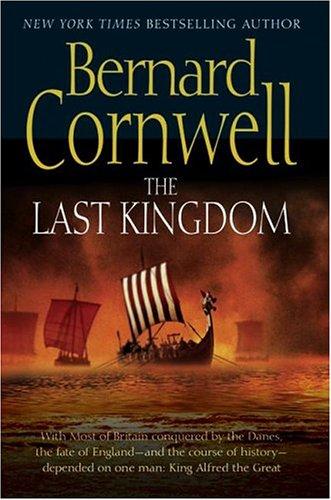
The Last Kingdom
by Bernard Cornwell
★ Top 25 book of 2004 · #11 on Best Books of 2004
Set in ninth-century England, this saga follows Uhtred, a nobleman's son taken captive as a boy and raised by a Danish chieftain in Viking ways. Pulled between two father figures, he must decide where his true loyalty lies.
Best for: Readers who love sweeping historical adventure about Vikings and Anglo-Saxon England
The Last Kingdom is #11 on BookWard's Best Books of 2004, out of 48 2004 books that cleared our data bar.
What The Last Kingdom is about
Uhtred is a ten-year-old Northumbrian boy, heir to the fortress of Bebbanburg, when his father is killed in a failed attack on Danish-held York. Taken in by the Danish Jarl Ragnar, he is raised as one of the family and taught to fight. Meanwhile his uncle seizes Bebbanburg and the title that should be his.
The first in Bernard Cornwell's Saxon Stories, the novel follows Uhtred through Danish raids across East Anglia, Mercia and Wessex, then into the service of King Alfred. Torn between the man who raised him and the king he serves, Uhtred has to decide where he belongs. Gritty and fast-moving, it suits readers who like their history muddy, violent and full of loyalties that pull in two directions.
The Last Kingdom on the Best Books of 2004
The Last Kingdom came out in 2004. Of the 48 books first published in 2004 that met BookWard's data bar, it ranks #11 on our Best Books of 2004 list.
Why it made the list: 258 readers have shelved it on Open Library; readers rate it 4.1 out of 5 (22 ratings); 20 are reading it right now. The list ranks each year’s books on how many readers have picked them up, how highly readers rate them, and how many are reading them right now.
Nearby on the 2004 list
- Rising Storm Erin Hunter, #9
- The Pigeon Finds a Hot Dog! Mo Willems, #10
- My Sister's Keeper Jodi Picoult, #12
- The Definitive Book of Body Language Allan Pease, #13
See all Best Books of 2004 Best books by year
More years: Best Books of 2003 Best Books of 2005.
The numbers behind it
- Readers: 204 want to read it, 20 are reading it now and 34 have read it, according to Open Library.
- Ratings: 4.1 out of 5 from 22 Open Library ratings.
| Signal | This book (0 to 100) | Weight |
|---|---|---|
| Reach | 65 | 55% |
| Reader love | 65 | 25% |
| Being read right now | 88 | 20% |
Questions about The Last Kingdom
When was The Last Kingdom published?
The Last Kingdom by Bernard Cornwell was first published in 2004.
Was The Last Kingdom one of the best books of 2004?
The Last Kingdom is #11 on BookWard's Best Books of 2004, out of 48 2004 books that cleared our data bar. 258 readers have shelved it on Open Library; readers rate it 4.1 out of 5 (22 ratings); 20 are reading it right now.
Why is The Last Kingdom on the Best Books of 2004 list?
258 readers have shelved it on Open Library; readers rate it 4.1 out of 5 (22 ratings); 20 are reading it right now.
More of the best books of 2004
- Darkly Dreaming Dexter Jeffry P. Lindsay, #1
- Rich Dad, Poor Dad for Teens Robert T. Kiyosaki, #2
- The Ruins of Gorlan John Flanagan, #3
- Blink Malcolm Gladwell, #4
- Alexander Hamilton Ron Chernow, #5
- She Comes First Ian Kerner, #6
See the full Best Books of 2004, the Top 100, or new books on Rising.
How we know
This page uses public data: Open Library reader counts and ratings, and Wikipedia page views for recent years. The description is paraphrased from real source text. Rankings reflect reading interest, not quality or sales, and can be affected by data gaps. Lists update monthly.
Suits mature teens and adults who enjoy historical adventure.
Depends on the edition you pick.
A Saxon boy raised by Danes, caught between two loyalties. 57% taste match
 BookWard’s take
A Saxon boy raised by Danes, caught between two loyalties
The Last Kingdom opens in 866 with a boy's father dead and the boy captured, and it keeps moving from there. That hook is immediate, and the pace holds through years of raiding and war without much sag in the middle. Cornwell is story-led rather than idea-led, and he shows his world through action instead of explaining it. Uhtred is the real draw: a narrator torn between the Danish father figure who raised him and King Alfred, whose piety leaves him cold. That divided loyalty gives the character depth and keeps the moral picture from turning simple. The prose is plain and brisk rather than ornate, and the violence is frequent and unsparing. It is also the first of a series, so expect a resolved arc with the larger story still ahead.
A full historical saga of war and growing up, though it moves briskly rather than sprawling the way the longest epics do.
Raids, battles and shifting allegiances keep it moving, close to BookWard's fast preference.
The Viking-raised Saxon protagonist and the focus on Alfred are distinctive, though the genre ground is familiar.
Plain, muscular and direct, built for momentum rather than ornament, a touch plainer than BookWard's middle ground.
Events drive the book, but Uhtred's loyalties give the plot an emotional core, so it balances both.
Loss and slaughter weigh heavily, though survival, friendship and marriage offer some light.
A conventional chronological memoir-style telling, with no formal experimentation.
Mostly serious, with grim soldierly wit rather than real comedy.
Slaughter, revenge and attempted assault give it a dark edge within a rousing adventure.
Bonds with Ragnar and loss in war land with feeling, delivered in a hard-edged register.
See all 50 dialsEvery position, side by side with this book
Where it lines up
- OpeningBookWard 10 · book 9
- PaceBookWard 8 · book 7
- Character depthBookWard 8 · book 7
Where it pulls apart
- Familiar tropesBookWard 10 · book 4
- LengthBookWard 1 · book 5
- Internal logicBookWard 10 · book 7
A full historical saga of war and growing up, though it moves briskly rather than sprawling the way the longest epics do.
It opens in 866 with a boy's father killed and the boy captured, so the story is under way almost at once.
Boy raised by the enemy and torn between two fathers is a well-worn shape, which sits below BookWard's taste for the fresh.
Events follow cause and effect through war, inheritance and betrayal, with motives that hold together.
Raids, battles and shifting allegiances keep it moving, close to BookWard's fast preference.
The Viking-raised Saxon protagonist and the focus on Alfred are distinctive, though the genre ground is familiar.
Uhtred's divided loyalty between Ragnar and Alfred gives him real inner conflict, which suits BookWard well.
The first book closes on a climactic battle and a settled arc, while leaving room for the series to continue.
Warm bonds like Uhtred and Ragnar's sit beside hard, unsentimental treatment of war and loss.
The violence is blunt and frequent, but it grows out of the war and the world's brutality rather than being thrown in for effect.
Not applicable: this is a novel.
Cornwell's first-person Uhtred has a confident, blunt, partisan voice that gives the book real identity.
This is firmly story-led: war, family and loyalty drive everything rather than argument or theory.
The history is mostly carried through scene and Uhtred's lived experience rather than lectured, which BookWard favors.
Moving from childhood captivity through raids and warfare, the book keeps fresh momentum instead of stalling.
Plain, muscular and direct, built for momentum rather than ornament, a touch plainer than BookWard's middle ground.
Events drive the book, but Uhtred's loyalties give the plot an emotional core, so it balances both.
Loss and slaughter weigh heavily, though survival, friendship and marriage offer some light.
A conventional chronological memoir-style telling, with no formal experimentation.
Mostly serious, with grim soldierly wit rather than real comedy.
Easy to follow and propulsive; the Anglo-Saxon names and politics are the main hurdle.
One narrator, Uhtred, carries the whole story.
It moves forward in time from boyhood to manhood without jumping around.
Grounded in historical events, with beliefs and omens treated as the characters' own.
Kings, jarls, priests and warriors fill the story, a sizable but manageable set of players.
The personal story sits inside a war for the fate of England's kingdoms.
Action, battle and journeys dominate, with Uhtred's divided loyalties running underneath.
Conversation carries plenty of scenes alongside the action, in a fairly even mix.
Marriage matters to Uhtred's path, but love is not the book's engine.
Ninth-century England under Viking invasion is far from most readers' daily experience, and richly realized.
Set in 866 and after, as far from the present day as a novel gets.
Stories of divided loyalty and war between peoples keep their pull well beyond 2004.
Uhtred tells his own story with plain confidence and bias, though he is not an outright deceiver.
Both Danes and Saxons have admirable and brutal sides, so loyalty is not a clear-cut choice.
Battles, halls and landscapes are drawn with solid detail, though action takes priority.
Not applicable: this is a novel.
Not applicable: this is a novel.
It is the first volume of The Saxon Stories.
Captures, betrayals and shifts of allegiance keep turns coming, though history frames the course.
A gripping adventure, though its violence and divided loyalties ask for some moral attention.
Slaughter, revenge and attempted assault give it a dark edge within a rousing adventure.
Bonds with Ragnar and loss in war land with feeling, delivered in a hard-edged register.
Humor is dry and soldierly, never broad.
Battles, raids and massacres are central and described plainly.
Sexual threat appears in the plot but is not dwelt on in explicit detail.
Rival kings, inheritance and the fate of a kingdom keep power struggles at the center.
Old English and Danish names add density, but the language itself is plain.
Uhtred's strong views on religion, kings and rivals color everything he tells.
Looks back at a pivotal chapter of English history, told as remembered.
Loyalty and honor matter to Uhtred, set against a hard world that rarely rewards them.
Review written by BookWard, dial version 1, November 2026.
Who is The Last Kingdom right for?
Suits mature teens and adults who enjoy historical adventure. It contains frequent battle violence, killing, and an attempted sexual assault early on.
Easy to follow and propulsive; the Anglo-Saxon names and politics are the main hurdle.
Slaughter, revenge and attempted assault give it a dark edge within a rousing adventure.
Bonds with Ragnar and loss in war land with feeling, delivered in a hard-edged register.
Battles, raids and massacres are central and described plainly.
Book CompanionThe Last Kingdom: ideas, characters, themes
A Saxon boy raised among Danish Vikings must decide whether his loyalty belongs to the man who raised him or to the king he is born to serve.
- A boy taken in battle. In 866, ten-year-old Uhtred is captured in the fight that kills his father, and is raised by the Danish chieftain Ragnar.
- Raised as a Dane. He takes on Viking language, religion and warrior training, and comes to love Ragnar like a father.
- A stolen birthright. His uncle takes Bebbanburg, so Uhtred is cut off from the title and fortress that should be his.
- Alfred of Wessex. The pious, introspective King Alfred, a crucial figure in English history, pulls Uhtred toward another loyalty.
- Divided allegiance. Uhtred's choice between old loyalty and new duty drives the book toward its climactic battle.
Characters
Uhtred
Narrator and hero
A Saxon noble's son raised by Danes, caught between two peoples.
Ragnar
Danish chieftain
The earl who captures Uhtred and raises him as a son.
King Alfred
King of Wessex
A devout, reflective ruler whose cause draws Uhtred in.
Ælfric
Uhtred's uncle
Takes Bebbanburg and its title from the rightful heir.
Beocca
Priest
An old family friend who works to bring Uhtred back to the Saxons.
Themes
Choosing between the people who raised you and the people you were born to.
Who you are when you carry two cultures at once.
Birthright claimed, lost and fought for.
Pagan Danes and Christian Saxons clash over gods as well as land.
Love and duty owed to those who raised you.
Discussion questions
- Is Uhtred more Dane or more Saxon, and does that change over the book?
- Why does Ragnar keep Uhtred rather than kill him, and what does that say about him?
- How does Uhtred's view of Alfred differ from how Alfred sees himself?
- Does the book make the Danes monsters, heroes, or something in between?
- What does Uhtred owe to the man who raised him versus the people he was born to?
Personalize your Book Companion
This is the general edition. In BookWard, the Companion is written for you: your reading profile, your notes, and spoiler-safe to the page you are on.
Buy, listen or borrow The Last Kingdom
Each link opens a search for this book on that store, in a new tab.
Read on a device
Borrow
Reviews and community
If you liked The Last Kingdom
A Brooklyn drug kingpin's daughter narrates her own fall in hip-hop slang
PostmortemPatricia CornwellThe forensic procedural that made Kay Scarpetta a fixture of crime fiction
Catching FireSuzanne CollinsA sequel that raises the stakes and widens the story
Red RisingPierce BrownA fast, brutal sci-fi revenge story that hooks from page one
Find your own best books
Add what you have read, rate it, and BookWard will recommend what to read next.
Free to start. No credit card needed.