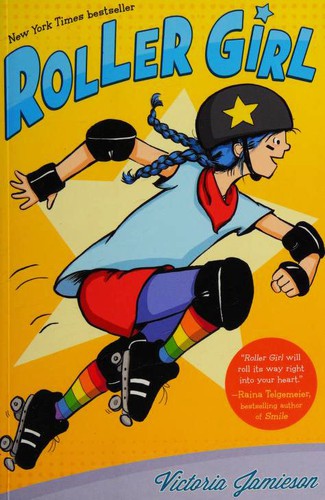
Roller Girl
by Victoria Jamieson
★ Top 25 book of 2014 · #14 on Best Books of 2014
Twelve-year-old Astrid discovers a passion for roller derby just as her best friend Nicole drifts away to dance camp. Over one tough summer, she faces older skaters, a fading friendship, a first bout and the start of junior high.
Best for: Middle-grade readers who like sports stories and tales of changing friendships
Roller Girl is #14 on BookWard's Best Books of 2014, out of 66 2014 books that cleared our data bar.
What Roller Girl is about
Astrid is twelve, and she has done nearly everything with her best friend Nicole for most of her life. Then, after a roller derby match, Astrid decides she wants to go to junior roller derby camp, while Nicole picks dance camp with Astrid's longtime rival, Rachel.
Set in present-day Portland, Oregon, this graphic novel follows Astrid through a summer of trying to keep up with older, tougher skaters. She makes a new friend in Zoey, who helps her dye her hair blue, and meets Braidy Punch, a skater who loves tearing down rivals. Her first bout and junior high are waiting at summer's end. Warm, funny and full of energy, it speaks to young readers dealing with changing friendships, self-doubt and growing up.
Roller Girl on the Best Books of 2014
Roller Girl came out in 2014. Of the 66 books first published in 2014 that met BookWard's data bar, it ranks #14 on our Best Books of 2014 list.
Why it made the list: 489 readers have shelved it on Open Library; readers rate it 4.4 out of 5 (53 ratings); 27 are reading it right now. The list ranks each year’s books on how many readers have picked them up, how highly readers rate them, and how many are reading them right now.
It earns Reader favorite.
Nearby on the 2014 list
- Heir of Fire Sarah J. Maas, #12
- The Assassin’s Blade Sarah J. Maas, #13
- Being Mortal Atul Gawande, #15
- Mr. Mercedes Stephen King, #16
See all Best Books of 2014 Best books by year
More years: Best Books of 2013 Best Books of 2015.
The numbers behind it
- Readers: 387 want to read it, 27 are reading it now and 75 have read it, according to Open Library.
- Ratings: 4.4 out of 5 from 53 Open Library ratings.
| Signal | This book (0 to 100) | Weight |
|---|---|---|
| Reach | 64 | 55% |
| Reader love | 91 | 25% |
| Being read right now | 64 | 20% |
Questions about Roller Girl
When was Roller Girl published?
Roller Girl by Victoria Jamieson was first published in 2014.
Was Roller Girl one of the best books of 2014?
Roller Girl is #14 on BookWard's Best Books of 2014, out of 66 2014 books that cleared our data bar. 489 readers have shelved it on Open Library; readers rate it 4.4 out of 5 (53 ratings); 27 are reading it right now.
Why is Roller Girl on the Best Books of 2014 list?
489 readers have shelved it on Open Library; readers rate it 4.4 out of 5 (53 ratings); 27 are reading it right now.
More of the best books of 2014
- To All the Boys I've Loved Before Jenny Han, #1
- The Long Haul Jeff Kinney, #2
- Zero to One Peter A. Thiel, #3
- Surrounded by Idiots Thomas Erikson, #4
- After (After Series, Book 1) Anna Todd, #5
- Ugly Love Colleen Hoover, #6
See the full Best Books of 2014, the Top 100, or new books on Rising.
How we know
This page uses public data: Open Library reader counts and ratings, and Wikipedia page views for recent years. The description is paraphrased from real source text. Rankings reflect reading interest, not quality or sales, and can be affected by data gaps. Lists update monthly.
Best suited to middle-grade and early teen readers, and a comfortable family read-aloud.
Depends on the edition you pick.
A graphic novel where friendship strains harder than the skates. 62% taste match
 BookWard’s take
A graphic novel where friendship strains harder than the skates
Roller Girl follows twelve-year-old Astrid through one summer of junior roller derby camp while her best friend Nicole drifts toward dance camp and a different crowd. It is a Newbery Honor graphic novel, and it earns the attention. The pace is fast, with practice, bruises and a looming bout keeping every chapter moving, though it runs gentler than I usually like. Character depth is the real strength: Astrid is stubborn, embarrassed and funny in ways that feel lived in. The ending resolves cleanly and the outlook is hopeful, with sentiment kept in check by honest awkwardness. Familiar tropes are present, since this is a growing-apart story, but the derby setting gives it fresh footing. It is short, quick and warm.
A compact graphic novel built around a single summer, which sits right alongside BookWard's love of tight books.
Camp sessions, practice and the approaching bout keep scenes short and moving, a little gentler than BookWard prefers.
The roller derby backdrop gives a familiar growing-up story a distinctive setting, though the core arc is recognizable.
Text is plain and conversational, with the pictures carrying much of the expression.
The derby gives it structure, but the real drive is Astrid's changing friendships and sense of self.
Astrid grows stronger and makes peace with change, leaving a clearly hopeful outlook that matches BookWard's.
Told in a straightforward sequence across one summer, more conventional than BookWard's middling preference.
Awkward moments and Astrid's mortification are played with real humor, close to BookWard's comic streak.
Gentle overall; the roughest moments are hurt feelings and bruises.
Real feeling around loneliness and friendship, but pitched at a moderate, middle-grade intensity.
See all 50 dialsEvery position, side by side with this book
Where it lines up
- Character depthBookWard 8 · book 8
- EndingBookWard 8 · book 8
- Shock for effectBookWard 9 · book 9
Where it pulls apart
- Familiar tropesBookWard 10 · book 5
- OpeningBookWard 10 · book 7
- Internal logicBookWard 10 · book 8
A compact graphic novel built around a single summer, which sits right alongside BookWard's love of tight books.
Astrid's first roller derby match sets the story in motion early, though it opens gently rather than with a jolt.
A friendship drifting apart is well-worn territory, but the junior derby camp setting keeps it from feeling stock.
Cause and effect between Astrid's choices and her friendships hold together cleanly, which BookWard values.
Camp sessions, practice and the approaching bout keep scenes short and moving, a little gentler than BookWard prefers.
The roller derby backdrop gives a familiar growing-up story a distinctive setting, though the core arc is recognizable.
Astrid's pride, insecurity and bad decisions are drawn with real specificity, matching BookWard's taste for deeply drawn people.
The bout and the friendship threads reach a clear, satisfying resolution, in line with BookWard's preference for closure.
Warm and sincere, but Astrid's awkward honesty keeps it from turning syrupy, slightly softer than BookWard's restrained ideal.
Nothing is there for effect; the hard moments are everyday ones like losing a friend, and they are earned.
This is a story, so rigor does not apply.
Astrid's wry, self-conscious perspective gives the book a personal, recognizable feel.
Firmly story-led, with feeling and incident carrying everything, which suits BookWard's story-first leaning.
Feelings and friendships are shown through scenes and drawings rather than explained, as BookWard likes.
One summer of escalating practice and friendship strain keeps momentum up, with little slack.
Text is plain and conversational, with the pictures carrying much of the expression.
The derby gives it structure, but the real drive is Astrid's changing friendships and sense of self.
Astrid grows stronger and makes peace with change, leaving a clearly hopeful outlook that matches BookWard's.
Told in a straightforward sequence across one summer, more conventional than BookWard's middling preference.
Awkward moments and Astrid's mortification are played with real humor, close to BookWard's comic streak.
Easy to read and quick to take in, well below the effort BookWard usually likes to spend.
We see everything through Astrid alone, narrower than BookWard's taste for many voices.
Events move forward in order through the summer, more linear than BookWard tends to like.
Entirely grounded in contemporary Portland and ordinary middle-school life.
A small circle of friends, rivals, teammates and family keeps the cast manageable.
Intimate in scope, centered on one girl, a few friendships and a single bout.
Astrid's feelings and the physical derby action share the page about equally.
Conversations between girls, in text and speech balloons, carry much of the story, in line with BookWard's taste.
Friendship, not romance, is the emotional center here.
Junior roller derby is a vivid subculture most readers will find new, though the school-age setting stays accessible.
Set in a recognizably contemporary world of modern kids and activities.
Friendships changing in the lead-up to middle school will stay true for a long time, even if the details date.
Astrid is honest with the reader about how she feels, a plainly reliable guide.
Right and wrong are fairly clear, though Astrid's missteps with friends add shades of gray.
The drawings do the describing, with sparse words carrying the setting.
This is a graphic novel, so nonfiction style does not apply.
Told from inside Astrid's own experience, with no detached distance.
A complete story that stands entirely on its own.
The story follows an expected arc, with few real surprises along the way.
A reassuring, encouraging read that rarely pushes the reader out of comfort.
Gentle overall; the roughest moments are hurt feelings and bruises.
Real feeling around loneliness and friendship, but pitched at a moderate, middle-grade intensity.
Gentle, observational comedy that falls between dry and broad.
Roller derby involves collisions and falls, but nothing graphic or harsh.
Nothing sexual appears.
Not a political book, apart from light themes of girls and body confidence.
Plain, everyday language with no dense or dialect-heavy writing.
Astrid's attitude colors the telling, though the book stays mostly evenhanded.
Pointed toward the next step, with Astrid heading into junior high.
Leans encouraging, believing in effort, resilience and friendship that can be repaired.
Review written by BookWard, dial version 1, November 2026.
Who is Roller Girl right for?
Best suited to middle-grade and early teen readers, and a comfortable family read-aloud. Sensitive content is mild, mostly hurt feelings, rivalry between girls and the bumps and bruises of contact sport.
Easy to read and quick to take in, well below the effort BookWard usually likes to spend.
Gentle overall; the roughest moments are hurt feelings and bruises.
Real feeling around loneliness and friendship, but pitched at a moderate, middle-grade intensity.
Roller derby involves collisions and falls, but nothing graphic or harsh.
Book CompanionRoller Girl: ideas, characters, themes
A girl discovers roller derby and learns to hold her own while her closest friendship quietly changes shape.
- A night out sparks it. An Evening of Cultural Enrichment with her mother and best friend Nicole introduces Astrid to a roller derby match.
- Friends split paths. Nicole chooses dance camp with Astrid's longtime rival Rachel instead of joining her at derby camp.
- Struggling at camp. Surrounded by older, more mature skaters, Astrid has a hard time keeping up and fitting in.
- A new friend and a new look. She pairs up with Zoey and dyes her hair blue, borrowing some derby confidence.
- Truth and a bout. Honesty with her mother and an apology to Nicole set up a bout where Astrid skates for her team.
Characters
Astrid
Protagonist
A twelve-year-old determined to become a roller derby skater while her friendships shift.
Nicole
Astrid's best friend
Chooses dance camp over derby, creating distance between the two.
Zoey
New friend and teammate
A fellow camper who partners with Astrid in class.
Rachel
Astrid's rival
A longtime rival who goes to dance camp with Nicole.
Braidy Punch
Fellow skater
A skater eager to tear down any rival.
Themes
People can grow in different directions without anyone being the villain.
Getting good at something hard takes practice, bruises and not quitting.
Hiding the truth makes things worse, while saying it plainly can repair them.
Belonging comes from trusting your own strength, not matching others.
The move toward junior high brings new roles and new relationships.
Discussion questions
- Why does Astrid struggle to tell her mother how her friendship with Nicole has changed?
- How does derby help Astrid understand herself in ways school hasn't?
- Is Astrid fair to Nicole and Rachel, or does she hold a grudge?
- What does the blue hair mean to Astrid at camp?
- Have you ever drifted from a close friend, and what helped?
Personalize your Book Companion
This is the general edition. In BookWard, the Companion is written for you: your reading profile, your notes, and spoiler-safe to the page you are on.
Buy, listen or borrow Roller Girl
Each link opens a search for this book on that store, in a new tab.
Read on a device
Borrow
Reviews and community
If you liked Roller Girl
A warm, spooky story of sisters, illness and moving on
There's a Boy in the Girl's Bathroom (Cascades)Louis SacharA short, funny school story about a kid everyone has written off
GutsRaina TelgemeierA graphic memoir where a stomachache becomes a story about anxiety
ChrysanthemumKevin HenkesA gentle, funny picture book about a name worth keeping
Find your own best books
Add what you have read, rate it, and BookWard will recommend what to read next.
Free to start. No credit card needed.