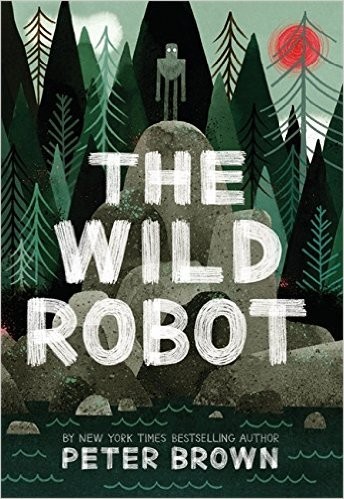
The Wild Robot
by Peter Brown
★ Top 25 book of 2016 · #21 on Best Books of 2016
Roz, a robot, wakes up alone on a remote island with no memory of how she arrived. To survive, she must adapt and learn from the wary animals around her, but her mysterious past eventually catches up with her.
Best for: Young readers who like survival adventures with animals and a robot hero
The Wild Robot is #21 on BookWard's Best Books of 2016, out of 70 2016 books that cleared our data bar.
What The Wild Robot is about
Roz, a robot, switches on for the first time on a remote island with no memory of how she arrived and no sense of what she is meant to do. She only knows she has to survive. A fierce storm and a vicious bear attack make the lesson plain: the island will not bend to her, so she must bend to it. Her best hope is to watch the animals who live there, however unwelcoming they are, and learn their ways.
Slowly, as she makes friends among them, the place begins to feel like home. But her mysterious past has not finished with her. Peter Brown, who also illustrates, wrote this first book in a series for young readers. It suits children who like stories about belonging, friendship across differences, and the question of what makes someone who they are.
The Wild Robot on the Best Books of 2016
The Wild Robot came out in 2016. Of the 70 books first published in 2016 that met BookWard's data bar, it ranks #21 on our Best Books of 2016 list.
Why it made the list: 432 readers have shelved it on Open Library; readers rate it 4.4 out of 5 (34 ratings); 20 are reading it right now. The list ranks each year’s books on how many readers have picked them up, how highly readers rate them, and how many are reading them right now.
Nearby on the 2016 list
- It Didn't Start with You Mark Wolynn, #19
- Grit Angela Duckworth, #20
- The Sun Is Also a Star Nicola Yoon, #22
- Pillow Thoughts Courtney Peppernell, #23
See all Best Books of 2016 Best books by year
More years: Best Books of 2015 Best Books of 2017.
The numbers behind it
- Readers: 384 want to read it, 20 are reading it now and 28 have read it, according to Open Library.
- Ratings: 4.4 out of 5 from 34 Open Library ratings.
| Signal | This book (0 to 100) | Weight |
|---|---|---|
| Reach | 57 | 55% |
| Reader love | 86 | 25% |
| Being read right now | 54 | 20% |
Questions about The Wild Robot
When was The Wild Robot published?
The Wild Robot by Peter Brown was first published in 2016.
Was The Wild Robot one of the best books of 2016?
The Wild Robot is #21 on BookWard's Best Books of 2016, out of 70 2016 books that cleared our data bar. 432 readers have shelved it on Open Library; readers rate it 4.4 out of 5 (34 ratings); 20 are reading it right now.
Why is The Wild Robot on the Best Books of 2016 list?
432 readers have shelved it on Open Library; readers rate it 4.4 out of 5 (34 ratings); 20 are reading it right now.
More of the best books of 2016
- It Ends with Us Colleen Hoover, #1
- Dog Man Dav Pilkey, #2
- The Subtle Art of Not Giving a F*ck Mark Manson, #3
- Never Split the Difference Chris Voss, #4
- The Hidden Oracle Rick Riordan, #5
- Born a Crime Trevor Noah, #6
See the full Best Books of 2016, the Top 100, or new books on Rising.
How we know
This page uses public data: Open Library reader counts and ratings, and Wikipedia page views for recent years. The description is paraphrased from real source text. Rankings reflect reading interest, not quality or sales, and can be affected by data gaps. Lists update monthly.
It suits young middle-grade readers and works well read aloud to younger children.
Depends on the edition you pick.
A robot on a wild island, told with quiet nerve. 66% taste match
 BookWard’s take
A robot on a wild island, told with quiet nerve
Peter Brown's The Wild Robot drops Roz onto a remote island with no memory of how she got there and a single urgent need: survive. That clean premise hooks you at once, and the book keeps a brisk pace without sagging. The internal logic is tight, since Roz has to learn the island's rules the hard way, and the book stays restrained on sentiment even when it turns tender. It is a short, story-led novel with a small cast and an intimate scale, and that economy is a large part of its appeal. The robot-meets-nature setup is a familiar one, but a distinctive, plainspoken voice keeps it fresh from the first page.
A short children's novel that wastes little, which matches BookWard's love of tight books.
Short chapters and constant small survival problems keep it moving, close to BookWard's quick preference.
A robot raised among wild animals is a distinctive take, though not wildly new, a touch under BookWard's bar.
Simple, clear sentences suit young readers; BookWard sits a little more ornate but values the clarity.
Plot and character feed each other as Roz adapts, landing near the middle of this dial.
The tone leans toward connection and community, more hopeful than BookWard's slightly guarded outlook.
A conventional linear telling in short chapters, in keeping with BookWard's moderate leaning.
There is gentle charm but the book is mainly earnest, lighter on humor than BookWard prefers.
Peril is real but handled gently for young readers, lighter than BookWard's midpoint.
Roz's growing attachments land with real feeling while staying quiet, around BookWard's level.
See all 50 dialsEvery position, side by side with this book
Where it lines up
- LengthBookWard 1 · book 1
- EndingBookWard 8 · book 8
- Shock for effectBookWard 9 · book 9
Where it pulls apart
- Familiar tropesBookWard 10 · book 6
- Internal logicBookWard 10 · book 8
- NarratorBookWard 7 · book 2
A short children's novel that wastes little, which matches BookWard's love of tight books.
Roz wakes alone on a wild island and must survive at once, which grabs hard from the start.
Stranded-survivor and machine-learns-feeling ideas are familiar, though the island setting and animal cast feel fresh enough.
Roz learns by trial and adaptation, so events follow cause and effect cleanly, which BookWard values.
Short chapters and constant small survival problems keep it moving, close to BookWard's quick preference.
A robot raised among wild animals is a distinctive take, though not wildly new, a touch under BookWard's bar.
Roz grows through experience and bonds, though the cast is drawn simply, a little lighter than BookWard likes.
The central arc resolves clearly while leaving room for the sequels, close to BookWard's taste.
Warmth is present and the telling stays plainspoken, so it is tender without being syrupy.
Danger exists, such as storms and a bear, but nothing is darkness for effect, which BookWard approves.
Brown's plain, calm narration has a recognizable personality, which BookWard rewards.
This is firmly story-led, built on Roz's survival and relationships, in line with BookWard's lean toward story.
Roz's world is shown through her experiences rather than lectured, which BookWard prefers.
The book is short and keeps adding new challenges, so the middle holds up well.
Simple, clear sentences suit young readers; BookWard sits a little more ornate but values the clarity.
Plot and character feed each other as Roz adapts, landing near the middle of this dial.
The tone leans toward connection and community, more hopeful than BookWard's slightly guarded outlook.
A conventional linear telling in short chapters, in keeping with BookWard's moderate leaning.
There is gentle charm but the book is mainly earnest, lighter on humor than BookWard prefers.
Very easy to read, so it asks little effort, a bit easier than BookWard's usual tolerance.
Events unfold in a straightforward sequence, more linear than BookWard's mild taste for shifting time.
A sentient robot among talking-aware animals is clearly fantastical, a bit above BookWard's middle.
Roz and the island animals make a modest, manageable cast, close to BookWard's comfort zone.
The island is a contained, intimate stage, a little more intimate than BookWard's midpoint.
Survival gives it real outward action, though Roz's growing feelings keep it balanced, a little outward.
There is no romantic thread; the bonds are about survival, family, and belonging.
A remote wild island seen through a robot's eyes feels unfamiliar and fresh, matching BookWard's liking.
A near-future, unplaced setting reads as timeless more than present day.
Survival, belonging, and adaptation are lasting themes that suit readers of any generation.
The narration is straightforward and trustworthy, less slippery than BookWard's taste for unreliable voices.
Right and wrong are fairly clear for a children's book, less ambiguous than BookWard enjoys.
Brown sketches the island economically, giving moderate rather than lush detail, near BookWard's middle.
This is the first of a trilogy, so it sits toward series, more than BookWard's usual standalone lean.
Roz's mysterious past gives the story a turn, but the book is mostly steady rather than twisty.
It is a comforting, accessible read that asks little of the reader, softer than BookWard's taste.
Peril is real but handled gently for young readers, lighter than BookWard's midpoint.
Roz's growing attachments land with real feeling while staying quiet, around BookWard's level.
The little humor there is stays gentle and dry rather than broad.
There is an occasional animal attack, kept mild and non-graphic.
There is no sexual content in this children's novel.
The book has no political agenda; its concerns are nature, family, and belonging.
Language is plain and clear throughout, easier than BookWard's midpoint.
The narration observes events evenly without pushing views, more neutral than BookWard's lean.
Roz looks ahead as she builds a new life, but the island is mostly about the present.
The story believes in kindness and cooperation across differences, more idealistic than BookWard's lean.
Review written by BookWard, dial version 1, November 2026.
Who is The Wild Robot right for?
It suits young middle-grade readers and works well read aloud to younger children. It includes some peril, such as a storm and a bear attack, but handles it gently.
Very easy to read, so it asks little effort, a bit easier than BookWard's usual tolerance.
Peril is real but handled gently for young readers, lighter than BookWard's midpoint.
Roz's growing attachments land with real feeling while staying quiet, around BookWard's level.
There is an occasional animal attack, kept mild and non-graphic.
Book CompanionThe Wild Robot: ideas, characters, themes
A robot with no past must learn to survive on a wild island, and in learning from its animals, discovers belonging.
- Awakening alone. Roz opens her eyes for the first time on a remote island with no idea how she got there or what she is for.
- Survival first. A fierce storm and a bear attack teach her quickly that she must adapt to live.
- Learning from the animals. Her best chance is to study the island's unwelcoming animals and pick up their ways.
- Slowly befriending. As she wins trust, the island stops feeling hostile and begins to feel like home.
- The past returns. Roz's mysterious origins come back to haunt her, setting up the tension that drives the book.
Characters
Roz
Protagonist
A robot stranded on a wild island who must adapt, learn, and find a place among the animals.
Themes
Surviving by changing how you act to fit a new place.
Finding home and acceptance among those unlike yourself.
The tension and overlap between the built and the wild.
Working out who you are when no one has told you.
Bonds formed by choice and care rather than origin.
Discussion questions
- How does Roz's lack of memory shape the way she meets the island?
- What does the book suggest about whether a machine can truly belong in nature?
- Which of Roz's early survival choices felt smartest, and why?
- How do the animals' attitudes toward Roz change, and what causes it?
- What does it mean for the island to start feeling like home?
Personalize your Book Companion
This is the general edition. In BookWard, the Companion is written for you: your reading profile, your notes, and spoiler-safe to the page you are on.
Buy, listen or borrow The Wild Robot
Each link opens a search for this book on that store, in a new tab.
Read on a device
Borrow
Reviews and community
If you liked The Wild Robot
A small mouse stands up to a tyrant owl
AmuletKazu KibuishiA fast, gorgeous middle-grade fantasy with real feeling underneath
My side of the mountainJean Craighead GeorgeA boy, a hollow tree, and a falcon: survival done simply
The Indian in the CupboardLynne Reid BanksA boy, a cupboard, and a toy brought to life
Find your own best books
Add what you have read, rate it, and BookWard will recommend what to read next.
Free to start. No credit card needed.