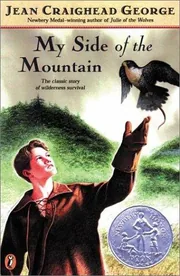
My side of the mountain
by Jean Craighead George · 1959
Written for young readers, it suits children who enjoy nature and adventure stories and works well as a read-aloud.
177 pages, about 3 to 4 hours.
A boy, a hollow tree, and a falcon: survival done simply. 59% taste match
About the book
My Side of the Mountain is a children's adventure novel by Jean Craighead George, first published in 1959. The author also illustrated the book. It follows a boy who leaves home in New York City and sets out to live on his own in the Catskill Mountains of New York State, narrating the year he spends there.
The story centers on wilderness survival and self-reliance. The boy makes his home in a tree, learns to get by on what the land provides, and forms bonds with the animals around him, including a falcon. Over the course of the year he also comes to see how much he needs the company of other people. The book is a work of fiction written for young readers, and it appears in a Spanish-language edition as well. It received a Newbery Honor in 1960. A film loosely based on it was released in 1969, and the author later wrote two sequels. The book has been issued in many editions, and a typical copy runs about 177 pages.
On Sunday morning Leo Nolan was sprawled on the floor of the living room reading the Sunday comics.
Setting
New York (State)Catskill Mountains (N.Y.)Catskill Mountains
Themes
FalconsSpanish language materialsSelf-relianceLiteratura juvenilVida montañesaAutodependenciaSurvivalWilderness survival
- Want to read 576
- Reading now 43
- Read 58
Most people shelving it are saving it for later.
Of 677 readers who put it on a shelf, 85% want to read it, 6% are reading it now, 9% have finished it and 0% stopped before the end.
By the numbers
- The median edition runs 177 pages. Counting about 275 words a page and an adult reading pace of 250 words a minute, that is about 3.2 hours of reading.
- Open Library tracks 45 editions from 24 publishers, the earliest dated 1959 and the latest 2011, across 4 languages.
- On reader demand it ranks in the top 1% of the classic books in our catalog (8,749 of them).
- Libraries shelve it under Dewey 813.54 and Library of Congress class PZ-0007.00000000.G2933 My 2005.
 BookWard’s take
A boy, a hollow tree, and a falcon: survival done simply
My Side of the Mountain opens with a boy already settled in his tree home, and that first sentence sets the quiet, confident tone for the rest. At 177 pages it is tight and short, which suits this reader. The opening hooks at once: you want to know how he got there and how he will manage. The pace moves steadily because each chapter solves a practical problem, so the middle does not sag. The prose is plain and clear, and the book is driven more by story than by ideas, with a hopeful outlook. It is more comforting than the books this reader usually favors, but it earns that warmth through the boy's real need for people.
At 177 pages it stays lean and never overstays, which matches BookWard's taste for tight books.
Steady and purposeful, driven by one problem after another, though calmer than BookWard's brisker preference.
A boy living in a tree with a falcon was distinctive in 1959 and still feels like its own thing.
Plain and clear for young readers, a little plainer than BookWard's slightly richer taste.
Plot and character share the load, with the year's events shaping the boy's inner change.
It is an optimistic book about resourcefulness and finding where you belong, a touch warmer than BookWard's norm.
A conventional single-narrator account of one year, told in order.
Light touches of charm appear, but the tone is mostly earnest.
Hardship exists, but the tone stays gentle and suitable for children.
Feelings run warm and modest rather than intense, less so than BookWard leans.
See all 50 dialsEvery position, side by side with this book
Where it lines up
- LengthBookWard 1 · book 1
- EndingBookWard 8 · book 8
- Shock for effectBookWard 9 · book 9
Where it pulls apart
- Familiar tropesBookWard 10 · book 6
- Internal logicBookWard 10 · book 7
- ExpositionBookWard 2 · book 5
At 177 pages it stays lean and never overstays, which matches BookWard's taste for tight books.
The first sentence drops you into the boy's tree home, and the how and why pull you straight in.
The runaway-survival setup is a well-worn adventure shape, though the specific year in the Catskills keeps it fresh.
Each survival step follows from the last in a practical, believable way, which BookWard values.
Steady and purposeful, driven by one problem after another, though calmer than BookWard's brisker preference.
A boy living in a tree with a falcon was distinctive in 1959 and still feels like its own thing.
The boy is clearly drawn through his choices and his slow realization about needing people, though he is not deeply complex.
It lands on a clear realization about human companionship, giving a satisfying resolution that fits BookWard's liking for closure.
Warm and affectionate toward nature and animals, but it stays fairly plainspoken rather than syrupy.
Hardship comes from nature and need, never from manufactured darkness, so any tension is earned.
This is fiction, so the nonfiction rigor dial does not apply.
A first-person narrator with a calm, direct, self-reliant voice that gives the book its identity.
It is firmly story-led, built on one boy's year, in line with BookWard's preference.
The boy often explains how he does things, so practical detail is stated more than dramatized, more than BookWard favors.
Seasons give the year a natural shape and each stretch brings something new, so it holds up.
Plain and clear for young readers, a little plainer than BookWard's slightly richer taste.
Plot and character share the load, with the year's events shaping the boy's inner change.
It is an optimistic book about resourcefulness and finding where you belong, a touch warmer than BookWard's norm.
A conventional single-narrator account of one year, told in order.
Light touches of charm appear, but the tone is mostly earnest.
Easy to read and aimed at young readers, so it asks little effort, lighter than BookWard's usual.
Told entirely through the one boy's eyes.
The year unfolds in order, season by season.
Entirely grounded in real wilderness and real animals.
The focus stays on the boy and a small circle of animals and few people.
An intimate story of one boy on one mountain.
Leans toward outdoor action and chores, with reflection woven in.
Mostly narration and action, with talk kept sparse.
Romance plays no real part in the story.
A mountain forest life is unfamiliar to most readers, which adds interest.
Written in 1959, it reads as a mid-century story rather than a present-day one.
The appeal of self-reliance and wild places has kept it in print in many editions.
The boy reports his year straightforwardly with no sign of unreliability.
Its lessons about self-reliance and needing others are clearly drawn, not murky.
Rich with practical detail about tree homes, animals, and the land through the seasons.
This is fiction, so the nonfiction style dial does not apply.
The whole book is the boy's personal, first-person account.
It stands well alone but was followed by two sequels, so it opens a small series.
It moves through a year of events rather than reversals, so surprises are few.
A gentle, reassuring read rather than a challenging one, softer than BookWard's usual.
Hardship exists, but the tone stays gentle and suitable for children.
Feelings run warm and modest rather than intense, less so than BookWard leans.
Whatever humor there is stays mild and dry, never broad.
Little violence, mostly the practical realities of hunting and survival.
No sexual content in this children's book.
Politics are absent; the focus is the wilderness and personal growth.
Plain, accessible language throughout.
The boy's own views on nature and independence color the narration.
It looks back to a classic, timeless idea of wilderness more than ahead.
It is hopeful about nature, self-sufficiency, and human connection, with little cynicism.
Review written by BookWard, dial version 1, November 2026.
Who is My side of the mountain right for?
Written for young readers, it suits children who enjoy nature and adventure stories and works well as a read-aloud. The main thing to note is that a young runaway lives alone in the wild, which some families may want to talk through.
Easy to read and aimed at young readers, so it asks little effort, lighter than BookWard's usual.
Hardship exists, but the tone stays gentle and suitable for children.
Feelings run warm and modest rather than intense, less so than BookWard leans.
Little violence, mostly the practical realities of hunting and survival.
Book CompanionMy side of the mountain: ideas, characters, themes
A boy sets out to live alone in the Catskill Mountains and learns how much he can do for himself and how much he still needs other people.
- A runaway to the wild. The boy leaves home in New York City to live on his own in the Catskill Mountains.
- A tree for a home. He makes his home in a tree, and the first line shows it hidden from passersby.
- Living off the land. The story follows how he gets by on what the land provides over one year.
- Animal companions. He forms bonds with animals around him, including a falcon.
- Needing people. By the end he realizes he needs human companionship.
Characters
The boy
Narrator and protagonist
A young runaway from New York City who spends a year alone in the Catskills.
The falcon
Animal companion
One of the animal friends the boy bonds with during his year on the mountain.
Themes
Learning to meet your own needs from what nature provides.
The practical struggle to eat, shelter, and stay safe in the wild.
The bonds the boy forms with the creatures around him.
Discovering that independence still leaves a need for other people.
Discussion questions
- Why do you think the boy chooses to leave home and live alone?
- What does the tree home tell us about how he wants to live?
- How do the animals, especially the falcon, change his year?
- Why does he come to see that he needs other people?
- Would you last a year alone in the wild, and what would be hardest?
Personalize your Book Companion
This is the general edition. In BookWard, the Companion is written for you: your reading profile, your notes, and spoiler-safe to the page you are on.
Buy, listen or borrow My side of the mountain
Each link opens a search for this book on that store, in a new tab.
Read on a device
Borrow
Reviews and community
If you liked My side of the mountain
A boy, a hatchet, and the wilderness that teaches him
The Indian in the CupboardLynne Reid BanksA boy, a cupboard, and a toy brought to life
The Wild RobotPeter BrownA robot on a wild island, told with quiet nerve
The RiverGary PaulsenA short, tense survival sequel that stays on the water
Sources: Open Library.
Track My side of the mountain and find your next favorite
Add it to your shelf, rate what you have read, and BookWard will recommend what fits you.
Free to start. No credit card needed.