It suits upper elementary and middle-grade readers, and works well for reluctant readers who like adventure.
192 pages, about 3 to 4.5 hours.
A boy, a hatchet, and the wilderness that teaches him. 66% taste match
About the book
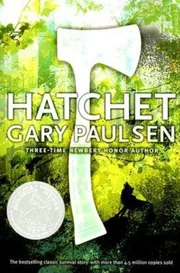
Hatchet is a young-adult survival novel by Gary Paulsen, a work of children's fiction that earned a Newbery Honor in 1988. The story follows Brian Robeson, a teenager whose parents have divorced. He boards a small plane bound for the north, where he plans to spend the summer with his father. When the aircraft goes down, Brian finds himself alone in the Canadian wilderness, far from anything familiar, and has to work out how to stay alive in a landscape unlike the one he knows.
The book is set in the 1980s and reaches from New York State to the northern forests of Canada. It deals with family separation alongside the practical struggle of living outdoors with very little. Hatchet opens a series of five novels, which continues with The River, Brian's Winter, Brian's Return and Brian's Hunt. Paulsen's novel runs to about 192 pages in its typical edition and has appeared in 81 editions since it was first published by Bradbury Press.
BRIAN ROBESON stared out the window of the small plane at the endless green northern wilderness below.
Setting
CanadaHamptonNew York State
Period
70-80s1987
Themes
Divorceplane crashsurvivalHatchetGary PaulsenTeensTeenagersYA
- Want to read 1,820
- Reading now 156
- Read 260
Most people shelving it are saving it for later.
Of 2236 readers who put it on a shelf, 81% want to read it, 7% are reading it now, 12% have finished it and 0% stopped before the end.
By the numbers
- The median edition runs 192 pages. Counting about 275 words a page and an adult reading pace of 250 words a minute, that is about 3.5 hours of reading.
- Open Library tracks 81 editions from 52 publishers, the earliest dated 1986 and the latest 2018, across 4 languages.
- On reader demand it ranks in the top 1% of the modern books in our catalog (15,152 of them).
- Libraries shelve it under Dewey [Fic] and Library of Congress class PZ-0007.00000000.P2843 Col 2004.
 BookWard’s take
A boy, a hatchet, and the wilderness that teaches him
Hatchet puts Brian Robeson alone in the Canadian wilderness after his plane goes down, and it never wastes a page getting him there. The opening grabs at once: a small plane, endless green below, and the story is already moving. At 192 pages, the book is tight, and it keeps a brisk pace because each chapter hands Brian a new problem to solve. Its internal logic is a real strength, since survival here runs on cause and effect, not luck. Most of what we learn comes through scenes of trial and error rather than explanation. The characterization draws on Brian's inner life as much as his actions, and the divorce he carries gives the survival plot an emotional core. It earned a Newbery Honor in 1988 and opens a five-book series.
At 192 pages it is lean and unpadded, which matches BookWard's love of short, tight books.
Each chapter brings a new problem to solve, so the story keeps moving at a brisk, steady clip.
The stranded-in-the-wild premise is classic, so it feels sturdy and well made more than strikingly new.
The sentences are plain and clear, in line with BookWard's lean-leaning taste.
Events drive the book, but Brian's inner change matters as much, so it balances both close to BookWard's lean.
Brian's resilience gives the book a hopeful current, a little warmer than BookWard's balance.
The story follows one boy straight through, a conventional shape that is close to BookWard's comfort zone.
This is a serious survival story with little humor, a bit more sober than BookWard's lighter tilt.
Danger and loneliness are real but handled for a young audience, mild compared with BookWard's range.
Fear, grief, and triumph are felt but not overplayed, close to BookWard's emotional range.
See all 50 dialsEvery position, side by side with this book
Where it lines up
- LengthBookWard 1 · book 1
- OpeningBookWard 10 · book 10
- PaceBookWard 8 · book 8
Where it pulls apart
- Familiar tropesBookWard 10 · book 6
- OriginalityBookWard 9 · book 6
- ViewpointsBookWard 7 · book 1
At 192 pages it is lean and unpadded, which matches BookWard's love of short, tight books.
It opens on a small plane over endless wilderness and moves fast, exactly the immediate pull BookWard rewards.
Survival-adventure has well-worn shapes, so it leans on some familiar beats where BookWard prefers fresher ground.
Brian's survival works through cause and effect, so the story holds together tightly, which BookWard values highly.
Each chapter brings a new problem to solve, so the story keeps moving at a brisk, steady clip.
The stranded-in-the-wild premise is classic, so it feels sturdy and well made more than strikingly new.
Brian's fears and the weight of his parents' divorce are drawn closely, giving the survival plot real depth.
The story resolves its central struggle with a clear sense of closure, close to what BookWard likes.
Brian's feelings are present but the book stays practical, a touch warmer than BookWard's restrained taste.
The danger is real and earned by the situation, not used for cheap effect, which BookWard respects.
This is fiction, so the dial does not apply.
Paulsen's plain, close narration has a clear identity that BookWard enjoys.
This is firmly story-led, driven by what happens to Brian, which suits BookWard's preference for story.
Brian learns by doing, so information arrives through scenes instead of being explained, as BookWard prefers.
With one problem leading to the next, the middle stays engaged more than most, close to BookWard's standard.
The sentences are plain and clear, in line with BookWard's lean-leaning taste.
Events drive the book, but Brian's inner change matters as much, so it balances both close to BookWard's lean.
Brian's resilience gives the book a hopeful current, a little warmer than BookWard's balance.
The story follows one boy straight through, a conventional shape that is close to BookWard's comfort zone.
This is a serious survival story with little humor, a bit more sober than BookWard's lighter tilt.
Short sentences and a clear storyline make it easy to read, a touch easier than BookWard usually goes.
The story stays with Brian alone, a narrower lens than BookWard's liking for many viewpoints.
It is grounded in a plausible wilderness setting, fitting BookWard's moderately realistic lean.
Brian is nearly alone for most of the book, a far smaller cast than BookWard typically seeks.
The story is one boy against the wilderness, intimate in scope and close to BookWard's mid-range.
Brian's practical struggle and his private thoughts share the page, sitting near BookWard's inward lean.
Brian is alone, so there is little conversation, lighter on dialogue than BookWard prefers.
Romance plays no part in this survival story, which fits BookWard's low-romance leaning.
The northern Canadian wilderness is unfamiliar to Brian and many readers, which BookWard enjoys.
Set in the 1980s, it sits in the recent past, a bit less present-day than BookWard's lean.
Survival and self-reliance stay relevant, so the book has held up as a lasting favorite.
The narration follows Brian plainly and honestly, more reliable than BookWard's taste for unreliability.
Brian's choices are mostly practical and clear, less ambiguous than BookWard likes.
The wilderness is rendered with enough detail to feel real, close to BookWard's moderate lean.
This is fiction, so the dial does not apply.
This is fiction, so the dial does not apply.
It opens a five-book series, so it leans toward the series end where BookWard sits mid-range.
The plot turns on survival problems and setbacks, a moderate number of surprises, a bit below BookWard's lean.
It asks Brian and the reader to face hardship, a gentler challenge than BookWard's appetite.
Danger and loneliness are real but handled for a young audience, mild compared with BookWard's range.
Fear, grief, and triumph are felt but not overplayed, close to BookWard's emotional range.
Humor is minimal, so there is little broad comedy and it falls toward the dry end.
There is danger and hardship but little graphic violence, quieter than BookWard's mid-range.
There is no sexual content, which sits at the low end of BookWard's mid-range.
Politics does not enter the story, which is more absent than BookWard's mid-range.
The language is plain and accessible, easier than BookWard's mid-range.
The narration stays close to Brian's experience without pushing views, more neutral than BookWard's lean.
The story is about a boy growing and moving ahead, nudging forward, a little below BookWard's lean.
Brian's perseverance carries a quietly idealistic faith in self-reliance, close to BookWard's lean.
Review written by BookWard, dial version 1, November 2026.
Who is Hatchet right for?
It suits upper elementary and middle-grade readers, and works well for reluctant readers who like adventure. It deals with a plane crash, loneliness, and danger, and some younger readers may find the peril intense.
Short sentences and a clear storyline make it easy to read, a touch easier than BookWard usually goes.
Danger and loneliness are real but handled for a young audience, mild compared with BookWard's range.
Fear, grief, and triumph are felt but not overplayed, close to BookWard's emotional range.
There is danger and hardship but little graphic violence, quieter than BookWard's mid-range.
Book CompanionHatchet: ideas, characters, themes
A boy stranded alone in the Canadian wilderness must learn to survive, and in doing so begins to understand himself.
- The crash. Brian's small plane goes down in the northern wilderness, leaving him alone far from anything familiar.
- The divorce behind the trip. Brian is flying north to spend the summer with his father, and his parents' divorce shadows the journey.
- Learning by doing. Survival comes through trial and error as Brian works out how to stay alive with very little.
- An unfamiliar world. The Canadian wilderness is unlike anything in Brian's life, forcing him to adapt.
- A series opener. Hatchet begins a five-novel series that continues with The River, Brian's Winter, Brian's Return and Brian's Hunt.
Characters
Brian Robeson
Protagonist
A teenager struggling through his parents' divorce who must survive alone in the Canadian wilderness.
Themes
Staying alive through resourcefulness, patience, and learning from mistakes.
Facing hardship reveals strengths Brian did not know he had.
Divorce shapes how Brian sees himself and the journey ahead.
The wilderness is both a threat and a teacher.
Discussion questions
- How does Brian's frame of mind change as his situation changes?
- In what ways does the divorce shape Brian's choices in the wilderness?
- Which survival skills does Brian learn by failing first?
- Is the wilderness best seen as an enemy, a teacher, or both?
- What does the story say about self-reliance?
Personalize your Book Companion
This is the general edition. In BookWard, the Companion is written for you: your reading profile, your notes, and spoiler-safe to the page you are on.
Buy, listen or borrow Hatchet
Each link opens a search for this book on that store, in a new tab.
Read on a device
Borrow
Reviews and community
If you liked Hatchet
A short, tense survival sequel that stays on the water
My side of the mountainJean Craighead GeorgeA boy, a hollow tree, and a falcon: survival done simply
The War That Saved My LifeKimberly Brubaker BradleyA child's wartime escape from cruelty, told with quiet force
The Wild RobotPeter BrownA robot on a wild island, told with quiet nerve
Sources: Open Library.
Track Hatchet and find your next favorite
Add it to your shelf, rate what you have read, and BookWard will recommend what fits you.
Free to start. No credit card needed.