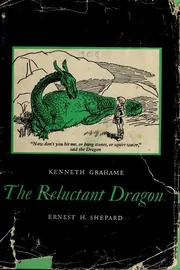
The reluctant dragon
by Kenneth Grahame, Jim Weiss · 1898
It suits young readers and anyone who likes gentle fairy-tale fantasy, and it is short enough to read aloud in one go.
38 pages, about 0.5 to 1 hours.
A gentle dragon, a kind boy, and one very polite compromise. 52% taste match
The story
The Reluctant Dragon is a children's fantasy story by Kenneth Grahame, first published in 1898 as a chapter in his collection Dream Days. It belongs to the tradition of fairy tales and fairy plays, and it is often cited as an early example of a story in which the dragon is a sympathetic figure rather than a menace. Many editions of the story have been issued over the years, including illustrated ones, and it runs to a short 38 pages in its median form.
The story begins long ago in a cottage between a small English village and the Downs, where a shepherd lives with his wife and their young son. The boy discovers a dragon living in a cave nearby and comes to understand that it is gentle and means no harm. The difficulty lies with the frightened villagers and with Saint George, the famous dragon killer, who must somehow be persuaded that there is nothing to fear. Friendship and compromise run through the tale, which suits readers who enjoy gentle fantasy about dragons and a boy who stands up for an unlikely companion.
LONG ago-might have been hundreds of years ago-in a cottage halfway between a little English village and the shoulder of the Downs, a shepherd lived with his wife and their little son.
Themes
DragonsFairy talesFairy playsFantasyFriendshipCompromise (Ethics)Indians of North AmericaPictorial works
- Want to read 68
- Reading now 7
- Read 21
Most people shelving it are saving it for later.
Of 96 readers who put it on a shelf, 71% want to read it, 7% are reading it now, 22% have finished it and 0% stopped before the end.
By the numbers
- The median edition runs 38 pages. Counting about 275 words a page and an adult reading pace of 250 words a minute, that is about 40 minutes of reading.
- Open Library tracks 228 editions from 35 publishers, the earliest dated 1938 and the latest 2022.
- On reader demand it ranks in the top 12% of the classic books in our catalog (8,749 of them).
- Libraries shelve it under Dewey 823.8 and Library of Congress class PZ-0008.00000000.G7463 Re.
 BookWard’s take
A gentle dragon, a kind boy, and one very polite compromise
The Reluctant Dragon is a short, sunny piece of children's fantasy, and a good deal of its charm comes from how little it asks of you. At 38 pages it is tight, which is a point in its favor, and it sets its problem straight away: a boy has found a harmless dragon, and the village and Saint George are not going to take that calmly. The trouble is that its shape is familiar. The idea of a sympathetic dragon is now so common that the story can feel less surprising than it once was, though it is often cited as an early example. It holds back from sentimentality, and its moral is clear without being heavy, which sits warmly with the tone. The ending resolves cleanly rather than trailing off.
At 38 pages it is about as short as a book gets, which matches BookWard's love of the tight and short.
A short tale moves along at a steady, easy clip rather than racing, a little gentler than BookWard's usual pace.
Cited as an early example of the friendly dragon, it was ahead of its time, though the idea now feels familiar.
The language is polished and slightly old-fashioned, a touch more ornate than plain.
The premise drives events as much as the characters do, so the tale sits near the middle of the dial.
It is a friendly, optimistic story that leans toward understanding and compromise.
A single conventional story told in order, with nothing experimental in how it is built.
The comedy of a dragon who would rather not fight gives it a lightly humorous tone.
Even with a dragon and a dragon killer, the tone stays gentle and safe.
Warmth and amusement dominate, with feeling kept light and mild.
See all 50 dialsEvery position, side by side with this book
Where it lines up
- LengthBookWard 1 · book 1
- Shock for effectBookWard 9 · book 9
- Sagging middleBookWard 8 · book 8
Where it pulls apart
- Familiar tropesBookWard 10 · book 4
- Internal logicBookWard 10 · book 6
- OpeningBookWard 10 · book 7
At 38 pages it is about as short as a book gets, which matches BookWard's love of the tight and short.
The boy, the cave and the dragon arrive quickly, so the opening engages early without needing a dramatic jolt.
Dragons, villagers and Saint George are familiar fairy-tale pieces, though the sympathetic dragon was a fresh angle in its day.
Its fairy-tale rules hold together well enough for a gentle fantasy, though they are not built to be airtight.
A short tale moves along at a steady, easy clip rather than racing, a little gentler than BookWard's usual pace.
Cited as an early example of the friendly dragon, it was ahead of its time, though the idea now feels familiar.
The boy, the dragon and Saint George are drawn as lively fairy-tale figures rather than deeply layered people.
The problem of persuading the village and Saint George gets a tidy, satisfying resolution rather than a loose end.
It is warm and affectionate without turning syrupy, landing in the middle of the dial.
Nothing here relies on shock; the stakes are mild and the story stays kind throughout.
This is a work of fiction, so rigor does not apply.
Grahame's storytelling voice is distinctive and playful, giving the tale a personality of its own.
The tale is led by its story of a boy, a dragon and a village, with a gentle idea about tolerance underneath.
A fairy-tale narrator explains some things outright, though much still unfolds through scenes and exchanges.
At 38 pages there is no room for a middle to droop, so the story stays sustained.
The language is polished and slightly old-fashioned, a touch more ornate than plain.
The premise drives events as much as the characters do, so the tale sits near the middle of the dial.
It is a friendly, optimistic story that leans toward understanding and compromise.
A single conventional story told in order, with nothing experimental in how it is built.
The comedy of a dragon who would rather not fight gives it a lightly humorous tone.
Short and clear, it makes very few demands on a reader, young or old.
The story keeps close to a single thread, with little jumping between perspectives.
It runs straight through from the discovery of the dragon to its resolution.
A living dragon and Saint George place it firmly in fairy-tale fantasy.
A small group of key figures carries the story: the boy, the dragon, Saint George and the villagers.
The action centers on one village and a nearby cave, so it stays intimate.
Events and encounters matter more than inner reflection, though the boy's understanding is central.
Conversation does a good share of the work in persuading the dragon and the others.
There is no romance; friendship is the relationship that matters here.
A long-ago English village near the Downs is a storybook setting, familiar from fairy tales.
Set long ago and published in 1898, it sits well toward the past.
Its sympathetic-dragon idea has carried through generations, and many editions have kept it in print.
The narrator tells the tale openly and can be taken at face value.
The message about tolerance and compromise is clear and easy to read.
Setting and creatures are sketched with some charm but not at great length.
It stands alone as a story, though it first appeared as a chapter in Dream Days.
The path from conflict to compromise is easy to follow, with few real surprises.
A comforting, reassuring read with nothing to unsettle the reader.
Even with a dragon and a dragon killer, the tone stays gentle and safe.
Warmth and amusement dominate, with feeling kept light and mild.
The humor is dry-leaning and good-natured rather than broad slapstick.
The threat of a dragon fight hangs over the tale, but little harm lands on the page.
There is no sexual content at all.
The tale has no political agenda beyond a plea for tolerance.
The language is plain and readable, with only light period flavor.
The narrator has plenty of personality and gentle opinions about the characters.
It reads as a story from the past with a timeless lesson, more backward than forward looking.
It believes that kindness and compromise can win out, which is an idealistic stance.
Review written by BookWard, dial version 1, November 2026.
Who is The reluctant dragon right for?
It suits young readers and anyone who likes gentle fairy-tale fantasy, and it is short enough to read aloud in one go. The threat of a dragon fight is mild, and nothing in it should upset sensitive readers.
Short and clear, it makes very few demands on a reader, young or old.
Even with a dragon and a dragon killer, the tone stays gentle and safe.
Warmth and amusement dominate, with feeling kept light and mild.
The threat of a dragon fight hangs over the tale, but little harm lands on the page.
Book CompanionThe reluctant dragon: ideas, characters, themes
A boy tries to convince a frightened village and Saint George that a gentle dragon is nothing to fear.
- The discovery. A shepherd's young son finds a dragon living in a cave near his cottage and realizes it is kindly and harmless.
- The problem. The villagers are frightened, and the famous dragon killer Saint George stands as the greatest obstacle to peace.
- The setting. The story takes place long ago in a cottage between a small English village and the Downs.
- The boy's stand. The boy takes it on himself to defend an unlikely companion against fear and suspicion.
- The wider legacy. The tale is often cited as a prototype for later stories where the dragon is sympathetic rather than a threat.
Characters
The boy
The shepherd's son who finds the dragon
He sees that the dragon is gentle and takes up its cause with the village.
The dragon
The kindly creature in the cave
A harmless dragon whose reluctance to be a menace drives the story.
Saint George
The famous dragon killer
The knight whose reputation makes him the greatest obstacle to the dragon's safety.
The villagers
The frightened community
They fear the dragon and must be persuaded there is no cause for alarm.
Themes
A bond forms across the line between a boy and a creature everyone else fears.
The tale favors finding a middle way over a fight to the finish.
The villagers judge the dragon by its kind rather than by what it is actually like.
The boy defends a companion when the whole village is against it.
Saint George and the dragon both carry a name that does not quite match the truth.
Discussion questions
- Why do you think the villagers fear the dragon before they know anything about it?
- What makes the boy so sure that the dragon is harmless?
- How does Saint George's reputation shape what everyone expects to happen?
- What does the story suggest about solving problems without a fight?
- Does a sympathetic dragon feel familiar to you today, and what does that say about this story's influence?
Personalize your Book Companion
This is the general edition. In BookWard, the Companion is written for you: your reading profile, your notes, and spoiler-safe to the page you are on.
Buy, listen or borrow The reluctant dragon
Each link opens a search for this book on that store, in a new tab.
Read on a device
Borrow
Reviews and community
If you liked The reluctant dragon
A short, sharp ghost comedy that turns sentimental at the close
The Wind in the WillowsKenneth GrahameA gentle riverbank classic with one gloriously reckless Toad
Room on the BroomJulia DonaldsonA rhyming broomstick tale where kindness gets crowded and then pays off
The Ugly DucklingHans Christian AndersenA short fairy tale about an unloved duckling who becomes a swan
Sources: Open Library.
Track The reluctant dragon and find your next favorite
Add it to your shelf, rate what you have read, and BookWard will recommend what fits you.
Free to start. No credit card needed.