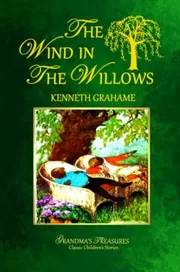
The Wind in the Willows
by Kenneth Grahame · 1908
It suits young readers who enjoy talking animals, rural English settings and stories about loyal companions, and it reads aloud well.
192 pages, about 3 to 4.5 hours.
A gentle riverbank classic with one gloriously reckless Toad. 53% taste match
About the book
Kenneth Grahame's The Wind in the Willows is a children's novel that first appeared in 1908. It is an animal fantasy set in the English countryside, where the characters live along a river and in the fields and woods nearby. The cast centres on four animals: Mole, Rat, Toad and Badger. The story begins on a spring morning with Mole busy cleaning his small home, and from there it follows the friendships that form among these creatures and the adventures they share.
Much of the plot turns on Mr. Toad, whose fixation on motorcars lands him in trouble and leaves Mole, Ratty and Badger trying to help him out of it. Country life and river life run through the book, along with friendship, folklore and a Christmas episode. A standard edition runs to roughly 192 pages, and the book has appeared in well over a thousand editions since its first publication, including illustrated and movable-book formats. It suits young readers who enjoy talking animals, rural English settings and stories about loyal companions.
THE MOLE HAD been working very hard all the morning, spring-cleaning his little home.
Setting
EnglandXian daiYing guo
Themes
AnimalsFriendshipToy and movable booksCountry lifeRiver lifeSpecimensChristmasFolklore
- Want to read 595
- Reading now 52
- Read 104
Most people shelving it are saving it for later.
Of 751 readers who put it on a shelf, 79% want to read it, 7% are reading it now, 14% have finished it and 0% stopped before the end.
By the numbers
- The median edition runs 192 pages. Counting about 275 words a page and an adult reading pace of 250 words a minute, that is about 3.5 hours of reading.
- Open Library tracks 1346 editions from 372 publishers, the earliest dated 1908 and the latest 2024, across 9 languages.
- On reader demand it ranks in the top 1% of the classic books in our catalog (8,749 of them).
- Libraries shelve it under Dewey 821.8 and Library of Congress class PZ-0007.00000000.D79Wim 2006.
 BookWard’s take
A gentle riverbank classic with one gloriously reckless Toad
Kenneth Grahame's 1908 animal fantasy is short, at roughly 192 pages, and it opens on a spring morning with Mole cleaning his small home, so the invitation to wander is immediate. It is tight and easy to read, though the prose is old-fashioned and rich, with real affection for river and field. The characters are the draw: Mole, Ratty, Badger and Toad are distinct enough to carry the book. The outlook is warm, and the sentiment is fond rather than syrupy. It leans on familiar talking-animal comforts, so it won't win points for freshness, and its episodic shape means the pace is leisurely rather than brisk. Read it for the voice and the company, not for plot machinery.
At about 192 pages it is compact and easy to finish, which fits BookWard's taste for tight books.
The book wanders through riverside episodes at an unhurried pace, slower than BookWard's preference for brisk momentum.
Animals living gentlemanly lives along a river was a distinctive idea, though it is less startling now than BookWard's top end.
The language is graceful and slightly ornate, leaning a little richer than BookWard's middle-of-the-road taste.
The best parts come from who the animals are, with Toad's obsession driving much of the plot.
It is a book of comfort, companionship and homecoming, comfortably more hopeful than BookWard's baseline.
It moves through loosely linked episodes in conventional order, with nothing experimental in the form.
Toad's vanity and the animals' fussy manners make it gently funny throughout, close to BookWard's liking.
The tone is kind and gentle, and the trouble involved is mild.
Feeling runs warm but stays mild, with contentment rather than heavy intensity.
See all 50 dialsEvery position, side by side with this book
Where it lines up
- Character depthBookWard 8 · book 8
- EndingBookWard 8 · book 8
- Shock for effectBookWard 9 · book 9
Where it pulls apart
- Familiar tropesBookWard 10 · book 4
- OpeningBookWard 10 · book 6
- Internal logicBookWard 10 · book 6
At about 192 pages it is compact and easy to finish, which fits BookWard's taste for tight books.
It begins with Mole on a spring morning, a pleasant opening that invites rather than grabs, so it sits below BookWard's love of instant hooks.
Talking animals in an English countryside are a familiar setup, though the book's affection gives them freshness; BookWard prefers fewer tropes.
Its animal world follows its own consistent, cosy rules, which holds together well enough for a children's fantasy.
The book wanders through riverside episodes at an unhurried pace, slower than BookWard's preference for brisk momentum.
Animals living gentlemanly lives along a river was a distinctive idea, though it is less startling now than BookWard's top end.
Mole, Ratty, Badger and Toad each have clear temperaments that make them feel like individuals, close to BookWard's taste.
The story resolves its central trouble satisfyingly, which suits BookWard's liking for closure.
It is openly affectionate about home and friendship, warmer and more sentimental than BookWard's restrained taste.
Nothing here is dark for effect; the trouble Toad gets into is mischief, so it never leans on shock.
This is a novel, so the nonfiction rigor dial does not apply.
Grahame's narration is warm, humorous and unmistakable, a strong match for BookWard's love of distinctive voice.
The book is story-led, built from friendships and adventures along a river rather than from an argument.
Events and settings are mostly shown through scenes and talk, in line with BookWard's preference for showing.
Its episodic structure means some stretches drift more than others, so energy is not perfectly even.
The language is graceful and slightly ornate, leaning a little richer than BookWard's middle-of-the-road taste.
The best parts come from who the animals are, with Toad's obsession driving much of the plot.
It is a book of comfort, companionship and homecoming, comfortably more hopeful than BookWard's baseline.
It moves through loosely linked episodes in conventional order, with nothing experimental in the form.
Toad's vanity and the animals' fussy manners make it gently funny throughout, close to BookWard's liking.
Though the diction is old, the story is plain to follow and easy to read aloud.
The narrator moves among the animals, but the book mostly stays close to its small company, so it is more single than many.
Events unfold in a straightforward sequence with no time jumps.
Animals talk, wear clothes and keep houses, so this is clearly fantasy, though it is anchored in a real countryside.
Four main animals carry the book, a cast that stays small and easy to hold.
The world is a riverbank, fields and woods, which keeps the stakes personal and intimate.
The book balances daily feeling and outdoor adventure fairly evenly.
Conversation among the animals carries much of the charm and a good share of the book.
Friendship is the central bond here and romance plays no real part.
The English countryside is easy to picture, though the animals' way of life adds a gentle strangeness.
It was published in 1908 and its way of life belongs firmly to the past.
More than a century on, it is still read in many editions, so it has real staying power.
A warm, trustworthy narrator guides the reader without trickery.
Loyalty, friendship and home are treated as plain goods, with little moral ambiguity.
Grahame lingers on river, meadow and woodland with obvious love, making description a real pleasure.
This is a novel, so the nonfiction style dial does not apply.
This is a novel, so the nonfiction perspective dial does not apply.
It stands as a single self-contained book.
Toad's scrapes bring some surprises, but the story is more about journey than reveals.
This is a comforting read with little to unsettle.
The tone is kind and gentle, and the trouble involved is mild.
Feeling runs warm but stays mild, with contentment rather than heavy intensity.
The humor mixes dry narration with Toad's more theatrical vanity, landing in the middle.
Little physical harm appears, and the tone stays light.
There is no sexual content.
The book has no political agenda, only the social comedy of country life.
The Edwardian phrasing is slightly dated but never hard to understand.
The narrator freely comments with affection and amusement, giving the telling a decided personality.
The book looks fondly back to river life and old ways, even as motorcars intrude.
Its faith in friendship, home and kindness is warm and sincere.
Review written by BookWard, dial version 1, November 2026.
Who is The Wind in the Willows right for?
It suits young readers who enjoy talking animals, rural English settings and stories about loyal companions, and it reads aloud well. Content is gentle, though the older English phrasing may need a little explaining.
Though the diction is old, the story is plain to follow and easy to read aloud.
The tone is kind and gentle, and the trouble involved is mild.
Feeling runs warm but stays mild, with contentment rather than heavy intensity.
Little physical harm appears, and the tone stays light.
Book CompanionThe Wind in the Willows: ideas, characters, themes
A circle of riverbank animals find that friendship, home and a little restraint matter more than showy adventure.
- A small, close company. The story centres on four animals: Mole, Rat, Toad and Badger, whose friendships drive the book.
- Spring and a fresh start. The story begins on a spring morning with Mole busy cleaning his small home, opening the book on a note of change.
- Toad's obsession. Much of the plot turns on Mr. Toad's fixation on motorcars and the trouble it brings.
- Friends to the rescue. Mole, Ratty and Badger try to help Toad out of the trouble he lands in.
- Country and river life. Fields, woods and the river form the world of the book, along with folklore and a Christmas episode.
Characters
Mole
One of the four central animals
Mole begins the story cleaning his small home on a spring morning, and his friendships grow from there.
Ratty
One of the four central animals
Ratty is one of the friends who tries to help Toad when he gets into trouble.
Badger
One of the four central animals
Badger joins Mole and Ratty in trying to help Toad out of his difficulties.
Mr. Toad
The friend who causes the trouble
Toad becomes obsessed with motorcars and gets into trouble, which sets much of the plot moving.
Themes
Loyalty among companions who stand by one another, even when one of them is a handful.
The comfort and pull of a familiar place and the lives built around it.
How one fixation, like Toad's love of motorcars, can pull a person into trouble.
A loving picture of river, field and wood as a place worth cherishing.
The book carries a thread of old tale and tradition alongside its everyday scenes.
Discussion questions
- Why do you think Mole, Ratty and Badger keep helping Toad despite his behavior?
- What does the book suggest about the pull between adventure and the comfort of home?
- How does the setting along the river shape the mood of the story?
- Is Toad a character to admire, pity, or laugh at, and why?
- Which episode would you most want to revisit, and what makes it stand out?
Personalize your Book Companion
This is the general edition. In BookWard, the Companion is written for you: your reading profile, your notes, and spoiler-safe to the page you are on.
Buy, listen or borrow The Wind in the Willows
Each link opens a search for this book on that store, in a new tab.
Read on a device
Borrow
Reviews and community
If you liked The Wind in the Willows
A gentle dragon, a kind boy, and one very polite compromise
A Little PrincessFrances Hodgson BurnettA kind girl keeps her dignity when fortune turns against her
The Canterville GhostOscar WildeA short, sharp ghost comedy that turns sentimental at the close
Anne of Green GablesLucy Maud MontgomeryA chatty orphan girl, a mistaken arrival, and a farm that changes
Sources: Open Library.
Track The Wind in the Willows and find your next favorite
Add it to your shelf, rate what you have read, and BookWard will recommend what fits you.
Free to start. No credit card needed.