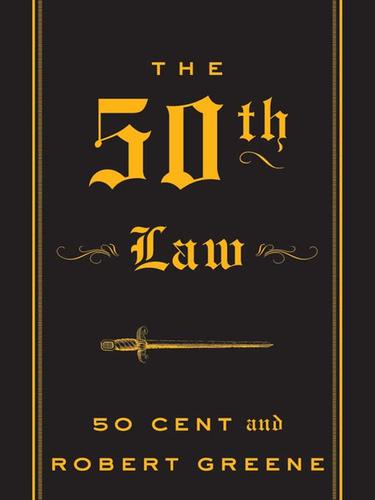
The 50Th Law
by Robert Greene
★ Top 25 book of 2009 · #16 on Best Books of 2009
Rapper 50 Cent teams up with Robert Greene to present a success manual built on one idea: fear nothing. Personal stories from the streets and the boardroom sit alongside examples of others who overcame hardship.
Best for: Entrepreneurs and anyone curious about Curtis Jackson's rise from tough beginnings
The 50Th Law is #16 on BookWard's Best Books of 2009, out of 42 2009 books that cleared our data bar.
What The 50Th Law is about
Written with rapper 50 Cent, Robert Greene's strategy book builds on a single idea: fear nothing. Each of its ten chapters takes one element of fearlessness and begins with a story from 50 Cent's own life, starting with the lessons he picked up as a young hustler in Southside Queens. His path from the streets to a music career, and then to the boardroom after the release of Get Rich or Die Tryin', gives the ideas a personal backbone.
Greene, who is known for The 48 Laws of Power, sets those stories beside examples from history. Malcolm X, Miles Davis, Sun Tzu, Machiavelli, James Baldwin, Lincoln, Socrates and Napoleon all appear. The pitch is that this single principle can steer you through both life and work.
It will suit readers who like their strategy mixed with memoir, and anyone who wants a push to stop letting fear make their decisions.
The 50Th Law on the Best Books of 2009
The 50Th Law came out in 2009. Of the 42 books first published in 2009 that met BookWard's data bar, it ranks #16 on our Best Books of 2009 list.
Why it made the list: 390 readers have shelved it on Open Library; 20 are reading it right now. The list ranks each year’s books on how many readers have picked them up, how highly readers rate them, and how many are reading them right now.
Nearby on the 2009 list
- Wolf Hall Hilary Mantel, #14
- The Boy Who Harnessed the Wind William Kamkwamba, #15
- Drive Daniel H. Pink, #17
- Fallen (Fallen #1) Lauren Kate, #18
See all Best Books of 2009 Best books by year
More years: Best Books of 2008 Best Books of 2010.
The numbers behind it
- Readers: 364 want to read it, 20 are reading it now and 6 have read it, according to Open Library.
| Signal | This book (0 to 100) | Weight |
|---|---|---|
| Reach | 67 | 55% |
| Reader love | 36 | 25% |
| Being read right now | 69 | 20% |
Questions about The 50Th Law
When was The 50Th Law published?
The 50Th Law by Robert Greene was first published in 2009.
Was The 50Th Law one of the best books of 2009?
The 50Th Law is #16 on BookWard's Best Books of 2009, out of 42 2009 books that cleared our data bar. 390 readers have shelved it on Open Library; 20 are reading it right now.
Why is The 50Th Law on the Best Books of 2009 list?
390 readers have shelved it on Open Library; 20 are reading it right now.
More of the best books of 2009
- The Last Olympian Rick Riordan, #1
- Catching Fire Suzanne Collins, #2
- The Maze Runner James Dashner, #3
- The Help Kathryn Stockett, #4
- Dork Diaries Rachel Renée Russell, #5
- I Will Teach You to Be Rich Ramit Sethi, #6
See the full Best Books of 2009, the Top 100, or new books on Rising.
How we know
This page uses public data: Open Library reader counts and ratings, and Wikipedia page views for recent years. The description is paraphrased from real source text. Rankings reflect reading interest, not quality or sales, and can be affected by data gaps. Lists update monthly.
Best suited to older teens and adults interested in strategy, entrepreneurship or personal growth.
Depends on the edition you pick.
Fearlessness as strategy, told through 50 Cent and history's hard cases. 49% taste match
 BookWard’s take
Fearlessness as strategy, told through 50 Cent and history's hard cases
The 50th Law pairs Curtis Jackson's rise from Southside Queens with Robert Greene's habit of mining history for lessons. Each of its ten chapters takes one factor of fearlessness, opens on a street story, then widens to figures like Malcolm X, Miles Davis and Napoleon. The authorial voice is distinctive and the pace is clear and steady: the structure never changes, so the middle never sags, though the formula can feel repetitive. As argument it is closer to curated anecdote than evidence, and it tends to explain the lesson outright rather than letting scenes carry it. Idea-led, motivational and unapologetically upbeat, it suits readers who want a framework with a memorable face attached.
A ten-chapter structure keeps it mid-sized; it is not tight, but it never sprawls the way big strategy books do.
Short anecdotes and quick pivots to historical figures keep things moving without rushing the argument.
The collaboration and the street-to-history pairing are unusual, even if the underlying advice is well worn.
Clear, direct and conversational, with little ornament; the style serves the message.
It follows a rise to fame but is organised by idea, so it sits near the middle.
The core message is that fear can be overcome, which makes it energetic and optimistic despite the grim backdrop.
Ten chapters each pairing a street story with historical examples is orderly and conventional for the genre.
It is earnest and motivational, with little humour.
Street life and survival are part of the backdrop, giving it an edge without being relentless.
Driven and motivational, with moments of intensity from hard-won experiences.
See all 50 dialsEvery position, side by side with this book
Where it lines up
- EndingBookWard 8 · book 7
- Authorial voiceBookWard 9 · book 8
- Sagging middleBookWard 8 · book 7
Where it pulls apart
- Familiar tropesBookWard 10 · book 4
- LengthBookWard 1 · book 5
- Internal logicBookWard 10 · book 6
A ten-chapter structure keeps it mid-sized; it is not tight, but it never sprawls the way big strategy books do.
Each chapter opens on a Southside Queens story, which pulls you in quickly, though the book as a whole builds more steadily.
Self-help framing and success-book maxims are familiar ground, though the street-meets-history pairing freshens them.
Each chapter argues one factor of fearlessness and ties it back to the central principle, though examples are chosen to fit.
Short anecdotes and quick pivots to historical figures keep things moving without rushing the argument.
The collaboration and the street-to-history pairing are unusual, even if the underlying advice is well worn.
50 Cent comes through as a real person with a past; the historical figures serve mostly as illustrations.
Mostly pragmatic and hard-edged, with a motivational glow that sometimes tips toward inspirational uplift.
Street violence appears as context for the lessons rather than as spectacle, and it serves the point being made.
It leans on stories and historical vignettes rather than data or systematic evidence, which BookWard finds a weakness.
The blend of Greene's aphoristic style and 50 Cent's streetwise stories is instantly recognisable.
The framework of fearlessness drives the book; life stories exist to prove each idea.
Lessons are stated plainly after the anecdote, so the meaning is explained outright instead of left to scene.
A repeating chapter pattern keeps energy level, with no obvious dip, though sameness can creep in.
Clear, direct and conversational, with little ornament; the style serves the message.
It follows a rise to fame but is organised by idea, so it sits near the middle.
The core message is that fear can be overcome, which makes it energetic and optimistic despite the grim backdrop.
Ten chapters each pairing a street story with historical examples is orderly and conventional for the genre.
It is earnest and motivational, with little humour.
Plain language and short illustrative stories make it an easy read.
The narration is largely 50 Cent's, with Greene's historical voices layered in as examples.
Moves between Queens, the music industry and historical episodes, but within a mostly forward-moving personal story.
Entirely grounded in real people and real events.
50 Cent plus a long parade of historical figures from Sun Tzu to James Baldwin makes the cast large.
The personal story is intimate, but the historical sweep gives it wider reach.
It balances outward events from street life with the inner discipline of fearlessness.
Largely narration and commentary, with little scene-by-scene conversation.
Romance is not a concern of the book.
The Southside Queens street world and the music business will be unfamiliar to many readers.
Anchored in 50 Cent's rise and the music world of the 2000s, with historical examples reaching far back.
The fearlessness themes travel well, though the celebrity context dates parts of it.
Presented as a straightforward semi-autobiographical account with no sign of unreliable narration.
The philosophy is clearly stated, though some tactics invite debate about their ethics.
Anecdotes carry enough colour to place you, but the focus stays on the lessons.
It mixes storytelling with a lesson-by-lesson framework, leaning slightly toward narrative.
Told from 50 Cent's own life, so the perspective is strongly personal.
A standalone, though it echoes Greene's earlier work on power.
A structured advice book with few surprises beyond the anecdotes themselves.
It pushes readers to confront their fears and rethink how they act.
Street life and survival are part of the backdrop, giving it an edge without being relentless.
Driven and motivational, with moments of intensity from hard-won experiences.
What humour there is runs dry and incidental.
Street violence features as context, but it is not dwelt on.
Little sexual content; it stays on strategy and mindset.
Occasional social and racial context appears, but politics is not the focus.
Accessible language with occasional street idiom, easy to follow.
Strong, confident assertions about how to live and act run throughout.
Draws on history for lessons but is aimed at what the reader does next.
It pairs hard-nosed realism with a belief that mindset can transform a life.
Review written by BookWard, dial version 1, November 2026.
Who is The 50Th Law right for?
Best suited to older teens and adults interested in strategy, entrepreneurship or personal growth. It contains references to street violence and hard living, so sensitive readers may want to be aware.
Plain language and short illustrative stories make it an easy read.
Street life and survival are part of the backdrop, giving it an edge without being relentless.
Driven and motivational, with moments of intensity from hard-won experiences.
Street violence features as context, but it is not dwelt on.
Book CompanionThe 50Th Law: ideas, characters, themes
Fearlessness, the book argues, is a discipline you can train, and it is the foundation for success in work and life.
- Fear as the obstacle. Each chapter treats a specific factor of fearlessness as a skill to be practised.
- Street lessons first. Every chapter begins with how 50 Cent learned the idea in Southside Queens.
- History as proof. Figures such as Malcolm X, Miles Davis and Sun Tzu show the same principle at work in other lives.
- Ten-chapter framework. The ten chapters give the philosophy a clear structure you can follow in order.
- Aimed at doers. The book is pitched at entrepreneurs and anyone facing adversity who wants a working philosophy.
Characters
50 Cent (Curtis Jackson)
Co-author and central subject
His rise from Southside Queens to music success is the personal spine of the book.
Robert Greene
Co-author
The author of The 48 Laws of Power, who supplies the historical framework and examples.
Malcolm X
Historical example
One of the figures whose life illustrates the book's ideas about fearlessness.
Sun Tzu
Historical example
A strategic thinker drawn on for lessons about conflict and discipline.
Themes
Acting without being ruled by fear, treated here as a learnable discipline.
Thinking ahead and choosing actions deliberately rather than reacting.
Hardship as a teacher that shapes how people respond to challenge.
Rising from a hard start to a different kind of life.
Discussion questions
- Is fearlessness really a skill that can be trained, or partly a matter of temperament?
- How well do the historical examples support the lessons drawn from 50 Cent's own life?
- What does it add to hear these ideas from someone who lived them rather than only studied them?
- Which chapter's idea would you most want to apply, and which feels least convincing?
- Does pairing street stories with figures like Napoleon and James Baldwin clarify the message or flatten the differences?
Personalize your Book Companion
This is the general edition. In BookWard, the Companion is written for you: your reading profile, your notes, and spoiler-safe to the page you are on.
Buy, listen or borrow The 50Th Law
Each link opens a search for this book on that store, in a new tab.
Read on a device
Borrow
Reviews and community
If you liked The 50Th Law
Robert Greene's long, opinionated field guide to why people behave as they do
The Body Keeps the ScoreBessel van der KolkA sweeping trauma bestseller whose science has drawn serious criticism
Ego Is the EnemyRyan HolidayA short, sharp case that your own ego is the obstacle
OutliersMalcolm GladwellSuccess has a postcode and a birthday, not just talent
Find your own best books
Add what you have read, rate it, and BookWard will recommend what to read next.
Free to start. No credit card needed.