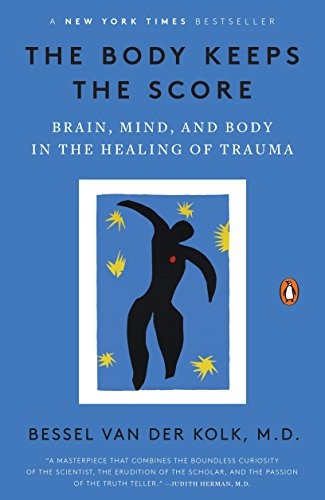
The Body Keeps the Score
by Bessel van der Kolk
★ Top 10 book of 2014 · #9 on Best Books of 2014
A leading trauma expert draws on three decades with survivors and recent science to show how trauma reshapes body and brain. He examines treatments like neurofeedback, yoga and drama, and the power of relationships to heal.
Best for: Readers curious about how trauma affects the brain and what treatments can help recovery
The Body Keeps the Score is #9 on BookWard's Best Books of 2014, out of 66 2014 books that cleared our data bar.
What The Body Keeps the Score is about
Bessel van der Kolk draws on more than thirty years of work with trauma survivors to explain how traumatic stress affects both mind and body. His central argument is that trauma reshapes the body and brain, wearing down the ability to feel pleasure, stay engaged, control impulses and trust other people. He gives special weight to attachment and social surroundings, arguing that relationships can hurt but can also heal.
The book also surveys ways of recovering, including EMDR, yoga, neurofeedback, meditation, sports and drama. It has stayed a bestseller for many years and appears in 36 languages. It is also contested: critics say it misstates some conclusions, leans on outdated research, and may steer readers away from evidence-based treatments such as CBT. It will interest survivors, their families and anyone curious about trauma, ideally read alongside professional advice.
The Body Keeps the Score on the Best Books of 2014
The Body Keeps the Score came out in 2014. Of the 66 books first published in 2014 that met BookWard's data bar, it ranks #9 on our Best Books of 2014 list.
Why it made the list: 1,799 readers have shelved it on Open Library; readers rate it 4.1 out of 5 (39 ratings); 71 are reading it right now. The list ranks each year’s books on how many readers have picked them up, how highly readers rate them, and how many are reading them right now.
Nearby on the 2014 list
- All the Light We Cannot See Anthony Doerr, #7
- Milk and Honey Rupi Kaur, #8
- Ignite Me Tahereh Mafi, #10
- Solitaire Alice Oseman, #11
See all Best Books of 2014 Best books by year
More years: Best Books of 2013 Best Books of 2015.
The numbers behind it
- Readers: 1,654 want to read it, 71 are reading it now and 73 have read it, according to Open Library.
- Ratings: 4.1 out of 5 from 39 Open Library ratings.
| Signal | This book (0 to 100) | Weight |
|---|---|---|
| Reach | 92 | 55% |
| Reader love | 53 | 25% |
| Being read right now | 86 | 20% |
Questions about The Body Keeps the Score
When was The Body Keeps the Score published?
The Body Keeps the Score by Bessel van der Kolk was first published in 2014.
Was The Body Keeps the Score one of the best books of 2014?
The Body Keeps the Score is #9 on BookWard's Best Books of 2014, out of 66 2014 books that cleared our data bar. 1,799 readers have shelved it on Open Library; readers rate it 4.1 out of 5 (39 ratings); 71 are reading it right now.
Why is The Body Keeps the Score on the Best Books of 2014 list?
1,799 readers have shelved it on Open Library; readers rate it 4.1 out of 5 (39 ratings); 71 are reading it right now.
More of the best books of 2014
- To All the Boys I've Loved Before Jenny Han, #1
- The Long Haul Jeff Kinney, #2
- Zero to One Peter A. Thiel, #3
- Surrounded by Idiots Thomas Erikson, #4
- After (After Series, Book 1) Anna Todd, #5
- Ugly Love Colleen Hoover, #6
See the full Best Books of 2014, the Top 100, or new books on Rising.
How we know
This page uses public data: Open Library reader counts and ratings, and Wikipedia page views for recent years. The description is paraphrased from real source text. Rankings reflect reading interest, not quality or sales, and can be affected by data gaps. Lists update monthly.
Best suited to adult readers and mature older teens interested in psychology or recovery.
Depends on the edition you pick.
A sweeping trauma bestseller whose science has drawn serious criticism. 39% taste match
 BookWard’s take
A sweeping trauma bestseller whose science has drawn serious criticism
Bessel van der Kolk's 2014 bestseller argues that trauma reshapes both brain and body, and that healing runs through relationships, movement and treatments like EMDR and yoga. It is an argument-driven book that explains its ideas outright rather than dramatizing them through scenes, which is not the approach I tend to warm to. Its weakest point is rigor: critics have charged that it misreads or overstates the research it cites, and that it drifts toward pseudoscience. The author's voice is distinctive, shaped by decades of clinical work with survivors, and the reading is gentle even when the subject is hard. The content is dark by nature, though the book frames recovery as possible. Worth reading as one clinician's argument, not as settled science.
A long, comprehensive survey of trauma and its treatments, which runs against BookWard's preference for tight books.
A steady, explanatory pace that moves by topic rather than momentum.
It popularised a body-centred view of trauma, though many of its ideas were already circulating in the field.
The writing is plain and accessible, built to explain rather than to dazzle.
There is no plot, though human cases give it a more character-minded feel than a dry text.
Its central message is that recovery is possible and the brain can change.
A conventional sequence from the nature of trauma through to treatment.
Humour is essentially absent from this serious subject.
Abuse, combat and neglect are central subjects, treated with care.
The case stories carry real emotional weight.
See all 50 dialsEvery position, side by side with this book
Where it lines up
- Authorial voiceBookWard 9 · book 8
- EndingBookWard 8 · book 6
- Character depthBookWard 8 · book 5
Where it pulls apart
- LengthBookWard 1 · book 8
- Familiar tropesBookWard 10 · book 4
- Internal logicBookWard 10 · book 4
A long, comprehensive survey of trauma and its treatments, which runs against BookWard's preference for tight books.
It opens on a clear, urgent premise about trauma's reach, though it is not a page-turner in the story sense.
Its core claims and self-help framing will feel familiar to anyone who has read popular psychology.
The argument holds together as a narrative, but critics say the cited research does not always support the claims, which BookWard weighs heavily.
A steady, explanatory pace that moves by topic rather than momentum.
It popularised a body-centred view of trauma, though many of its ideas were already circulating in the field.
Patients appear as illustrations of the argument rather than fully drawn people.
It closes on a hopeful survey of paths to recovery rather than leaving questions hanging.
It leans on emotive case stories and reassurance, a bit warmer than BookWard prefers.
Painful material is there to explain trauma, though some case detail is vivid.
Critics say it misrepresents conclusions and relies on outdated research, a real miss for a reader who values rigor.
Van der Kolk's clinical experience and convictions give it a strong, recognisable presence.
This is a book of arguments and claims, with cases serving as evidence.
Concepts and findings are explained outright, with little left to show in scene.
Topic by topic it holds attention, though some chapters feel like survey rather than drive.
The writing is plain and accessible, built to explain rather than to dazzle.
There is no plot, though human cases give it a more character-minded feel than a dry text.
Its central message is that recovery is possible and the brain can change.
A conventional sequence from the nature of trauma through to treatment.
Humour is essentially absent from this serious subject.
Accessible to general readers, though the subject matter takes emotional effort.
The author's clinical view dominates, with patients heard mainly through his telling.
It follows a logical progression through the subject, with case histories along the way.
Entirely grounded in clinical and research settings.
A moderate roster of patients and researchers appears across the book.
Personal suffering and treatment dominate, though it addresses trauma as a wider social problem.
It is centred on inner experience, memory, body sensation and feeling.
Mostly explanation and case summary, with only occasional quoted exchanges.
Romance plays no role beyond the relationships discussed as part of healing.
The clinical and research settings are familiar to most readers.
Written in the 2010s and framed around contemporary treatment debates.
Its popularity has lasted, but the science it leans on is already dated in places.
The author speaks plainly in his own voice, though critics question how fairly he reports the evidence.
It takes a clear stance on trauma, healing and what society owes survivors.
Case details are specific, but the book is built on argument rather than atmosphere.
It mixes case stories with research, leaning more toward narrative than a pure analysis.
It draws on the author's own practice and convictions throughout.
A standalone work.
There are no plot surprises, only a steady unfolding of claims.
It confronts painful subject matter and challenges comfortable assumptions about mind and body.
Abuse, combat and neglect are central subjects, treated with care.
The case stories carry real emotional weight.
Violence is described through survivors' accounts rather than staged for effect.
Sexual abuse is discussed as a cause of trauma rather than depicted.
It touches on social conditions and institutions, but is not a political book.
Clinical terms are explained in plain language.
The author argues his case firmly and favours certain treatments over others.
It points toward new therapies and a more body-aware future for treatment.
It holds a hopeful belief that healing is possible and relationships can mend.
Review written by BookWard, dial version 1, November 2026.
Who is The Body Keeps the Score right for?
Best suited to adult readers and mature older teens interested in psychology or recovery. It discusses abuse, combat trauma and violence, which may be distressing for survivors, and it should not replace professional care or evidence-based treatment.
Accessible to general readers, though the subject matter takes emotional effort.
Abuse, combat and neglect are central subjects, treated with care.
The case stories carry real emotional weight.
Violence is described through survivors' accounts rather than staged for effect.
Book CompanionThe Body Keeps the Score: ideas, characters, themes
Trauma is held in the body as well as the mind, and healing means restoring safety, connection and a sense of control through relationships and body-based therapies.
- Trauma reshapes brain and body. Van der Kolk argues that traumatic experience changes how people feel pleasure, engage with others, control themselves and trust.
- Attachment protects. The attachment system and social environment play a central role in guarding against trauma-related disorders.
- Relationships hurt and heal. The same human bonds that can cause harm are presented as the most powerful route to recovery.
- Many paths to healing. The book surveys interventions including EMDR, yoga, neurofeedback, meditation, sports and drama.
- The brain can change. Neuroplasticity is offered as the basis for hope that sufferers can reclaim their lives.
Themes
How overwhelming experience leaves lasting marks on mind and body.
The range of therapies and practices said to help survivors recover.
Why relationships both wound and restore.
The idea that feelings and memories live in physical sensation.
How far a popular book's claims should be trusted against the research.
Discussion questions
- Why do you think the book's body-centred framing resonated with so many readers?
- How should a reader weigh a compelling argument against criticism that its sources do not support it?
- Which of the treatments described seemed most persuasive, and what would you want to check?
- What does the book suggest about the role of community in preventing and healing trauma?
- How does the author's clinical experience shape what he notices and what he leaves out?
Personalize your Book Companion
This is the general edition. In BookWard, the Companion is written for you: your reading profile, your notes, and spoiler-safe to the page you are on.
Buy, listen or borrow The Body Keeps the Score
Each link opens a search for this book on that store, in a new tab.
Read on a device
Borrow
Reviews and community
If you liked The Body Keeps the Score
Fearlessness as strategy, told through 50 Cent and history's hard cases
ScatteredGabor MatéA physician's personal, environment-first case about attention deficit disorder
The Laws of Human NatureRobert GreeneRobert Greene's long, opinionated field guide to why people behave as they do
Why Does He Do That?Lundy BancroftA counselor's clear-eyed guide to recognizing and leaving abusive men
Find your own best books
Add what you have read, rate it, and BookWard will recommend what to read next.
Free to start. No credit card needed.