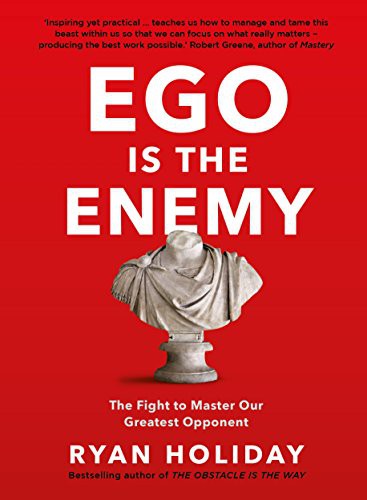
Ego Is the Enemy
by Ryan Holiday
★ Top 25 book of 2016 · #14 on Best Books of 2016
Ryan Holiday argues that our biggest obstacle to success is our own ego, which hinders learning, blinds us when we succeed and deepens the pain of failure. He illustrates this with stories of figures who conquered it.
Best for: Ambitious people who want to tame pride and build humility for lasting success
Ego Is the Enemy is #14 on BookWard's Best Books of 2016, out of 70 2016 books that cleared our data bar.
What Ego Is the Enemy is about
Ryan Holiday's fourth book argues that our biggest obstacles often come from inside us. Attitude, selfishness and self-absorption, he says, do more damage than outside circumstances. He uses "ego" in the everyday sense of an unhealthy belief in your own importance, not the Freudian term or a clinical diagnosis, and he takes care to separate it from real confidence.
His answer is humility, self-awareness, purpose and realism. The book shows how ego slows learning early in a career, hides our faults when things go well, and makes setbacks hurt more. To make the case he draws on literature, philosophy and history, and on figures such as Steve Jobs, Larry Page, John DeLorean, Jackie Robinson and Eleanor Roosevelt, some who stumbled and some who succeeded by keeping ego in check. It also speaks to an age of social media, reality TV and constant self-promotion. Direct and motivational, it will suit ambitious people at any stage who want a steadier way to work and to handle both wins and failures.
Ego Is the Enemy on the Best Books of 2016
Ego Is the Enemy came out in 2016. Of the 70 books first published in 2016 that met BookWard's data bar, it ranks #14 on our Best Books of 2016 list.
Why it made the list: 1,828 readers have shelved it on Open Library; readers rate it 3.8 out of 5 (66 ratings); 145 are reading it right now. The list ranks each year’s books on how many readers have picked them up, how highly readers rate them, and how many are reading them right now.
It earns Being read right now.
Nearby on the 2016 list
- The Way I Used to Be Amber Smith, #12
- Scythe Neal Shusterman, #13
- Culpa Tuya Mercedes Ron, #15
- A Gentleman in Moscow Amor Towles, #16
See all Best Books of 2016 Best books by year
More years: Best Books of 2015 Best Books of 2017.
The numbers behind it
- Readers: 1,597 want to read it, 145 are reading it now and 86 have read it, according to Open Library.
- Ratings: 3.8 out of 5 from 66 Open Library ratings.
| Signal | This book (0 to 100) | Weight |
|---|---|---|
| Reach | 91 | 55% |
| Reader love | 20 | 25% |
| Being read right now | 93 | 20% |
Questions about Ego Is the Enemy
When was Ego Is the Enemy published?
Ego Is the Enemy by Ryan Holiday was first published in 2016.
Was Ego Is the Enemy one of the best books of 2016?
Ego Is the Enemy is #14 on BookWard's Best Books of 2016, out of 70 2016 books that cleared our data bar. 1,828 readers have shelved it on Open Library; readers rate it 3.8 out of 5 (66 ratings); 145 are reading it right now.
Why is Ego Is the Enemy on the Best Books of 2016 list?
1,828 readers have shelved it on Open Library; readers rate it 3.8 out of 5 (66 ratings); 145 are reading it right now.
More of the best books of 2016
- It Ends with Us Colleen Hoover, #1
- Dog Man Dav Pilkey, #2
- The Subtle Art of Not Giving a F*ck Mark Manson, #3
- Never Split the Difference Chris Voss, #4
- The Hidden Oracle Rick Riordan, #5
- Born a Crime Trevor Noah, #6
See the full Best Books of 2016, the Top 100, or new books on Rising.
How we know
This page uses public data: Open Library reader counts and ratings, and Wikipedia page views for recent years. The description is paraphrased from real source text. Rankings reflect reading interest, not quality or sales, and can be affected by data gaps. Lists update monthly.
Suits older teens and adults, especially those early in a career or facing a setback.
Depends on the edition you pick.
A short, sharp case that your own ego is the obstacle. 42% taste match
 BookWard’s take
A short, sharp case that your own ego is the obstacle
Ryan Holiday argues that our biggest problems come from inside us rather than from other people or circumstances, and he builds that case through stories drawn from history and the modern world. The book is driven by ideas, and the voice is confident and aphoristic, never neutral. The self-help frame is well worn, but the choice of examples keeps it from feeling stale. Its main weakness is that it leans on anecdote rather than evidence, which is where it parts ways with a reader who wants proof. It is also opinionated and heavy on exposition, telling you the point outright, yet it stays restrained about sentiment and moves briskly. If you want ideas with momentum rather than a deep study, it delivers.
A compact self-help volume built from short chapters, which suits BookWard's preference for tight books.
Short chapters and a steady stream of anecdotes keep it moving, close to BookWard's fast pace.
The core claim that ego holds us back is a familiar idea, though the examples add some freshness.
The prose is plain, direct and quotable, which sits a little plainer than BookWard's mid-range preference.
There is no plot to speak of, so the drive comes from the argument and the people used to illustrate it.
It warns about failure but offers humility as a workable way forward, so the outlook is encouraging.
A conventional, linear arc through stages of a career, from aspiring to success to failure.
The tone is earnest and instructive, with little humour.
Cautionary tales of failure add some gloom, but the book stays gentle overall.
The tone is controlled and motivational rather than emotionally intense.
See all 50 dialsEvery position, side by side with this book
Where it lines up
- PaceBookWard 8 · book 7
- Authorial voiceBookWard 9 · book 8
- LengthBookWard 1 · book 3
Where it pulls apart
- Familiar tropesBookWard 10 · book 4
- ExpositionBookWard 2 · book 9
- OpeningBookWard 10 · book 6
A compact self-help volume built from short chapters, which suits BookWard's preference for tight books.
The self-help format is familiar and the lesson of humility is a well-trodden one, which sits below BookWard's taste.
The argument follows a clear arc, but it rests on selected examples rather than tight proof, short of BookWard's airtight standard.
Short chapters and a steady stream of anecdotes keep it moving, close to BookWard's fast pace.
The core claim that ego holds us back is a familiar idea, though the examples add some freshness.
Figures appear as brief illustrations of a point, so they read as types more than fully drawn people.
It is mostly matter-of-fact, with some inspirational uplift, so it is more restrained than sentimental.
It uses cautionary tales of downfall for effect, which works but leans on drama more than BookWard likes.
It relies on anecdotes and historical examples rather than systematic evidence, well below BookWard's rigorous taste.
Holiday writes with a confident, aphoristic style that is easy to recognise, matching BookWard's taste for distinct voices.
The book is built around an argument about ego, with stories serving the idea, far from BookWard's story-led lean.
It explains its lessons outright instead of dramatising them, which is the opposite of BookWard's preference for showing.
The prose is plain, direct and quotable, which sits a little plainer than BookWard's mid-range preference.
There is no plot to speak of, so the drive comes from the argument and the people used to illustrate it.
It warns about failure but offers humility as a workable way forward, so the outlook is encouraging.
A conventional, linear arc through stages of a career, from aspiring to success to failure.
The tone is earnest and instructive, with little humour.
It is an accessible read with short chapters and plain language, easier than BookWard's usual taste.
It draws on many figures across history, though all filtered through Holiday's single authorial lens.
The book moves in a linear sequence of life stages, while its examples jump across eras.
It is entirely grounded in real people and real events.
A long run of historical and contemporary figures appears, each briefly, which makes for a large cast.
The scope is personal and individual, even when the examples come from big historical moments.
The focus is on mindset, attitude and self-awareness rather than on action.
Romance plays no part in the book.
The settings are familiar business, sport and political worlds rather than anything unusual.
It speaks to a social media age, with examples from both the past and the present.
Its warning about ego is an old human theme, but the self-help packaging dates somewhat.
The moral is clear and one-sided: ego is the problem, and humility is the answer.
Description is sparse and functional, used only to set up each example.
It leans more narrative than analytical, using stories to carry each lesson.
Holiday speaks to the reader directly and draws on his own outlook, so it feels personal rather than detached.
It is a standalone book, though it fits alongside Holiday's other works.
There are few surprises, since the thesis is announced up front and the examples follow it.
It asks the reader to look critically at themselves, which is mildly challenging more than comforting.
Cautionary tales of failure add some gloom, but the book stays gentle overall.
The tone is controlled and motivational rather than emotionally intense.
There is essentially no sexual content.
Political figures appear as examples, but the book is not about politics.
The language is plain and easy to follow.
Holiday argues his case forcefully and does not pretend to be neutral.
It draws on history to guide present and future choices, so it looks back to move forward.
It is optimistic that humility and self-awareness can change outcomes, with a mild idealist streak.
Review written by BookWard, dial version 1, November 2026.
Who is Ego Is the Enemy right for?
Suits older teens and adults, especially those early in a career or facing a setback. It is free of graphic content, with only passing references to failure and historical conflict.
It is an accessible read with short chapters and plain language, easier than BookWard's usual taste.
Cautionary tales of failure add some gloom, but the book stays gentle overall.
The tone is controlled and motivational rather than emotionally intense.
Book CompanionEgo Is the Enemy: ideas, characters, themes
Our biggest obstacle is often our own ego, defined as an unhealthy belief in our own importance, and humility and realism are the answer.
- Ego is not the clinical kind. The book uses ego in the everyday sense of an unhealthy belief in your own importance, not Freud's term.
- Problems start within. Holiday argues that attitude, selfishness and self-absorption cause more trouble than outside circumstances.
- It hurts at every stage. Ego gets in the way early in a career, blinds us in success, and magnifies the sting of failure.
- Confidence is not ego. The book separates healthy confidence from the inflated self-image that clouds judgment.
- The remedy is humility. Holiday points to humility, self-awareness, purpose and realism as the way to keep ego in check.
Characters
George Marshall
Historical figure
One of the figures held up as someone who rose to the highest levels by mastering his own ego.
Katharine Graham
Historical figure
Featured among the examples of people who achieved power and success by conquering ego.
Steve Jobs
Historical figure
Among the well-known figures cited in the book's cautionary and positive stories.
Christopher McCandless
Historical figure
One of the individuals the book draws on to illustrate the dangers of ego.
Themes
Seeing yourself clearly and without inflation as the basis for growth.
Noticing your own habits of mind before they sabotage you.
Focusing on the work itself rather than on how you look doing it.
How ego distorts both the good and the bad moments of a career.
Facing the facts of a situation instead of the story you tell about yourself.
Discussion questions
- Where have you seen ego get in the way of someone's learning or success?
- How would you tell the difference between confidence and ego in your own life?
- Which of the historical examples did you find most persuasive, and why?
- Does an age of social media make ego harder to resist?
- Is humility always the right answer, or can it hold a person back too?
Personalize your Book Companion
This is the general edition. In BookWard, the Companion is written for you: your reading profile, your notes, and spoiler-safe to the page you are on.
Buy, listen or borrow Ego Is the Enemy
Each link opens a search for this book on that store, in a new tab.
Read on a device
Borrow
Reviews and community
If you liked Ego Is the Enemy
Gladwell on snap judgments: brisk, vivid, and sometimes too neat
The Obstacle Is the WayRyan HolidayStoic advice for setbacks, told through famous lives
Slow ProductivityCal NewportA calm, idea-led case against busyness as proof of work
DriveDaniel H. PinkA lively case that autonomy, mastery and purpose beat carrots and sticks
Find your own best books
Add what you have read, rate it, and BookWard will recommend what to read next.
Free to start. No credit card needed.