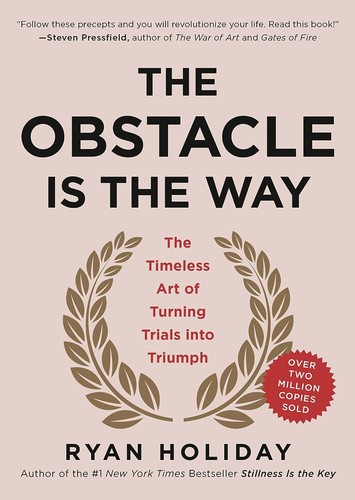
The Obstacle Is the Way
by Ryan Holiday
★ Top 25 book of 2014 · #20 on Best Books of 2014
Drawing on Stoic philosophy, this book argues that every obstacle can become an opportunity to grow stronger. Using true stories of famous achievers, it shows how focusing on what you control turns problems into advantages.
Best for: People feeling frustrated, demoralized or stuck who want a resilient mindset
The Obstacle Is the Way is #20 on BookWard's Best Books of 2014, out of 66 2014 books that cleared our data bar.
What The Obstacle Is the Way is about
Ryan Holiday builds this book on one idea from the Stoics: you cannot always choose what happens to you, but you can choose how you respond, and that response is what defines you. The title comes from a line in Marcus Aurelius's Meditations: what stands in the way becomes the way.
Holiday lays out a practical framework of three disciplines, perception, action and will, for turning obstacles into opportunities. Each section is backed by historical anecdotes drawn from politics, business, sports and history, with figures such as John D. Rockefeller, Amelia Earhart, Ulysses S. Grant and Steve Jobs. The tone is direct and motivational. It will suit anyone facing a setback at work, in training or in life who wants a clear way to focus on what they can control and let the rest go.
The Obstacle Is the Way on the Best Books of 2014
The Obstacle Is the Way came out in 2014. Of the 66 books first published in 2014 that met BookWard's data bar, it ranks #20 on our Best Books of 2014 list.
Why it made the list: 759 readers have shelved it on Open Library; readers rate it 3.9 out of 5 (32 ratings); 42 are reading it right now. The list ranks each year’s books on how many readers have picked them up, how highly readers rate them, and how many are reading them right now.
Nearby on the 2014 list
- Archer's Voice Mia Sheridan, #18
- The Crossover Kwame Alexander, #19
- Everblaze Shannon Messenger, #21
- The Girl on the Train Paula Hawkins, #22
See all Best Books of 2014 Best books by year
More years: Best Books of 2013 Best Books of 2015.
The numbers behind it
- Readers: 667 want to read it, 42 are reading it now and 50 have read it, according to Open Library.
- Ratings: 3.9 out of 5 from 32 Open Library ratings.
| Signal | This book (0 to 100) | Weight |
|---|---|---|
| Reach | 79 | 55% |
| Reader love | 21 | 25% |
| Being read right now | 80 | 20% |
Questions about The Obstacle Is the Way
When was The Obstacle Is the Way published?
The Obstacle Is the Way by Ryan Holiday was first published in 2014.
Was The Obstacle Is the Way one of the best books of 2014?
The Obstacle Is the Way is #20 on BookWard's Best Books of 2014, out of 66 2014 books that cleared our data bar. 759 readers have shelved it on Open Library; readers rate it 3.9 out of 5 (32 ratings); 42 are reading it right now.
Why is The Obstacle Is the Way on the Best Books of 2014 list?
759 readers have shelved it on Open Library; readers rate it 3.9 out of 5 (32 ratings); 42 are reading it right now.
More of the best books of 2014
- To All the Boys I've Loved Before Jenny Han, #1
- The Long Haul Jeff Kinney, #2
- Zero to One Peter A. Thiel, #3
- Surrounded by Idiots Thomas Erikson, #4
- After (After Series, Book 1) Anna Todd, #5
- Ugly Love Colleen Hoover, #6
See the full Best Books of 2014, the Top 100, or new books on Rising.
How we know
This page uses public data: Open Library reader counts and ratings, and Wikipedia page views for recent years. The description is paraphrased from real source text. Rankings reflect reading interest, not quality or sales, and can be affected by data gaps. Lists update monthly.
Suits teens and adults, especially anyone interested in self-improvement, sports or business.
Depends on the edition you pick.
Stoic advice for setbacks, told through famous lives. 45% taste match
 BookWard’s take
Stoic advice for setbacks, told through famous lives
Ryan Holiday takes a line from Marcus Aurelius and builds a three-part method around it: perception, action and will. Each section leans on short historical stories from politics, business, sports and history. It is a book more about ideas than story, and the lessons are stated outright rather than left for you to infer. It is a quick, direct read that moves fast, with no real sagging middle. Readers who value originality and rigor may find it more a curated collection of anecdotes than a tightly argued case. It is hopeful and highly readable, with a clear, confident voice, and its staying power comes from the ancient philosophy underneath.
A compact, chapter-by-chapter self-help book that gets to its point quickly, close to BookWard's taste for tight reads.
Short anecdote-driven sections keep things moving briskly, in line with BookWard's preference for pace.
The ideas come largely from Stoic philosophy and popular self-help, so the contribution is in the packaging and examples rather than the thinking.
The writing is plain and direct, unadorned, a bit plainer than BookWard's middle-ground taste.
There is no plot or arc to drive it; ideas and examples carry it, so neither plot nor character leads.
The whole premise is that adversity can be turned into advantage, making it strongly hopeful, more so than BookWard's leaning.
A conventional three-part framework with short illustrated chapters, less experimental than BookWard's slight appetite for structure play.
Serious and earnest in tone, with little humor to speak of.
Hardship appears as a teaching theme, but the tone stays gentle and upbeat.
It aims to inspire and steel the reader, producing moderate rather than intense emotion.
See all 50 dialsEvery position, side by side with this book
Where it lines up
- PaceBookWard 8 · book 8
- Shock for effectBookWard 9 · book 9
- LengthBookWard 1 · book 2
Where it pulls apart
- Familiar tropesBookWard 10 · book 4
- ExpositionBookWard 2 · book 9
- Internal logicBookWard 10 · book 6
A compact, chapter-by-chapter self-help book that gets to its point quickly, close to BookWard's taste for tight reads.
The Marcus Aurelius quote and the promise of a method open the book, though it is more of a steady start than a gripping one.
Stoic self-help and 'turn trials into triumph' framing are well-worn territory, which sits against BookWard's wish to avoid the familiar.
The three-discipline framework holds together, though the argument rests on selected success stories rather than strict proof.
Short anecdote-driven sections keep things moving briskly, in line with BookWard's preference for pace.
The ideas come largely from Stoic philosophy and popular self-help, so the contribution is in the packaging and examples rather than the thinking.
Historical figures appear as brief illustrations of a lesson, not as fully drawn people, which falls short of BookWard's taste for depth.
A self-help framework wraps up with a clear takeaway rather than leaving questions hanging, matching BookWard's liking for resolution.
The tone is motivational and encouraging, warmer and more inspirational than BookWard's restrained taste.
There is little darkness for effect; hardships are used to teach, so nothing leans on shock.
It draws on historical anecdotes and Meditations, but the evidence is selective and illustrative, which is lighter than BookWard's appetite for rigor.
Holiday writes in a confident, coaching tone that is recognizable but closer to the self-help house style than a singular voice.
The book is built around a framework of ideas, with stories serving as support, leaning far toward ideas.
Lessons are stated plainly and explained outright, the opposite of BookWard's preference for showing in scene.
Short, repeating sections keep the energy even from start to finish, so there is little sag.
The writing is plain and direct, unadorned, a bit plainer than BookWard's middle-ground taste.
There is no plot or arc to drive it; ideas and examples carry it, so neither plot nor character leads.
The whole premise is that adversity can be turned into advantage, making it strongly hopeful, more so than BookWard's leaning.
A conventional three-part framework with short illustrated chapters, less experimental than BookWard's slight appetite for structure play.
Serious and earnest in tone, with little humor to speak of.
Easy to read in short sittings, a bit lighter than BookWard's comfortable level of effort.
The book moves through many historical figures from different fields, giving a wide spread of examples rather than a single lens.
Examples jump across centuries and fields, so the book moves around in time, though the framework itself is linear.
Entirely grounded in real people and events.
A large rotating set of historical figures appears across the chapters, each briefly.
Examples range from personal setbacks to historic campaigns, mixing the intimate with the grand.
It balances mindset (perception, will) with action, splitting attention between inner and outer.
Largely exposition with few spoken exchanges, so dialogue is light.
Romance is not part of the book.
The settings are familiar worlds of business, sport, politics and history.
It mixes ancient, historical and modern examples, from Marcus Aurelius to recent business and sports figures.
Rooted in ancient Stoic thought with a message that does not depend on a single moment.
The author addresses the reader directly and is a straightforward, reliable guide.
The lessons are laid out clearly with little ambiguity, the opposite of BookWard's taste for moral complexity.
Anecdotes are told briskly with little scene-setting, so description stays sparse.
It blends anecdote and short stories with a stated framework, sitting between narrative and analytical.
Holiday speaks to the reader as a coach, personal in tone but not memoir.
A standalone book, though the author later wrote related Stoic titles.
Not a book of surprises; the method is clear from the start.
It pushes you to reframe setbacks, but in an encouraging way, so it is more motivating than unsettling.
Hardship appears as a teaching theme, but the tone stays gentle and upbeat.
It aims to inspire and steel the reader, producing moderate rather than intense emotion.
Mostly humorless, with little in the way of jokes either dry or broad.
Historical struggles are mentioned but violence is not dwelt on.
Absent.
Political figures feature as examples, but the book is not about politics.
Plain, accessible language throughout.
Holiday argues his case with confidence and conviction, making the narration strongly opinionated.
It draws heavily on ancient wisdom and history but aims at what the reader does next.
Optimistic about what discipline and mindset can achieve, firmly on the idealistic side.
Review written by BookWard, dial version 1, November 2026.
Who is The Obstacle Is the Way right for?
Suits teens and adults, especially anyone interested in self-improvement, sports or business. It deals with hardship in general terms and has little graphic or sensitive content.
Easy to read in short sittings, a bit lighter than BookWard's comfortable level of effort.
Hardship appears as a teaching theme, but the tone stays gentle and upbeat.
It aims to inspire and steel the reader, producing moderate rather than intense emotion.
Historical struggles are mentioned but violence is not dwelt on.
Book CompanionThe Obstacle Is the Way: ideas, characters, themes
How you respond to an obstacle matters more than the obstacle, and with the right mindset the obstacle itself can become your path forward.
- The quote behind the title. The book takes its name from Marcus Aurelius in Meditations: what stands in the way becomes the way.
- Three disciplines. Holiday organizes his framework around perception, action and will.
- Perception. The first discipline is about how you see a problem, since framing shapes what you can do about it.
- Action. Seeing clearly is not enough; the method calls for deliberate, persistent effort.
- Will. The third discipline is about endurance and accepting what you cannot control.
Characters
Marcus Aurelius
Source of the central idea
The Roman emperor whose Meditations supplies the quote the book is named after.
John D. Rockefeller
Historical example
Cited among successful figures who applied Stoic principles.
Amelia Earhart
Historical example
One of the figures used to illustrate overcoming difficulty.
Ulysses S. Grant
Historical example
Cited as a figure who turned hard situations to advantage.
Steve Jobs
Historical example
Among the modern figures drawn on to illustrate the framework.
Themes
Focusing on what you can control and accepting what you cannot.
Using hardship to grow stronger rather than being stopped by it.
How reframing a problem changes what you can do about it.
Steady action and will as the basis of achievement.
The idea that the difficulty itself can be the route to success.
Discussion questions
- Do you agree that how we respond to an obstacle matters more than the obstacle itself?
- Which of the three disciplines, perception, action or will, do you find hardest in practice?
- Do the historical examples prove the method, or do they only illustrate it?
- Where might a Stoic approach to setbacks fall short?
- Which obstacle in your own life could you try to look at differently?
Personalize your Book Companion
This is the general edition. In BookWard, the Companion is written for you: your reading profile, your notes, and spoiler-safe to the page you are on.
Buy, listen or borrow The Obstacle Is the Way
Each link opens a search for this book on that store, in a new tab.
Read on a device
Borrow
Reviews and community
If you liked The Obstacle Is the Way
A short, sharp case that your own ego is the obstacle
OutliersMalcolm GladwellSuccess has a postcode and a birthday, not just talent
The Power of HabitCharles DuhiggHabit science told through stories, with a framework you can use
BlinkMalcolm GladwellGladwell on snap judgments: brisk, vivid, and sometimes too neat
Find your own best books
Add what you have read, rate it, and BookWard will recommend what to read next.
Free to start. No credit card needed.