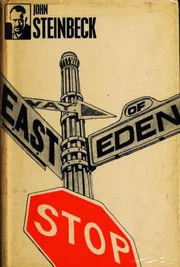
East of Eden
by John Steinbeck · 1952
Best suited to mature teens and adults, given its length and serious themes.
611 pages, about 9.5 to 14.5 hours.
Steinbeck's sprawling Cain and Abel saga, built to outlast its length. 51% taste match
The story
East of Eden is a family saga by John Steinbeck, first published in 1952. It is classed as historical fiction and domestic fiction, and it follows two families, the Trasks and the Hamiltons, across three generations. The story unfolds in the Salinas Valley of Northern California, with the 19th and 20th centuries as its backdrop. Characters include Adam Trask, Cathy Ames, Charles Trask, Cyrus Trask, Caleb and Aron Trask, Abra Bacon, and Samuel Hamilton.
The book draws on the biblical stories of Cain and Abel and of Adam and Eve, and it turns on guilt, love, freedom, self-destruction, and the struggle for acceptance. Twins and migrant labor also appear among its subjects. Steinbeck wrote it with his young sons, Thom and John, in mind, intending to set down the sights, sounds, smells, and colors of the valley for them. Some scenes move beyond California, to Connecticut, Massachusetts, San Francisco, and Stanford University. The median edition runs to 611 pages, and the novel has appeared in 105 editions.
The Salinas Valley is in Northern California.
Characters
The TrasksThe HamiltonsCainAbelCharles TraskAdam Trask
Setting
CaliforniaSalinas River ValleySalinas, Valle del Río (California)SalinasConnecticut
Period
19th century20th century
Themes
migrant labordepravitybeneficencelovethe struggle for acceptanceself-destructionguiltfreedom
- Want to read 1,189
- Reading now 79
- Read 153
Most people shelving it are saving it for later.
Of 1421 readers who put it on a shelf, 84% want to read it, 6% are reading it now, 11% have finished it and 0% stopped before the end.
By the numbers
- The median edition runs 611 pages. Counting about 275 words a page and an adult reading pace of 250 words a minute, that is about 11 hours of reading.
- Open Library tracks 105 editions from 73 publishers, the earliest dated 1952 and the latest 2022, across 13 languages.
- On reader demand it ranks in the top 1% of the classic books in our catalog (8,749 of them).
- Libraries shelve it under Dewey 823.91 and Library of Congress class PS-3537.00000000.T3234E3 2016.
 BookWard’s take
Steinbeck's sprawling Cain and Abel saga, built to outlast its length
East of Eden runs 611 pages across three generations of the Trask and Hamilton families, and it asks a lot of a reader who likes things tight. Length sits near the top of the scale, and BookWard sits at the bottom, so this is a long commitment. Where it earns that space is character depth: Steinbeck draws his people with the patience of a man writing for his sons. The Cain and Abel frame gives it real internal logic and staying power, and the Salinas Valley is rendered with rich description. It also leans on a famous biblical template, so its familiar tropes are deliberate rather than accidental. Expect idea and story braided together, with the book willing to stop and explain itself.
At 611 pages it is a long, wide-ranging saga, the opposite of BookWard's taste for short and tight.
It moves at a measured, generational pace, slower than BookWard's preference for brisk.
The scope and the way it merges allegory, autobiography and epic feel fresh even with a borrowed frame.
The language is lyrical and heightened, more ornate than BookWard's lean preference.
Choices and temperaments drive events, in line with BookWard's lean toward character.
Guilt and freedom are weighed seriously, but the book keeps a thread of hope that BookWard appreciates.
It follows two families generation by generation, conventional in shape despite its size.
It is a serious book, with little humor to lighten the load.
Cain and Abel rivalry and themes of depravity give it real shadow.
Grief, love and rivalry run deep, making it emotionally intense.
See all 50 dialsEvery position, side by side with this book
Where it lines up
- Authorial voiceBookWard 9 · book 9
- EndingBookWard 8 · book 7
- Shock for effectBookWard 9 · book 8
Where it pulls apart
- LengthBookWard 1 · book 10
- Familiar tropesBookWard 10 · book 5
- OpeningBookWard 10 · book 6
At 611 pages it is a long, wide-ranging saga, the opposite of BookWard's taste for short and tight.
It opens by settling into the Salinas Valley rather than grabbing you, which is slower than BookWard likes.
It deliberately rebuilds the Cain and Abel and Adam and Eve stories, familiar ground that Steinbeck reworks rather than avoids.
The biblical pattern gives the families' choices a firm internal consistency that BookWard values.
It moves at a measured, generational pace, slower than BookWard's preference for brisk.
The scope and the way it merges allegory, autobiography and epic feel fresh even with a borrowed frame.
Steinbeck gives the Trasks and Hamiltons real interiority, matching BookWard's love of deeply drawn people.
The family conflicts reach a clear resolution rather than trailing off, which suits BookWard.
It reaches for big feeling and moral warmth, a little more openly than BookWard's restrained taste.
The darkness serves the book's themes of guilt and self-destruction, which is how BookWard likes it earned.
Steinbeck's address to his own sons gives the narration a strong, unmistakable personality.
Story carries it, but ideas about good and evil are woven in more openly than BookWard usually likes.
Steinbeck pauses to reflect and explain, leaning toward telling more than BookWard prefers.
The middle has stretches of family and backstory that can stall in a book this size.
The language is lyrical and heightened, more ornate than BookWard's lean preference.
Choices and temperaments drive events, in line with BookWard's lean toward character.
Guilt and freedom are weighed seriously, but the book keeps a thread of hope that BookWard appreciates.
It follows two families generation by generation, conventional in shape despite its size.
It is a serious book, with little humor to lighten the load.
It asks patience for its length and ideas but is not hard to follow line by line.
It moves between several family members across generations, giving many vantage points.
It runs forward through three generations in a mostly linear way.
The world is firmly realistic and rooted in a real California valley.
Two families across three generations make for a sizable cast to keep track of.
Spanning generations and moral themes, it reaches epic scope even in a domestic setting.
It balances family conflict and inner struggle, leaning a touch toward the inward.
Conversation carries a good share of the drama among family members.
Love matters to the story, but it is one thread among family, guilt and rivalry.
A Northern California valley a century ago is an unfamiliar setting for most readers today.
It looks back to the 19th and early 20th centuries, far from present day.
Its biblical themes of guilt, love and freedom give it lasting reach.
The narrating voice is open and trustworthy about the families it describes.
The book wrestles with good and evil, leaving some of the judgment to the reader.
Steinbeck lingers on the sights, sounds, smells and colors of the Salinas Valley.
It stands alone as a single novel.
The pull is in family rivalry and its consequences more than a string of surprises.
It confronts guilt, depravity and self-destruction rather than offering easy comfort.
Cain and Abel rivalry and themes of depravity give it real shadow.
Grief, love and rivalry run deep, making it emotionally intense.
Humor is sparing and understated where it appears.
The Cain and Abel conflict brings real harm but it is not the book's focus.
Sexual content is present within the family drama but not dominant.
Migrant labor appears in the background but politics is not central.
The language is rich but readable, without heavy dialect.
Steinbeck's narration offers views and reflections rather than staying neutral.
It looks back at the past, tracing how earlier generations shape later ones.
Despite its dark themes, it holds a belief in human freedom to choose.
Review written by BookWard, dial version 1, November 2026.
Who is East of Eden right for?
Best suited to mature teens and adults, given its length and serious themes. It deals with guilt, depravity, self-destruction, and family conflict.
It asks patience for its length and ideas but is not hard to follow line by line.
Cain and Abel rivalry and themes of depravity give it real shadow.
Grief, love and rivalry run deep, making it emotionally intense.
The Cain and Abel conflict brings real harm but it is not the book's focus.
Book CompanionEast of Eden: ideas, characters, themes
Steinbeck reworks the stories of Cain and Abel and of Adam and Eve through two California families to ask what it means to be human.
- Two families. The novel follows the Trasks and the Hamiltons across three generations.
- A valley as setting. The Salinas Valley is rendered in careful detail, from its colors to its smells.
- Written for his sons. Steinbeck originally addressed it to his young sons, Thom and John.
- Biblical echoes. The rivalry of Cain and Abel and the fall of Adam and Eve shape the story.
- His own verdict. Steinbeck considered it his masterpiece and a culmination of his craft.
Characters
Adam Trask
Central figure of the Trask family
A key character whose life ties the generations together.
Cathy Ames
Major character in the Trask story
A significant figure among the book's characters.
Samuel Hamilton
Head of the Hamilton family
Represents the second family at the heart of the novel.
Caleb and Aron Trask
Twin brothers in the younger generation
Their relationship echoes the Cain and Abel story.
Themes
The ever-present struggle between opposing moral forces.
The weight people carry for what they have done.
The capacity to choose one's own path.
The need to be seen and valued by family.
How people harm themselves through their own choices.
Discussion questions
- How do the Cain and Abel echoes shape the way you read the Trask brothers?
- Why might Steinbeck have written this novel for his sons?
- What role does the Salinas Valley play in the story?
- How do the Trasks and the Hamiltons contrast with each other?
- Does the book suggest people are free to choose their own nature?
Personalize your Book Companion
This is the general edition. In BookWard, the Companion is written for you: your reading profile, your notes, and spoiler-safe to the page you are on.
Buy, listen or borrow East of Eden
Each link opens a search for this book on that store, in a new tab.
Read on a device
Borrow
Reviews and community
If you liked East of Eden
A family's undoing in the Congo, told by five women
The Book ThiefMarkus ZusakDeath narrates a foster girl's war, and the book earns it
Hearts in AtlantisStephen KingStephen King's elegy for the sixties and the generation that blew it
PachinkoMin Jin LeeFour generations of a Korean family in Japan, told with patience
Sources: Open Library.
Track East of Eden and find your next favorite
Add it to your shelf, rate what you have read, and BookWard will recommend what fits you.
Free to start. No credit card needed.