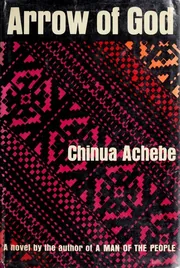
Arrow of God
by Chinua Achebe · 1964
Suited to mature teens and adults, and widely read in school and university settings.
266 pages, about 4 to 6 hours.
A proud priest and a changing world, told without a false note. 64% taste match
The story
Arrow of God is a novel by Chinua Achebe, first published in 1964. It is the third of his novels and belongs with Things Fall Apart and No Longer at Ease in what is known as The African Trilogy, works that share a region and a set of concerns. It also appeared in the Heinemann African Writers Series.
The story is set in 1921 among the Igbo villages of Umuaro in Eastern Nigeria, under British colonial administration. Its central figure is Ezeulu, the elderly Chief Priest of the god Ulu, whose standing in the community is tested by the arrival of the District Officer and by Christian missionaries. Ezeulu sends one of his sons to learn the ways of the new religion, and the decision sets older traditions and newer influences against each other. Captain Winterbottom is the British official with whom the priest comes into conflict. The book draws on proverbs, rituals of worship and customs of hospitality to portray village life in colonial Nigeria. It is literary fiction and a work of African writing in English.
"What have I done to this child?
Setting
NigeriaNigerian fiction
Themes
Igbo (African people)LiteratureIgbo (Pueblo africano)Novela africanaNovela nigerianaNovelaHistoryAfrican literature (English)
- Want to read 174
- Reading now 20
- Read 12
Most people shelving it are saving it for later.
Of 206 readers who put it on a shelf, 84% want to read it, 10% are reading it now, 6% have finished it and 0% stopped before the end.
By the numbers
- The median edition runs 266 pages. Counting about 275 words a page and an adult reading pace of 250 words a minute, that is about 4.9 hours of reading.
- Open Library tracks 28 editions from 15 publishers, the earliest dated 1964 and the latest 2015, across 3 languages.
- On reader demand it ranks in the top 8% of the classic books in our catalog (8,749 of them).
- Libraries shelve it under Dewey 823 and Library of Congress class PR-9387.90000000.A3 Ar.
 BookWard’s take
A proud priest and a changing world, told without a false note
Achebe's third novel is a precise, unhurried portrait of Ezeulu, Chief Priest of Ulu, in 1921 Umuaro. What it gets most right is that it sidesteps the familiar tropes. Colonialism here is a slow pressure on a fully realised community, not a sketch of villain and victim, and the Igbo proverbs, rituals and hospitality do real work in scene. The voice is unmistakable, dry and composed, and the characters have real depth, Ezeulu above all, who is neither saint nor fool. The opening is where some readers may hesitate: it builds patiently rather than hooking you at once, and the pace stays measured throughout. The book is also deliberately short on moral clarity, and it refuses to hand you a side to cheer for. Read it for the craft, the unsentimental restraint and a tragedy that is earned rather than shocking.
At 266 pages it is compact for its ambition, though shorter than BookWard's ideal tightness still allows some patient scene-setting.
The telling is deliberate and rooted in ritual and talk, slower than BookWard prefers.
Few novels render a precolonial-to-colonial Igbo community this fully from the inside, and the approach still feels fresh.
Clear and plain on the surface, with a formal, proverb-rich texture that adds richness without ornament.
Events spring from Ezeulu's pride and choices, so character leads, though the colonial plot matters too.
The arc moves toward tragedy, with little consolation for its central figure.
A conventional, chronological telling with no formal tricks.
Wry touches appear in talk and proverb, but the book is mostly serious.
See all 50 dialsEvery position, side by side with this book
Where it lines up
- Shock for effectBookWard 9 · book 9
- Authorial voiceBookWard 9 · book 9
- Familiar tropesBookWard 10 · book 9
Where it pulls apart
- OpeningBookWard 10 · book 4
- PaceBookWard 8 · book 4
- LengthBookWard 1 · book 3
At 266 pages it is compact for its ambition, though shorter than BookWard's ideal tightness still allows some patient scene-setting.
It opens by establishing a world and a man rather than grabbing the reader at once, which runs against BookWard's love of immediate pull.
It resists the standard colonial story, giving both sides texture and refusing easy heroes, which BookWard rewards.
Cause and consequence follow tightly from character, custom and belief, so events feel inevitable rather than arranged.
The telling is deliberate and rooted in ritual and talk, slower than BookWard prefers.
Few novels render a precolonial-to-colonial Igbo community this fully from the inside, and the approach still feels fresh.
Ezeulu is proud, shrewd and flawed, and the surrounding figures are drawn with similar care.
The story closes on a clear, resolved tragedy rather than leaving its central conflict hanging.
Achebe's tone stays cool and observant, trusting events rather than pushing the reader toward feeling.
The darkness comes from character and consequence, never from effect, which fits BookWard's taste exactly.
Not applicable to a novel.
The measured, proverb-laced narration is unmistakably Achebe and unlike generic literary fiction.
It carries real ideas about authority and change but delivers them through a story, so it sits near the middle.
Customs and beliefs are shown through scenes, arguments and ceremonies, not explained, which BookWard likes.
The structure holds its tension through village politics and personal stakes with little dead weight.
Clear and plain on the surface, with a formal, proverb-rich texture that adds richness without ornament.
Events spring from Ezeulu's pride and choices, so character leads, though the colonial plot matters too.
The arc moves toward tragedy, with little consolation for its central figure.
A conventional, chronological telling with no formal tricks.
Wry touches appear in talk and proverb, but the book is mostly serious.
Accessible in language, but many names and the tangle of village politics ask for attention.
The narration moves between Igbo villagers and colonial officials, giving several angles on the same events.
The story runs forward in a straightforward sequence.
The setting is realistic, though belief in gods and spirits is treated as part of the characters' lived world.
A sizeable community of elders, rivals, family members and officials populates Umuaro.
It covers a whole community and a clash of systems, yet stays anchored to one household.
It balances Ezeulu's private reasoning with public events and ceremonies.
Argument, proverb and ceremony carry much of the story, so talk is heavy.
Romance is not a focus of the book.
A 1920s Igbo village and its customs will be unfamiliar to many readers, and the book makes them concrete.
It is set in 1921 and was written in 1964, firmly in the past.
Its themes of authority, pride and cultural collision have kept their force.
The narration is steady and trustworthy, never tricking the reader.
Neither Ezeulu nor the colonists are simply right or wrong, so the book resists a clear verdict.
Village life, ritual and setting are rendered in vivid, specific detail.
Review written by BookWard, dial version 1, November 2026.
Who is Arrow of God right for?
Suited to mature teens and adults, and widely read in school and university settings. It deals with colonial conflict, religious clashes and a tragic outcome, handled with restraint.
Accessible in language, but many names and the tangle of village politics ask for attention.
Book CompanionArrow of God: ideas, characters, themes
A proud religious leader tries to hold his authority and his people's traditions together as colonial rule and a new faith press in around him.
- Setting. The story takes place in 1921 among the Igbo villages of Umuaro in Eastern Nigeria under British administration.
- Central figure. Ezeulu is the elderly Chief Priest of the god Ulu, and his standing in the community is tested from several sides.
- The new religion. Ezeulu sends one of his sons to learn Christianity, a decision that sets older and newer influences against each other.
- Colonial pressure. Captain Winterbottom, the British official, becomes the figure with whom the priest comes into conflict.
- Place in Achebe's work. It is the third novel in The African Trilogy, alongside Things Fall Apart and No Longer at Ease.
Characters
Ezeulu
Chief Priest of Ulu
An elderly, dignified and proud leader whose authority is challenged as the world around him changes.
Captain Winterbottom
British colonial official
The British administrator whose dealings with Ezeulu drive much of the conflict.
Themes
Who holds power, how it is earned, and what happens when it is challenged.
The strain between inherited customs and new religious and political forces.
How a leader's certainty can protect him and also undo him.
The effect of outside rule on an established community and its beliefs.
How religion shapes identity, loyalty and family decisions.
Discussion questions
- Is Ezeulu a sympathetic figure, a tragic one, or both, and what makes you say so?
- Why might Ezeulu choose to send his son to learn the new religion?
- How does Achebe use proverbs and ritual to build the world of Umuaro?
- What does the book suggest about how colonial power actually works day to day?
- Does the ending feel earned by what comes before it?
Personalize your Book Companion
This is the general edition. In BookWard, the Companion is written for you: your reading profile, your notes, and spoiler-safe to the page you are on.
Buy, listen or borrow Arrow of God
Each link opens a search for this book on that store, in a new tab.
Read on a device
Borrow
Reviews and community
If you liked Arrow of God
A compact, clear-eyed tragedy of a man and his clan
The Power and the GloryGraham GreeneA hunted, drinking priest and the faith he cannot shed
The river betweenNgũgĩ wa ThiongʼoTwo ridges, two faiths, and one young man holding the line
Burmese DaysGeorge OrwellOrwell's first novel: empire, rot, and one man's small cowardice
Sources: Open Library.
Track Arrow of God and find your next favorite
Add it to your shelf, rate what you have read, and BookWard will recommend what fits you.
Free to start. No credit card needed.