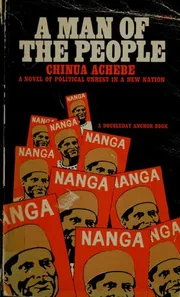
A Man of the People
by Chinua Achebe · 1966
It suits mature teens and adults interested in politics, satire and African literature.
150 pages, about 2.5 to 3.5 hours.
Achebe's short, sharp satire of Nigerian politics and a corrupt charmer. 73% taste match
What is inside
A Man of the People is a satirical novel by the Nigerian writer Chinua Achebe, first published in 1966. It belongs to the tradition of Nigerian satire in English and takes politics and government as its subject. At about 150 pages, it is a compact work of fiction.
The story is narrated by Odili, a young and educated man who finds himself in conflict with Chief Nanga, a former teacher who has moved into political life. The setting is an unnamed fictional African country in the twentieth century, shaped by West African customs drawn from Achebe's native Nigeria. Odili stands for the younger generation and its changing outlook, while Nanga stands for older, traditional ways. The novel's opening presents Chief the Honourable M. A. Nanga, M.P., as the most approachable politician in the country. The narrative closes with a military coup, which echoes a real coup in Nigeria carried out by a group of army officers including Major Chukwuma Kaduna Nzeogwu.
The book has appeared in some 40 editions, and it suits readers interested in political fiction, African literature, and satire set around the machinery of government.
No one can deny that Chief the Honourable M. A. Nanga, M.P., was the most approachable politician in the country.
Themes
PoliticiansPolitique et gouvernementRomansSatire, Nigerian (English)Politics and government
- Want to read 176
- Reading now 23
- Read 16
Most people shelving it are saving it for later.
Of 215 readers who put it on a shelf, 82% want to read it, 11% are reading it now, 7% have finished it and 0% stopped before the end.
By the numbers
- The median edition runs 150 pages. Counting about 275 words a page and an adult reading pace of 250 words a minute, that is about 2.8 hours of reading.
- Open Library tracks 40 editions from 24 publishers, the earliest dated 1966 and the latest 2013, across 4 languages.
- On reader demand it ranks in the top 6% of the classic books in our catalog (8,749 of them).
- Libraries shelve it under Dewey 823 and Library of Congress class PR-9387.90000000.A3 M3 1989.
 BookWard’s take
Achebe's short, sharp satire of Nigerian politics and a corrupt charmer
Achebe packs a whole political system into about 150 pages, and the compression is the point. Odili's narration is the draw: an educated young man at odds with Chief Nanga, his former teacher, in an unnamed African country. The voice is unmistakable, dry and observant in a way only Achebe could manage. The book is short and moves briskly, with little sagging in the middle. The ending is where it leaves the comfortable path: it closes on a military coup, decisive but hardly cozy. Politics is front and center throughout, yet the humor stays dry and the moral picture stays murky, with no easy heroes to rest on. That blend of bite and brevity is why it has lasted.
At roughly 150 pages it is compact and does not overstay, which fits BookWard's love of tight books.
Short chapters and a steady forward push keep it moving, a little below BookWard's fastest preference.
A Nigerian political satire told in an unflinching, ironic register was a distinctive voice in its moment.
Achebe's prose is plain and clear, closer to unadorned than ornate, which suits the satire.
The story is driven by the clash between two men, balancing plot and character fairly evenly.
Politically it is cynical about its leaders and its society, so it leans bleak rather than hopeful.
A conventional first-person narrative told in straightforward sequence, without formal experiment.
The satire carries real humor, though it is the biting kind in a serious setting.
The subject is grim but handled with satire's wry distance, giving a moderate darkness.
Restraint and irony dominate, with feeling kept in check beneath the satire.
See all 50 dialsEvery position, side by side with this book
Where it lines up
- EndingBookWard 8 · book 8
- Authorial voiceBookWard 9 · book 9
- Sagging middleBookWard 8 · book 8
Where it pulls apart
- OpeningBookWard 10 · book 8
- Familiar tropesBookWard 10 · book 8
- Internal logicBookWard 10 · book 8
At roughly 150 pages it is compact and does not overstay, which fits BookWard's love of tight books.
The opening introduces Chief Nanga as the country's most approachable politician, a sly, quick entry that suits BookWard's taste for hooks.
The satire of a charming, entrenched politician avoids easy moralizing and feels freshly observed rather than formulaic.
The political world operates by a consistent internal logic of patronage and favor, which holds together firmly.
Short chapters and a steady forward push keep it moving, a little below BookWard's fastest preference.
A Nigerian political satire told in an unflinching, ironic register was a distinctive voice in its moment.
Odili and Nanga are drawn with real texture, though satire keeps some figures a touch broader than life.
It closes on a military coup that settles the story's direction decisively, matching BookWard's taste for resolution.
Achebe stays wry and unsentimental, refusing to soften his portrait of power and those who chase it.
Its bleakness grows out of the satire and the setting rather than being thrown in for effect.
Not a nonfiction work, so this dial does not apply.
Odili's dry, knowing narration gives the book a distinctive personality that is hard to confuse with anyone else's.
Story carries the book, but the satirical argument about power is always close behind, so it leans a little toward ideas.
Politics and custom come out through scenes and talk, with little stopping to explain.
Brevity and constant friction between Odili and Nanga keep the middle from sagging.
Achebe's prose is plain and clear, closer to unadorned than ornate, which suits the satire.
The story is driven by the clash between two men, balancing plot and character fairly evenly.
Politically it is cynical about its leaders and its society, so it leans bleak rather than hopeful.
A conventional first-person narrative told in straightforward sequence, without formal experiment.
The satire carries real humor, though it is the biting kind in a serious setting.
The language is accessible and the length short, so it reads easily despite its serious subject.
Everything comes through Odili alone, a single narrating viewpoint.
Events unfold in a largely straight line toward the coup.
The unnamed country is invented but wholly realistic, with no fantastical elements.
A moderate cast of politicians, hangers-on and friends fills the story without becoming sprawling.
It touches a whole nation's politics yet stays anchored in one man's rivalry, so it sits in the middle.
Odili's reflections matter, but political maneuvering and public events carry more of the weight.
Much of the satire plays out in conversation, so talk is prominent.
There is a romantic thread, but politics, not love, is the book's core.
A fictional West African nation shaped by Nigerian customs will feel unfamiliar to many readers.
Set in the twentieth century and published in 1966, it belongs to the past rather than the present day.
Its portrait of charming, entrenched power still reads as sharply relevant today.
Odili is mostly trustworthy as a narrator, though his own motives color what he tells.
Nobody is purely heroic or villainous, and the book leaves the moral picture murky.
Description serves the scenes without lingering, so it stays fairly lean.
It stands alone as a single novel.
Events turn and reverse enough to keep readers guessing, though the book is not built on twists.
It confronts corruption and political failure squarely rather than comforting the reader.
The subject is grim but handled with satire's wry distance, giving a moderate darkness.
Restraint and irony dominate, with feeling kept in check beneath the satire.
The humor is dry and ironic rather than broad or slapstick.
Violence arrives mainly as political upheaval toward the end rather than as constant on-page brutality.
Sexual content is a minor presence, mostly in the background of political and personal intrigue.
Politics and government are the book's central subject and appear on nearly every page.
The language is largely plain English, with some local color but little dense dialect.
Odili's narration is pointed and opinionated, not a neutral report.
It looks at its own present and the failures of the past more than toward a hopeful future.
The book is skeptical of those in power and treats idealism warily.
Review written by BookWard, dial version 1, November 2026.
Who is A Man of the People right for?
It suits mature teens and adults interested in politics, satire and African literature. It deals with corruption and political upheaval, including a military coup.
The language is accessible and the length short, so it reads easily despite its serious subject.
The subject is grim but handled with satire's wry distance, giving a moderate darkness.
Restraint and irony dominate, with feeling kept in check beneath the satire.
Violence arrives mainly as political upheaval toward the end rather than as constant on-page brutality.
Book CompanionA Man of the People: ideas, characters, themes
A young narrator's clash with a charming former teacher turned politician exposes how power and popularity can hollow out a nation.
- The narrator's position. Odili is a young, educated man who stands for a changing generation and watches the old guard from close range.
- The charming politician. Chief the Honourable M. A. Nanga, M.P., is introduced as the most approachable politician in the country.
- An unnamed country. The book is set in a fictional 20th-century African country, shaped by customs drawn from Achebe's native Nigeria.
- Old and new. The conflict between Odili and Nanga pits a younger outlook against traditional ways.
- The coup. The narrative ends with a military coup that echoes a real coup in Nigeria.
Characters
Odili
Narrator
A young, educated man who represents the changing younger generation and falls into conflict with Nanga.
Chief Nanga
Politician and former teacher
Odili's former teacher, now a member of parliament, presented as the country's most approachable politician.
Themes
How power and patronage bend a country's public life.
The tension between a younger outlook and traditional ways.
Using irony and humor to expose the failings of those in power.
How being liked and being trustworthy can pull apart.
Discussion questions
- Why might Achebe choose an unnamed country rather than naming Nigeria directly?
- How does Odili's relationship to Nanga as a former teacher shape their conflict?
- What does the book suggest about the appeal of a politician who seems approachable?
- How does the coup at the end change your reading of what came before?
- Does the satire feel dated, or does it still apply to politics today?
Personalize your Book Companion
This is the general edition. In BookWard, the Companion is written for you: your reading profile, your notes, and spoiler-safe to the page you are on.
Buy, listen or borrow A Man of the People
Each link opens a search for this book on that store, in a new tab.
Read on a device
Borrow
Reviews and community
If you liked A Man of the People
A child's-eye memoir of revolution, drawn in stark black and white
Down and Out in Paris and LondonGeorge OrwellOrwell's first book, and a clear-eyed look at poverty
Burmese DaysGeorge OrwellOrwell's first novel: empire, rot, and one man's small cowardice
The player of gamesIain BanksA bored game master walks into an empire built on one game
Sources: Open Library.
Track A Man of the People and find your next favorite
Add it to your shelf, rate what you have read, and BookWard will recommend what fits you.
Free to start. No credit card needed.