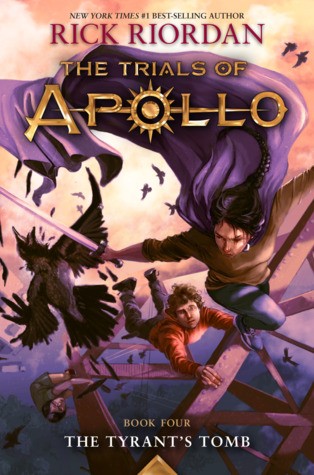
The Tyrant's Tomb
by Rick Riordan
★ Top 25 book of 2019 · #18 on Best Books of 2019
Apollo, banished from Olympus and living as a human, heads to Camp Jupiter to help Roman demigods face a trio of evil emperors. Their hope lies in the forgotten tomb of an even worse ruler.
Best for: Fans of mythology-inspired adventure who have followed Apollo's journey through the series
The Tyrant's Tomb is #18 on BookWard's Best Books of 2019, out of 83 2019 books that cleared our data bar.
What The Tyrant's Tomb is about
Apollo, living as the mortal Lester Papadopoulos, brings Meg and the body of their fallen friend Jason to Camp Jupiter in the San Francisco Bay Area. Lavinia and Hazel Levesque help them on the way, and praetors Frank Zhang and Reyna Ramírez-Arellano greet them at Camp Jupiter.
The camp's hope may lie in the forgotten tomb of Tarquin, the last king of Rome, who has returned. Elsewhere, Ella the harpy and Tyson the Cyclops are busy rebuilding the Sibylline Books. Apollo, Meg and Hazel are sent to Sutro Tower to destroy a soundless god and claim Sibyl's Jar, which is needed to win divine aid. This fourth Trials of Apollo adventure carries grief and sacrifice alongside its action, and it will suit readers already following the series.
The Tyrant's Tomb on the Best Books of 2019
The Tyrant's Tomb came out in 2019. Of the 83 books first published in 2019 that met BookWard's data bar, it ranks #18 on our Best Books of 2019 list.
Why it made the list: 414 readers have shelved it on Open Library; readers rate it 4.4 out of 5 (19 ratings). The list ranks each year’s books on how many readers have picked them up, how highly readers rate them, and how many are reading them right now.
Nearby on the 2019 list
- Daisy Jones & the Six Taylor Jenkins Reid, #16
- On Earth We're Briefly Gorgeous Ocean Vuong, #17
- Everything Is F*cked Mark Manson, #19
- Invisible Women Caroline Criado Perez, #20
See all Best Books of 2019 Best books by year
More years: Best Books of 2018 Best Books of 2020.
The numbers behind it
- Readers: 374 want to read it, 10 are reading it now and 30 have read it, according to Open Library.
- Ratings: 4.4 out of 5 from 19 Open Library ratings.
| Signal | This book (0 to 100) | Weight |
|---|---|---|
| Reach | 70 | 55% |
| Reader love | 89 | 25% |
| Being read right now | 49 | 20% |
Questions about The Tyrant's Tomb
When was The Tyrant's Tomb published?
The Tyrant's Tomb by Rick Riordan was first published in 2019.
Was The Tyrant's Tomb one of the best books of 2019?
The Tyrant's Tomb is #18 on BookWard's Best Books of 2019, out of 83 2019 books that cleared our data bar. 414 readers have shelved it on Open Library; readers rate it 4.4 out of 5 (19 ratings).
Why is The Tyrant's Tomb on the Best Books of 2019 list?
414 readers have shelved it on Open Library; readers rate it 4.4 out of 5 (19 ratings).
More of the best books of 2019
- Red, White & Royal Blue Casey McQuiston, #1
- A Good Girl's Guide to Murder Holly Jackson, #2
- Heartstopper, Volume 2 Alice Oseman, #3
- Guts Raina Telgemeier, #4
- The Silent Patient Alex Michaelides, #5
- Into the Pit (Five Nights at Freddy’s Scott Cawthon, #6
See the full Best Books of 2019, the Top 100, or new books on Rising.
How we know
This page uses public data: Open Library reader counts and ratings, and Wikipedia page views for recent years. The description is paraphrased from real source text. Rankings reflect reading interest, not quality or sales, and can be affected by data gaps. Lists update monthly.
Suits readers from about nine or ten upward, especially those who already like Riordan's mythology adventures.
Depends on the edition you pick.
Apollo's fourth mortal trial: fast, funny, and deep in the series. 49% taste match
 BookWard’s take
Apollo's fourth mortal trial: fast, funny, and deep in the series
The Tyrant's Tomb drops Apollo, still stuck as the teenager Lester Papadopoulos, into Camp Jupiter, and it opens with a body, a coffin and a monster attack almost at once. That hook is strong, and the pace stays brisk. Riordan's authorial voice is the real draw: Apollo narrates with wounded vanity and constant jokes, which keeps the tone funny even when the stakes turn grave. The catch is familiar tropes. This is a quest structure built on Greco-Roman myth, and it is the fourth book in a series, so newcomers will feel the weight of what came before. Expect a large cast of returning friends, an easy read, and a prophecy-driven mission rather than anything formally daring.
Monster attacks, tunnels and a ticking threat to the camp keep it moving at roughly BookWard's own speed.
The premise of a god turned teenager is inventive, but this fourth entry reuses the series formula more than it breaks new ground.
The writing is plain and conversational, built for quick reading, not ornament.
The mission and prophecy drive events more than internal change, though Apollo's growth runs alongside.
Loss looms, but friendship and resilience keep the outlook leaning hopeful.
A straightforward quest told in order, with nothing experimental in its construction.
Apollo's wisecracks and haiku-flavoured vanity keep it funny even through the grim moments.
Death, grief and monster attacks appear, but always at a middle-grade level.
Grief for Jason and the strain of a doomed fight give it moderate emotional weight.
See all 50 dialsEvery position, side by side with this book
Where it lines up
- PaceBookWard 8 · book 8
- Authorial voiceBookWard 9 · book 9
- Story or ideasBookWard 3 · book 2
Where it pulls apart
- Familiar tropesBookWard 10 · book 3
- Internal logicBookWard 10 · book 6
- OriginalityBookWard 9 · book 4
It begins in motion with Apollo, Meg and Jason's coffin under attack, which matches BookWard's love of an immediate hook.
A quest, a prophecy and a band of demigods are well-worn mythic furniture, short of the fresh ground BookWard wants.
The mythology and the series rules mostly hold together, though a fantasy built on gods and prophecy bends where it needs to.
Monster attacks, tunnels and a ticking threat to the camp keep it moving at roughly BookWard's own speed.
The premise of a god turned teenager is inventive, but this fourth entry reuses the series formula more than it breaks new ground.
Apollo's arc from vain god toward something humbler carries real feeling, though many supporting figures stay lightly sketched.
As the penultimate book it resolves its own mission while pointing at the finale, so it is only partly closed.
Grief over Jason is handled warmly and openly, leaning more heartfelt than restrained, softer than BookWard's taste.
It takes on a death at the outset with real consequences, not just for effect, which sits fairly well with BookWard.
Apollo's vain, self-mocking narration is instantly recognisable, and it is the book's strongest quality for BookWard.
This is entirely story-led: a mission, a prophecy and a threat, rather than a book of ideas.
Riordan often explains mythology and series history outright, which cuts against BookWard's wish to see things in scene.
The quest keeps handing out new destinations and dangers, so the middle holds its energy fairly well.
The writing is plain and conversational, built for quick reading, not ornament.
The mission and prophecy drive events more than internal change, though Apollo's growth runs alongside.
Loss looms, but friendship and resilience keep the outlook leaning hopeful.
A straightforward quest told in order, with nothing experimental in its construction.
Apollo's wisecracks and haiku-flavoured vanity keep it funny even through the grim moments.
Written for middle-grade readers, it is easy to read, though series knowledge helps.
Everything is filtered through Apollo's first-person voice alone.
The story moves forward in a straight line with no time jumps.
Gods, dryads, harpies and Cyclopes live openly in this world, so it is fully fantastical.
Hazel, Frank, Reyna, Lavinia, Tyson, Ella and Meg crowd the page, so the cast is large.
A camp's survival against a Roman triumvirate gives it real stakes, though still within an adventure frame.
Fights, chases and missions dominate, with Apollo's reflections giving only brief pauses.
Banter among the demigods carries a lot of the story and much of the humour.
Romance is a minor thread, with friendship and loyalty in front.
The Greco-Roman demigod world is fantastical, but series readers will find it well known.
Mythic figures meet a modern American setting around the San Francisco Bay Area.
It is rooted in myth, but is strongest as part of its own series.
Apollo is vain and self-regarding, yet he reports events honestly enough to trust.
Heroes and villains are fairly clearly marked, with Apollo's growth as the main grey area.
Settings are sketched briskly, with detail left to action and voice.
It is the fourth book in The Trials of Apollo, so it leans heavily on what came earlier.
Prophecies, hidden tombs and sudden threats deliver a steady supply of turns.
It is comfort-leaning adventure, fun and familiar rather than disturbing.
Death, grief and monster attacks appear, but always at a middle-grade level.
Grief for Jason and the strain of a doomed fight give it moderate emotional weight.
Apollo's jokes are broad and playful, closer to farce than dry wit.
Monster fights and a death occur, though the treatment stays suited to young readers.
Nothing sexual appears on the page.
Roman leadership and camp governance feature, but only as story backdrop.
The language is plain and quick to read.
Apollo narrates with strong views, boasting and complaining throughout.
It draws heavily on ancient myth while pushing toward the series' finale.
Friendship, courage and learning to be a hero lean the book toward idealism.
Review written by BookWard, dial version 1, November 2026.
Who is The Tyrant's Tomb right for?
Suits readers from about nine or ten upward, especially those who already like Riordan's mythology adventures. It includes a death, grief, monster fights and some peril, all handled at a young-reader level.
Written for middle-grade readers, it is easy to read, though series knowledge helps.
Death, grief and monster attacks appear, but always at a middle-grade level.
Grief for Jason and the strain of a doomed fight give it moderate emotional weight.
Monster fights and a death occur, though the treatment stays suited to young readers.
Book CompanionThe Tyrant's Tomb: ideas, characters, themes
A banished god, living as a teenager, must learn what being a hero means while helping Camp Jupiter survive.
- Jason's coffin. The story starts with Apollo and Meg carrying Jason's body toward Camp Jupiter.
- A rescue. Lavinia arrives with dryads and a faun to fight off a monster and guide them.
- The camp's plan. Camp Jupiter decides to carry on Jason's plan to build temples for the gods.
- The sibyl books. Ella and Tyson are recreating the Sibylline Books, which lead to a prophecy about a tomb.
- A threat of fire. The villains weigh taking the camp quietly or destroying it with Greek fire.
Characters
Apollo (Lester Papadopoulos)
narrator and hero-in-training
A god turned human teenager who must restore five oracles.
Meg
Apollo's companion
Travels with Apollo and helps carry Jason's body to Camp Jupiter.
Lavinia
rescuer and guide
A pink-haired girl who helps lead them to the camp.
Hazel Levesque
Camp Jupiter ally
Arrives to fight monsters and recognises Jason's coffin.
Reyna Ramírez-Arellano
praetor
Helps lead Camp Jupiter's defence.
Themes
What it takes to act bravely when you are powerless.
How friends carry on after losing someone.
A proud god learning from mortal life.
Allies working together against stronger enemies.
Choosing to protect others at personal cost.
Discussion questions
- How has Apollo changed since the start of the series?
- Why does the camp choose to continue Jason's plan?
- What makes Apollo's narration funny, and when does it turn serious?
- How does the book handle death in a middle-grade story?
- Why do the villains choose between conquest and destruction?
Personalize your Book Companion
This is the general edition. In BookWard, the Companion is written for you: your reading profile, your notes, and spoiler-safe to the page you are on.
Buy, listen or borrow The Tyrant's Tomb
Each link opens a search for this book on that store, in a new tab.
Read on a device
Borrow
Reviews and community
If you liked The Tyrant's Tomb
A fast, funny Greek-myth quest told by a god turned teenager
The Sword of SummerRick RiordanNorse myth meets a homeless Boston teen, fast and funny
The Hidden OracleRick RiordanA fallen god, a teenage body, and a very funny voice
The Tower of NeroRick RiordanApollo's last trial: a fast, funny finale for a long saga
Find your own best books
Add what you have read, rate it, and BookWard will recommend what to read next.
Free to start. No credit card needed.