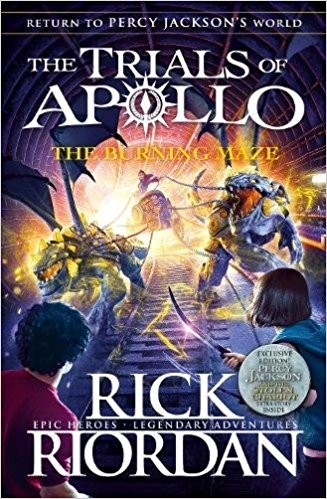
The Burning Maze
by Rick Riordan
★ Top 25 book of 2018 · #15 on Best Books of 2018
Apollo, banished from Olympus and living as a mortal teenager, must restore darkened Oracles without his powers. Alongside Meg, he heads into a Labyrinth to confront a threat to Camp Jupiter.
Best for: Young fans of mythology-based adventure and the ongoing Riordan series
The Burning Maze is #15 on BookWard's Best Books of 2018, out of 60 2018 books that cleared our data bar.
What The Burning Maze is about
Apollo, once a god, has been thrown out of Olympus by Zeus and now lives as Lester Papadopoulos, a mortal teenager with no powers to lean on. His path back to the heavens runs through a daunting task: restoring five Oracles that have gone dark. Along the way he is bound to Meg, a young daughter of Demeter, and the two have already come through trials at Camp Half-Blood and in Indianapolis.
In Indianapolis, Meg received the Dark Prophecy while sitting on the Throne of Memory, and it warned that a trio of Roman emperors is planning an attack on Camp Jupiter. While Leo flies ahead on Festus to alert the Roman camp, Lester and Meg head into the Labyrinth. They are looking for the third emperor and for an Oracle who speaks only in word puzzles, somewhere in the American Southwest. The prophecy points to a satyr as their guide, and Meg knows just whom to call. Readers who enjoy a humorous, quick-moving quest about humility, friendship and second chances will find plenty here.
The Burning Maze on the Best Books of 2018
The Burning Maze came out in 2018. Of the 60 books first published in 2018 that met BookWard's data bar, it ranks #15 on our Best Books of 2018 list.
Why it made the list: 510 readers have shelved it on Open Library; readers rate it 4.4 out of 5 (14 ratings). The list ranks each year’s books on how many readers have picked them up, how highly readers rate them, and how many are reading them right now.
Nearby on the 2018 list
- Factfulness Hans Rosling, #13
- My Year of Rest and Relaxation Ottessa Moshfegh, #14
- Monday's Not Coming Tiffany D. Jackson, #16
- Front Desk Kelly Yang, #17
See all Best Books of 2018 Best books by year
More years: Best Books of 2017 Best Books of 2019.
The numbers behind it
- Readers: 450 want to read it, 17 are reading it now and 43 have read it, according to Open Library.
- Ratings: 4.4 out of 5 from 14 Open Library ratings.
| Signal | This book (0 to 100) | Weight |
|---|---|---|
| Reach | 70 | 55% |
| Reader love | 60 | 25% |
| Being read right now | 70 | 20% |
Questions about The Burning Maze
When was The Burning Maze published?
The Burning Maze by Rick Riordan was first published in 2018.
Was The Burning Maze one of the best books of 2018?
The Burning Maze is #15 on BookWard's Best Books of 2018, out of 60 2018 books that cleared our data bar. 510 readers have shelved it on Open Library; readers rate it 4.4 out of 5 (14 ratings).
Why is The Burning Maze on the Best Books of 2018 list?
510 readers have shelved it on Open Library; readers rate it 4.4 out of 5 (14 ratings).
More of the best books of 2018
- Heartstopper, Volume 1 Alice Oseman, #1
- Where the Crawdads Sing Delia Owens, #2
- The Laws of Human Nature Robert Greene, #3
- Atomic Habits James Clear, #4
- Five Feet Apart Rachael Lippincott, #5
- Verity Colleen Hoover, #6
See the full Best Books of 2018, the Top 100, or new books on Rising.
How we know
This page uses public data: Open Library reader counts and ratings, and Wikipedia page views for recent years. The description is paraphrased from real source text. Rankings reflect reading interest, not quality or sales, and can be affected by data gaps. Lists update monthly.
Suits middle-grade and young teen readers, and fans of Greek myth.
Depends on the edition you pick.
A fast, funny Greek-myth quest told by a god turned teenager. 50% taste match
 BookWard’s take
A fast, funny Greek-myth quest told by a god turned teenager
The Burning Maze is the third Trials of Apollo book, and it is not a place to start. The hook is immediate: a disgraced god stuck in a teenage body, bound to a stubborn young daughter of Demeter, with a Dark Prophecy pointing at the American Southwest and a Labyrinth to cross. Pace stays high and the humor is broad and constant, carried by a first-person narrator with a strong, vain, self-mocking voice. Familiar tropes are part of the fun, since the quest-and-prophecy frame is well worn, so originality comes from the voice and the mythology mash-up rather than the structure. Character depth lands well for the genre, especially in how Apollo slowly changes. Expect story over ideas, and plenty explained outright.
A middle-grade adventure that moves along without sprawling, shorter than the epics, which BookWard prefers even tighter.
Trials, chases, and cliffhangers keep things moving at a quick clip, close to BookWard's own fast taste.
Retelling Greek myth through a disgraced god's snark is fresh in tone but follows a known series formula.
Plain, conversational prose built for speed and jokes, a little plainer than BookWard's middle ground.
Events and the quest drive things more than inner change, though Apollo's growth matters.
Hard losses are balanced by humor and loyalty, leaving a hopeful if bruised outlook.
A straightforward linear quest narrative with chapter-to-chapter momentum.
Jokes, haiku, and Apollo's self-mockery are everywhere, funnier than almost any book BookWard sits beside.
Peril and loss are present but kept within a middle-grade register.
Loss and friendship land with real feeling, though softened by humor.
See all 50 dialsEvery position, side by side with this book
Where it lines up
- PaceBookWard 8 · book 8
- Authorial voiceBookWard 9 · book 9
- Story or ideasBookWard 3 · book 2
Where it pulls apart
- Familiar tropesBookWard 10 · book 3
- Internal logicBookWard 10 · book 6
- LengthBookWard 1 · book 4
A middle-grade adventure that moves along without sprawling, shorter than the epics, which BookWard prefers even tighter.
It drops straight into a god's humiliating mortal life and a looming prophecy, a start that grabs quickly, as BookWard likes.
Quest, prophecy, and chosen companions are well-worn fantasy ground, which sits against BookWard's wish to avoid familiar tropes.
Myth-based rules hold together well enough for the story, though magic bends where the plot needs it, short of airtight.
Trials, chases, and cliffhangers keep things moving at a quick clip, close to BookWard's own fast taste.
Retelling Greek myth through a disgraced god's snark is fresh in tone but follows a known series formula.
Apollo's vanity and slow growth give him real shape, though supporting players lean toward types.
This installment resolves its own trial while leaving the larger prophecy open for the next book.
Friendship and loss are handled warmly, with some tugging at feelings, a touch more sentimental than BookWard likes.
Darker turns serve the stakes of the quest rather than existing for effect, which fits BookWard.
Apollo's self-regarding, wisecracking first-person narration is the book's signature, distinctive and a strong match for BookWard.
This is a story-first adventure, with mythology as scenery rather than the point, close to BookWard's story-led bent.
Recaps of earlier books and myth background are often explained outright, where BookWard would rather see them shown.
The quest structure keeps momentum going through the middle, with few lulls.
Plain, conversational prose built for speed and jokes, a little plainer than BookWard's middle ground.
Events and the quest drive things more than inner change, though Apollo's growth matters.
Hard losses are balanced by humor and loyalty, leaving a hopeful if bruised outlook.
A straightforward linear quest narrative with chapter-to-chapter momentum.
Jokes, haiku, and Apollo's self-mockery are everywhere, funnier than almost any book BookWard sits beside.
Easy, fast reading aimed at younger readers, lighter than BookWard's slightly demanding taste.
Told entirely through Apollo's first-person eyes, a single viewpoint.
The story moves forward in order without time jumps.
Gods, monsters, and a magical Labyrinth make this fully fantastical, beyond BookWard's mixed comfort.
A good-sized band of demigods, companions, and villains shares the page, larger than BookWard's usual.
Roman emperors threatening a camp raise stakes beyond one person, though the focus stays on a small party.
Action, travel, and trials dominate, with Apollo's inner voice as commentary.
Banter between Apollo and his companions fills much of the book.
Romance is a minor thread beside the quest and friendships.
A mythology-laced modern America is part familiar, part strange, close to BookWard's taste for unfamiliar settings.
Set in the present day, with ancient gods dropped into modern life.
Its jokes and references are rooted in its moment, though the myths underneath are lasting.
Apollo is vain and self-deceiving at times, but mostly tells events straight.
Heroes and villains are clearly marked, with little ambiguity.
Description is brisk and functional, serving action over atmosphere.
Third in a five-book run, so it relies on earlier volumes and leaves threads open.
Prophecy riddles and reveals keep surprises coming through the quest.
A comforting, adventure-driven read with little to unsettle.
Peril and loss are present but kept within a middle-grade register.
Loss and friendship land with real feeling, though softened by humor.
Jokes lean broad and silly, with puns and slapstick, though Apollo's ego adds some dryness.
Monster fights and danger appear regularly but without graphic detail.
Essentially absent, in keeping with its young audience.
Power struggles among emperors exist, but real-world politics stay out of it.
Plain, accessible language throughout.
Apollo comments on everything with strong, self-regarding opinions.
Rooted in ancient myth but driven by a push toward saving the present.
Loyalty and courage are treated as worth the cost, leaning idealistic.
Review written by BookWard, dial version 1, November 2026.
Who is The Burning Maze right for?
Suits middle-grade and young teen readers, and fans of Greek myth. It includes monster fights and some loss, but nothing graphic.
Easy, fast reading aimed at younger readers, lighter than BookWard's slightly demanding taste.
Peril and loss are present but kept within a middle-grade register.
Loss and friendship land with real feeling, though softened by humor.
Monster fights and danger appear regularly but without graphic detail.
Book CompanionThe Burning Maze: ideas, characters, themes
A god stripped of his powers must restore ancient Oracles while learning humility in a teenage mortal body.
- Third trial. Apollo and Meg head into the Labyrinth to find the next emperor and an Oracle who speaks in word puzzles.
- The Dark Prophecy. Meg's words from the Throne of Memory reveal a plot by Roman emperors against Camp Jupiter.
- Powerless god. Apollo is now Lester Papadopoulos, a mortal teenager without godly abilities.
- A satyr guide. The prophecy's line about a cloven guide points to a satyr companion Meg knows.
- Warning the camp. Leo flies ahead on Festus to alert the Roman camp while the others go through the Labyrinth.
Characters
Apollo (Lester)
Narrator and protagonist
A formerly glorious god now living as an awkward mortal teenager.
Meg
Companion
A confounding young daughter of Demeter to whom Apollo is duty-bound.
Leo
Demigod ally
Flies ahead on Festus to warn the Roman camp.
Themes
Learning to live without power or status.
Relying on companions to survive impossible tasks.
Earning back a place through service.
Riddling warnings that shape what the heroes must do.
Discussion questions
- How does Apollo's mortal life change the way he sees other people?
- What makes Meg's relationship with Apollo work despite their friction?
- Why do riddling prophecies make for good storytelling in a quest?
- How does humor change the feel of high-stakes danger in this book?
- Would the story work as well without Apollo's boastful narration?
Personalize your Book Companion
This is the general edition. In BookWard, the Companion is written for you: your reading profile, your notes, and spoiler-safe to the page you are on.
Buy, listen or borrow The Burning Maze
Each link opens a search for this book on that store, in a new tab.
Read on a device
Borrow
Reviews and community
If you liked The Burning Maze
Apollo's fourth mortal trial: fast, funny, and deep in the series
The Sword of SummerRick RiordanNorse myth meets a homeless Boston teen, fast and funny
The Hidden OracleRick RiordanA fallen god, a teenage body, and a very funny voice
The Tower of NeroRick RiordanApollo's last trial: a fast, funny finale for a long saga
Find your own best books
Add what you have read, rate it, and BookWard will recommend what to read next.
Free to start. No credit card needed.