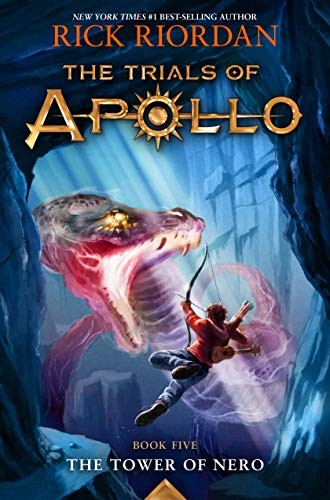
The Tower of Nero
by Rick Riordan
★ Top 10 book of 2020 · #10 on Best Books of 2020
With the battle for Camp Jupiter won, Apollo and Meg turn to their last and likely deadly mission: taking down the emperor Nero for good. Apollo hopes to regain his godly form, while Meg must confront her troubled past.
Best for: Readers following the series who want its final showdown with the emperor Nero
The Tower of Nero is #10 on BookWard's Best Books of 2020, out of 65 2020 books that cleared our data bar.
What The Tower of Nero is about
Apollo, in his human form as Lester Papadopoulos, is running out of time. In this fifth and final book of The Trials of Apollo, he and his demigod master Meg set out to free the last oracle, with Apollo telling the story himself in his usual vain, funny voice.
Their enemies are personal ones: Meg's abusive stepfather Nero, who leads the malevolent Triumvirate Holdings alongside Commodus and Julius Caesar, and Python, Apollo's old nemesis. Nero gives the pair two days to surrender or Manhattan will burn. Will Solace and his boyfriend Nico di Angelo come to help. Beneath the jokes and the mythology, this is a story about facing the past, recovering from harm, and what it takes to change. It suits readers who have followed Camp Half-Blood from the start.
The Tower of Nero on the Best Books of 2020
The Tower of Nero came out in 2020. Of the 65 books first published in 2020 that met BookWard's data bar, it ranks #10 on our Best Books of 2020 list.
Why it made the list: 444 readers have shelved it on Open Library; readers rate it 4.6 out of 5 (25 ratings). The list ranks each year’s books on how many readers have picked them up, how highly readers rate them, and how many are reading them right now.
Nearby on the 2020 list
- Think Like a Monk Jay Shetty, #8
- Piranesi Susanna Clarke, #9
- The Almanack of Naval Ravikant Eric Jorgenson, #11
- Guest List Lucy Foley, #12
See all Best Books of 2020 Best books by year
More years: Best Books of 2019 Best Books of 2021.
The numbers behind it
- Readers: 386 want to read it, 11 are reading it now and 47 have read it, according to Open Library.
- Ratings: 4.6 out of 5 from 25 Open Library ratings.
| Signal | This book (0 to 100) | Weight |
|---|---|---|
| Reach | 74 | 55% |
| Reader love | 98 | 25% |
| Being read right now | 63 | 20% |
Questions about The Tower of Nero
When was The Tower of Nero published?
The Tower of Nero by Rick Riordan was first published in 2020.
Was The Tower of Nero one of the best books of 2020?
The Tower of Nero is #10 on BookWard's Best Books of 2020, out of 65 2020 books that cleared our data bar. 444 readers have shelved it on Open Library; readers rate it 4.6 out of 5 (25 ratings).
Why is The Tower of Nero on the Best Books of 2020 list?
444 readers have shelved it on Open Library; readers rate it 4.6 out of 5 (25 ratings).
More of the best books of 2020
- Good Girl, Bad Blood Holly Jackson, #1
- The Inheritance Games Jennifer Lynn Barnes, #2
- The Psychology of Money Morgan Housel, #3
- The Ballad of Songbirds and Snakes Suzanne Collins, #4
- Heartstopper, Volume 3 Alice Oseman, #5
- The Midnight Library Matt Haig, #6
See the full Best Books of 2020, the Top 100, or new books on Rising.
How we know
This page uses public data: Open Library reader counts and ratings, and Wikipedia page views for recent years. The description is paraphrased from real source text. Rankings reflect reading interest, not quality or sales, and can be affected by data gaps. Lists update monthly.
Best for readers around 10 and up, and especially for those who know the earlier books.
Depends on the edition you pick.
Apollo's last trial: a fast, funny finale for a long saga. 54% taste match
 BookWard’s take
Apollo's last trial: a fast, funny finale for a long saga
The Tower of Nero closes both The Trials of Apollo and the whole Camp Half-Blood Chronicles, so it carries a lot of series weight. Apollo narrates in first person, and that voice is the draw: a vain former god learning humility, played for jokes. The hook is immediate. Nero's ultimatum that Manhattan will burn sets a clock the story keeps ticking down. The pace is brisk, with barely any sag, and the ending delivers a full resolution. On the downside, it leans on familiar tropes and mythic set pieces, so it never feels especially fresh. It tilts toward hope and warmth rather than bleakness, and the humor is broad where I'd rather it be dry. This is a satisfying farewell for committed fans of the series, and less so for newcomers.
A middle-grade adventure of moderate size, brisk for a finale, though the series baggage makes it longer than it feels.
Short chapters, a ticking clock and constant action keep it moving, close to BookWard's quick preference.
The Greco-Roman setting is fresh in treatment but the formula is established, so it lands below BookWard's high bar.
Plain, conversational and quick to read, with jokes preferred over ornament.
The plot of the final showdown leads, though character growth runs alongside it.
Despite grim enemies, the tone is warm and the series ends on optimism, leaning well above BookWard's.
A conventional quest arc told straight through in sequence.
Apollo's jokes and haiku-style asides make this one of the funnier modern fantasy voices.
Threatening villains and some harsh moments, softened by a middle-grade tone.
Farewells, abuse backstory and sacrifice carry real feeling, kept in check by humor.
See all 50 dialsEvery position, side by side with this book
Where it lines up
- PaceBookWard 8 · book 8
- Authorial voiceBookWard 9 · book 9
- EndingBookWard 8 · book 9
Where it pulls apart
- Familiar tropesBookWard 10 · book 4
- Internal logicBookWard 10 · book 6
- LengthBookWard 1 · book 4
A middle-grade adventure of moderate size, brisk for a finale, though the series baggage makes it longer than it feels.
Nero's two-day ultimatum to burn Manhattan puts the stakes in play almost immediately, which suits BookWard well.
Chosen-hero quests, prophecies and villains with world-ending plans are well-worn mythic territory, short of BookWard's bar.
Prophecy rules and godly powers mostly hold together, though a long series leaves some convenient fixes.
Short chapters, a ticking clock and constant action keep it moving, close to BookWard's quick preference.
The Greco-Roman setting is fresh in treatment but the formula is established, so it lands below BookWard's high bar.
Apollo's slow growth from arrogance to empathy is the real arc, and Meg's trauma gives it weight.
As the series finale it ties off its major threads, which matches BookWard's appetite for resolution.
Warm friendships and emotional payoffs lean sweet for a farewell, softer than BookWard's restrained taste.
Darker beats, like Lu losing her hands, feel tied to the stakes, though some threat is aimed at young readers.
Fiction, so the rigor dial does not apply.
Apollo's vain, self-mocking first-person narration is unmistakable and carries the whole book.
This is plain adventure storytelling, driven by quests and fights rather than ideas.
Series lore and mythology are explained fairly openly by the narrator, more than BookWard likes.
Escapes, battles and revelations keep tension up, with little downtime before the finale.
Plain, conversational and quick to read, with jokes preferred over ornament.
The plot of the final showdown leads, though character growth runs alongside it.
Despite grim enemies, the tone is warm and the series ends on optimism, leaning well above BookWard's.
A conventional quest arc told straight through in sequence.
Apollo's jokes and haiku-style asides make this one of the funnier modern fantasy voices.
Easy reading for its target age, though series knowledge helps.
Told entirely through Apollo's first-person narration.
The story runs chronologically over a short, urgent stretch.
Gods, monsters and oracles in a modern city make this firmly fantastical.
Many gods, demigods, emperors and allies crowd the final battle, a bigger cast than BookWard favors.
A threat to all of Manhattan and the last oracle gives it big stakes, though the focus stays on a small band of friends.
Action and fighting dominate, with Apollo's reflections in between.
Banter among the characters drives much of the book and carries the humor.
Will and Nico's relationship appears but stays secondary to the quest.
Mythology meets modern New York, with hidden realms and troglodytes offering some unfamiliar territory.
Set in present-day New York with gods hidden in it.
A series finale tied to its fandom, though the mythic material has lasting appeal.
Apollo is boastful and self-serving yet honest about his growth, mostly reliable.
Good and evil are clearly drawn, with villains plainly villainous.
Functional description serves the action, with flourishes saved for monsters and set pieces.
Fiction, so the nonfiction dial does not apply.
Fiction, so the perspective dial does not apply.
The fifth and final Trials of Apollo book, closing the whole Camp Half-Blood Chronicles.
Prophecy twists, betrayals and reversals arrive regularly in the finale.
A comfortable, familiar ride for series fans, designed to satisfy more than provoke.
Threatening villains and some harsh moments, softened by a middle-grade tone.
Farewells, abuse backstory and sacrifice carry real feeling, kept in check by humor.
The jokes are broad, playful and self-mocking rather than dry.
Battles and monster fights recur, handled at a middle-grade level.
Essentially none, aside from a relationship shown without explicit content.
Villains are power-hungry emperors, but this is mythic conflict, not political commentary.
Plain, accessible modern language throughout.
Apollo's constant commentary and judgments make the narration highly opinionated.
It resolves the past while setting the heroes toward a hopeful future.
Friendship, humility and redemption are central, giving it an idealistic core.
Review written by BookWard, dial version 1, November 2026.
Who is The Tower of Nero right for?
Best for readers around 10 and up, and especially for those who know the earlier books. It includes fantasy battles, a character losing her hands, and a past of parental abuse, all handled at a middle-grade level.
Easy reading for its target age, though series knowledge helps.
Threatening villains and some harsh moments, softened by a middle-grade tone.
Farewells, abuse backstory and sacrifice carry real feeling, kept in check by humor.
Battles and monster fights recur, handled at a middle-grade level.
Book CompanionThe Tower of Nero: ideas, characters, themes
A mortal-bound Apollo and his demigod master Meg face Nero and Python in a final fight to free the last oracle.
- The ultimatum. Nero gives Meg and Apollo two days to surrender or Manhattan burns, setting the clock.
- Triumvirate Holdings. A malevolent group led by Nero with Commodus and Julius Caesar threatens to unleash Python.
- The last oracle. The mission centers on freeing the final oracle, tied to a prophecy Python has tampered with.
- Allies from the camp. Will Solace, Nico di Angelo and Rachel Dare help, and Camp Half-Blood demigods join the fight.
- A series farewell. It closes The Trials of Apollo and the main Camp Half-Blood Chronicles.
Characters
Apollo (Lester Papadopoulos)
Narrator
The former god in human form, learning humility while fighting to free the last oracle.
Meg
Apollo's demigod master
Faces her abusive stepfather Nero and her troubled past.
Nero
Main antagonist
Leader of Triumvirate Holdings and Meg's stepfather, threatening to burn Manhattan.
Lu
Ally
Helps Apollo and Meg and pays a heavy price for it.
Will Solace
Apollo's son and ally
Joins the mission with his boyfriend Nico di Angelo.
Themes
Apollo's arc from godly arrogance to empathy.
Meg confronting the stepfather who hurt her.
Friends and allies forming a team against tyranny.
Characters give up something precious for the greater good.
Closing a long saga and what heroes carry forward.
Discussion questions
- How does Apollo's narration shape how much we trust or like him?
- Why does Meg's confrontation with Nero matter more than the larger world threat?
- What does Lu's choice say about the price of immortality?
- Does the finale pay off the series as a whole?
- How do the many allies help or crowd the story?
Personalize your Book Companion
This is the general edition. In BookWard, the Companion is written for you: your reading profile, your notes, and spoiler-safe to the page you are on.
Buy, listen or borrow The Tower of Nero
Each link opens a search for this book on that store, in a new tab.
Read on a device
Borrow
Reviews and community
If you liked The Tower of Nero
Apollo's fourth mortal trial: fast, funny, and deep in the series
The Burning MazeRick RiordanA fast, funny Greek-myth quest told by a god turned teenager
Wrath of the Triple GoddessRick RiordanPercy house-sits for a goddess, and the pets escape
The Sword of SummerRick RiordanNorse myth meets a homeless Boston teen, fast and funny
Find your own best books
Add what you have read, rate it, and BookWard will recommend what to read next.
Free to start. No credit card needed.