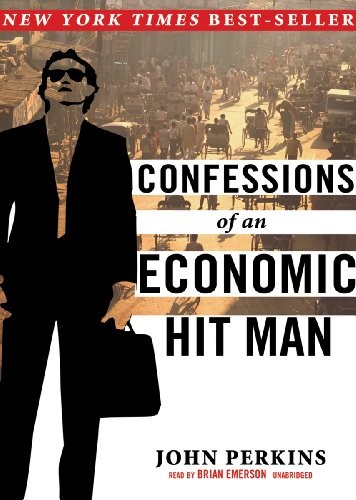
Confessions of an Economic Hit Man
by Perkins, John
This Sinhalese translation presents a controversial book examining how U.S. government economic policies have affected developing countries. It offers a challenging look at global economics and power.
Best for: Sinhalese readers curious about controversial views on U.S. economic policy abroad
Confessions of an Economic Hit Man ranked #23 on BookWard's Best Books of 2004 when we last measured it, in October 2026.
What Confessions of an Economic Hit Man is about
John Perkins presents this book as a confession about his own working life. He describes his years at the Boston engineering consulting firm Chas. T. Main, where he says he was trained as an "economic hitman" and sent to persuade leaders of poorer countries to accept very large development loans. In his telling, the construction and engineering projects went to American companies, which gave the United States influence and access to natural resources while mostly enriching local elites. He argues that a "corporatocracy" driven by greed has built a kind of American empire, and he questions the belief that all economic growth benefits everyone. The book was a commercial success, appearing on the best-seller lists of both the New York Times and Amazon, but critics expressed doubts about the accuracy and validity of Perkins' claims, several reviewers discussed a lack of documentation or verification, and a number of former colleagues at Chas T. Main disputed or disagreed with some of his allegations. It will interest readers curious about debt, foreign policy and corporate power, ideally read with those doubts in mind.
Confessions of an Economic Hit Man on the Best Books of 2004
Confessions of an Economic Hit Man came out in 2004. When we last measured it, in October 2026, it ranked #23 on our Best Books of 2004 list. It is not among the top books of 2004 on this month’s list, and the numbers on this page are the latest we have.
The numbers behind it
- Readers: 197 want to read it, 15 are reading it now and 21 have read it, according to Open Library.
- Ratings: 3.5 out of 5 from 16 Open Library ratings.
| Signal | This book (0 to 100) | Weight |
|---|---|---|
| Reach | 54 | 55% |
| Reader love | 6 | 25% |
| Being read right now | 75 | 20% |
Questions about Confessions of an Economic Hit Man
When was Confessions of an Economic Hit Man published?
Confessions of an Economic Hit Man by Perkins, John was first published in 2004.
Was Confessions of an Economic Hit Man one of the best books of 2004?
Confessions of an Economic Hit Man ranked #23 on BookWard's Best Books of 2004 when we last measured it, in October 2026. 233 readers have shelved it on Open Library; readers rate it 3.5 out of 5 (16 ratings).
Why is Confessions of an Economic Hit Man on the Best Books of 2004 list?
233 readers have shelved it on Open Library; readers rate it 3.5 out of 5 (16 ratings).
More of the best books of 2004
- Darkly Dreaming Dexter Jeffry P. Lindsay, #1
- Rich Dad, Poor Dad for Teens Robert T. Kiyosaki, #2
- The Ruins of Gorlan John Flanagan, #3
- Blink Malcolm Gladwell, #4
- Alexander Hamilton Ron Chernow, #5
- She Comes First Ian Kerner, #6
See the full Best Books of 2004, the Top 100, or new books on Rising.
How we know
This page uses public data: Open Library reader counts and ratings, and Wikipedia page views for recent years. The description is paraphrased from real source text. Rankings reflect reading interest, not quality or sales, and can be affected by data gaps. Lists update monthly.
Suits adult and older teen readers interested in economics and politics.
Depends on the edition you pick.
A first-person insider tale about loans as a tool of empire. 44% taste match
 BookWard’s take
A first-person insider tale about loans as a tool of empire
Perkins writes as a participant, telling how he says he was recruited and trained to persuade leaders of poorer countries to take on huge development loans. The pull is the voice and the pace: it moves like a memoir with a thesis, and it hooks early. Its argument is idea-led, built around a corporatocracy in which growth enriches elites while ordinary people lose out. The rigor is where I part ways with it. The book's central claims lack documentation, and reviewers and former colleagues have disputed several of them, so it works better as a provocative account than as proof. Opinion runs hot throughout, which makes it a spirited, quick read for anyone curious about debt, aid and power, so long as you read it critically.
Anecdotes and revelations arrive briskly, close to the fast pace BookWard enjoys.
The economic hit man framing was striking and fresh to many readers, though the underlying critique is established.
The writing is plain and functional, built for clarity over style.
It leans toward argument and events rather than interior character study.
The picture of global exploitation is grim, with only a late nod toward change.
A straightforward first-person chronology of one career, with little formal play.
A serious, accusatory tone throughout with little levity.
The subject of exploitation and coercion is heavy but rarely graphic.
Moral anger and regret run through it without becoming overwhelming.
See all 50 dialsEvery position, side by side with this book
Where it lines up
- PaceBookWard 8 · book 7
- OpeningBookWard 10 · book 8
- SentimentBookWard 8 · book 6
Where it pulls apart
- Internal logicBookWard 10 · book 4
- Familiar tropesBookWard 10 · book 5
- Rigor (nonfiction)BookWard 9 · book 2
It opens by promising a confession about secret recruitment, which pulls you in quickly, matching BookWard's wish for an immediate hook.
Conspiracy and insider-whistleblower framing is a familiar mode, though the subject matter itself is less common.
The causal chain of loans, debt and influence is clear, but gaps in verification weaken how well it holds together.
Anecdotes and revelations arrive briskly, close to the fast pace BookWard enjoys.
The economic hit man framing was striking and fresh to many readers, though the underlying critique is established.
Perkins and a few recruiters are sketched mainly to serve the argument, short of the depth BookWard values.
It closes by pressing its thesis and a call to action rather than tying off a personal arc.
Guilt and moral urgency color the telling, so it leans somewhat emotional rather than restrained.
Revelations land hard, but their weight rests on claims that are disputed, so the darkness feels less earned.
Reviewers noted a lack of documentation and former colleagues disputed claims, well below the rigor BookWard demands.
A confessional, insistent first-person voice gives it a recognizable personality.
The thesis about corporatocracy drives the book more than any story arc, with anecdotes serving the argument.
Perkins often explains outright how the system works, which runs against BookWard's preference for showing in scene.
Momentum holds through most of the book, though argument sometimes repeats itself.
The writing is plain and functional, built for clarity over style.
It leans toward argument and events rather than interior character study.
The picture of global exploitation is grim, with only a late nod toward change.
A straightforward first-person chronology of one career, with little formal play.
A serious, accusatory tone throughout with little levity.
Accessible prose and a clear thesis make it an easy read.
Everything is filtered through Perkins alone.
Mostly follows his career in order, with occasional reflective jumps.
Entirely set in the real world of finance, politics and travel.
A modest circle of recruiters, leaders and contacts appears around the narrator.
Moves from one firm to the geopolitics of whole nations and a global empire.
Balances his guilt with reports of deals, trips and power plays.
Reconstructed conversations carry a fair share of the revelations.
Seduction is part of the recruitment tale but not a central thread.
Takes readers into boardrooms, development projects and the capitals of developing nations.
Looks back at the 1970s onward, though the claims are aimed at today's world.
Debates about debt and influence persist, though specific claims date.
It is a self-reported insider account whose claims are disputed, so the narrator's reliability is in question.
Perkins frames the system as plainly wrong, leaving little ambiguity.
Places and projects are sketched economically rather than richly rendered.
Told as a personal story rather than a systematic analysis.
It is intensely personal, grounded in the author's own involvement and guilt.
A standalone account, though the author has written related works.
Reveals about recruitment and deals keep arriving, though the core thesis is stated early.
It asks readers to rethink foreign aid and corporate power, though its case is open to doubt.
The subject of exploitation and coercion is heavy but rarely graphic.
Moral anger and regret run through it without becoming overwhelming.
Humor does not play a real role in the book.
Coercion and the fate of some leaders are described but not shown in detail.
A seduction episode appears but is handled briefly.
A direct, sustained critique of U.S. foreign policy and corporate power.
Plain, accessible English with minimal jargon.
Perkins argues forcefully and openly takes a side.
Mostly a retrospective account, ending with a push toward change.
Cynical about institutions but ends hoping reform is possible.
Review written by BookWard, dial version 1, November 2026.
Who is Confessions of an Economic Hit Man right for?
Suits adult and older teen readers interested in economics and politics. It includes a seduction episode and discussions of coercion and exploitation, handled without graphic detail.
Accessible prose and a clear thesis make it an easy read.
The subject of exploitation and coercion is heavy but rarely graphic.
Moral anger and regret run through it without becoming overwhelming.
Coercion and the fate of some leaders are described but not shown in detail.
Book CompanionConfessions of an Economic Hit Man: ideas, characters, themes
Perkins says he helped steer poorer nations into large loans that bound them to American corporate and political interests.
- The recruitment. Perkins says the NSA was involved in getting him hired by Chas. T. Main in Boston.
- Training. He says a colleague named Claudine Martin seduced and trained him for the role.
- The job. His task, he says, was to persuade leaders to accept big development loans for construction and engineering projects.
- Who benefits. He argues the loans mainly enriched local elites and U.S. companies rather than the poor.
- Corporatocracy. He describes a system in which greed and corporate power drive the expansion of American influence.
Characters
John Perkins
Narrator and author
The self-described economic hit man recounting his career.
Claudine Martin
Trainer
A Chas. T. Main businesswoman who he says trained him.
Einar Greve
Firm executive
Vice president of the firm and alleged NSA liaison, per Perkins.
Themes
Loans used to create dependence and influence.
The narrator's own role in a system he now condemns.
Growth that enriches a few while many bear the costs.
Companies shaping foreign policy and resource access.
How far to trust an insider account that is hard to verify.
Discussion questions
- How much weight should an unverifiable insider account carry?
- Does the book's argument stand if some specific claims are disputed?
- Is economic growth always good for the people it affects?
- How does Perkins's guilt shape the way he tells the story?
- What would convincing evidence for or against his thesis look like?
Personalize your Book Companion
This is the general edition. In BookWard, the Companion is written for you: your reading profile, your notes, and spoiler-safe to the page you are on.
Buy, listen or borrow Confessions of an Economic Hit Man
Each link opens a search for this book on that store, in a new tab.
Read on a device
Borrow
Reviews and community
If you liked Confessions of an Economic Hit Man
A former Pentagon insider's personal case for taking UAP seriously
Permanent RecordEdward SnowdenA whistleblower's memoir that explains the machine he helped build
End of WomanCarrie GressA polemic arguing feminism erased the very category of woman
OutliersMalcolm GladwellSuccess has a postcode and a birthday, not just talent
Find your own best books
Add what you have read, rate it, and BookWard will recommend what to read next.
Free to start. No credit card needed.