Best suited to adult and older teen readers interested in government, intelligence and unexplained phenomena.
304 pages, about 5 to 7 hours.
A former Pentagon insider's personal case for taking UAP seriously. 43% taste match
What it covers
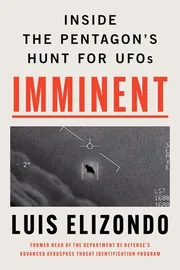
Imminent is a 2024 work of history and politics by Luis Elizondo, a former senior intelligence official and special agent. It looks at unidentified anomalous phenomena, the term now used in place of UFOs, and at how the United States government has dealt with them. Elizondo writes as the former head of a Pentagon program set up to investigate these sightings, drawing on a career spent in classified work. The book covers the government's role in such investigations, the effort to keep that role out of public view, and reports of unidentified craft in the air, in the water and in space going back to World War II.
The text moves through well-known names and places in the field, among them Roswell, Skinwalker Ranch and the Pentagon. People who appear include Hal Puthoff, Harry Reid, Jacques Vallee, Lonnie Zamora, Eric Davis, Chris Mellon, Garry Nolan, Marco Rubio, General Mattis and Tom Delonge. It sits alongside works on intelligence and espionage, space sciences and conspiracy theories, with a focus on national security. It runs to about 304 pages and has appeared in three editions.
Characters
Hal PuthoffHarry ReidJacques ValleeLonnie ZamoraEric DavisChris Mellon
Setting
RoswellPentagonSkinwalker Ranch
Themes
UFOsUAPUnexplained phenomenaUFOs & ExtraterrestrialsIntelligence & EspionageSpace sciencesConspiracy theoriesNew York Times bestseller
By the numbers
- The median edition runs 304 pages. Counting about 275 words a page and an adult reading pace of 250 words a minute, that is about 5.6 hours of reading.
- Open Library tracks 3 editions from 2 publishers.
- On reader demand it ranks in the top 17% of the recent releases books in our catalog (1,627 of them).
 BookWard’s take
A former Pentagon insider's personal case for taking UAP seriously
Imminent is Luis Elizondo's first-person account of running a Pentagon effort to investigate unidentified anomalous phenomena, and it reads as testimony more than as a weighed investigation. The rigor is thin: this is an insider's account built on personal experience and assertion, not an evidence-led case, and a reader hoping to be persuaded by proof will mostly be asked to take his word. The voice is where it does better, since the narration is opinionated and unmistakably his. It also leans heavily on familiar tropes. Roswell, Skinwalker Ranch and a government cover-up are well-worn ground, and the book stays close to the genre's staples. It moves briskly across its 304 pages and keeps a personal, urgent perspective throughout. Read it for the insider view, and keep your own standards for proof close at hand.
At 304 pages it is a mid-length trade nonfiction book, longer than BookWard's tight ideal but not sprawling.
A first-person insider account with big claims tends to move quickly, close to BookWard's brisk preference.
The insider framing is fresh, but the UAP subject and its cast of known figures are well-trodden ground.
The prose is plain and direct, in the manner of a trade memoir, not ornate.
It is built around an unfolding argument and events more than the inner growth of its people.
It carries urgency and alarm but frames the subject as a call to action instead of despair.
It follows a conventional memoir-plus-argument arc without formal experiment.
The subject is treated with gravity, and the tone stays serious throughout.
Reports of medical injuries and threats to nuclear sites give it some weight without being relentlessly grim.
Urgency and conviction run through it, though it is not an intensely emotional read.
See all 50 dialsEvery position, side by side with this book
Where it lines up
- PaceBookWard 8 · book 7
- OpeningBookWard 10 · book 8
- SentimentBookWard 8 · book 6
Where it pulls apart
- Familiar tropesBookWard 10 · book 3
- Internal logicBookWard 10 · book 4
- Rigor (nonfiction)BookWard 9 · book 3
At 304 pages it is a mid-length trade nonfiction book, longer than BookWard's tight ideal but not sprawling.
A former Pentagon program head promising long-hidden secrets opens with a strong pull, which suits BookWard's taste for an immediate hook.
Roswell, Skinwalker Ranch and government cover-up narratives are staples of UFO writing, so it leans on familiar tropes, unlike BookWard's preference.
Its claims rest on testimony and assertion that stretch conventional physics, which falls short of BookWard's airtight standard.
A first-person insider account with big claims tends to move quickly, close to BookWard's brisk preference.
The insider framing is fresh, but the UAP subject and its cast of known figures are well-trodden ground.
People appear mainly as colleagues and sources in a case being made, not as deeply drawn figures.
The book closes on a call to action about humanity's big questions, not a settled resolution.
The tone is earnest and urgent, with some emotional framing, so it is less restrained than BookWard prefers.
The material is startling by design, with claims of injuries and interference, though the effect rests on revelation more than gratuitous darkness.
It is an insider's account built on personal experience, short of the rigorous evidence BookWard values in nonfiction.
Elizondo's first-person, insider perspective gives it a distinct and recognizable voice.
It is driven by an argument about what the government knows, more than by a plotted story.
A testimonial argument explains its claims outright instead of dramatizing them in scene, well past BookWard's show-don't-tell leaning.
A steady stream of claims and names keeps momentum fairly even, though a long case-making book can drift.
The prose is plain and direct, in the manner of a trade memoir, not ornate.
It is built around an unfolding argument and events more than the inner growth of its people.
It carries urgency and alarm but frames the subject as a call to action instead of despair.
It follows a conventional memoir-plus-argument arc without formal experiment.
The subject is treated with gravity, and the tone stays serious throughout.
It is written for a general audience and reads easily without specialist background.
It is told from one man's vantage point, though other figures are quoted along the way.
The account runs largely forward from his career while reaching back to World War II reports.
Its central claim of nonhuman intelligence and craft defying physics sits far from the grounded.
A long list of named figures from government, science and the field appears across the book.
The claims reach from military bases to humanity's place in the universe, making it epic in scope.
It centers on external events, programs and sightings more than inner reflection.
As a nonfiction account it leans on narration and summary, with conversations reported occasionally.
Romance plays no part in a book about national security and unexplained phenomena.
The classified intelligence world and UAP territory will be unfamiliar to most readers.
It is a 2024 book engaging a current public debate while reaching back decades.
Tied to a live, shifting public conversation, it is more of its moment than enduring.
Elizondo narrates as an interested participant making a case, which invites caution about his certainty.
The framing presents secrecy as the problem and disclosure as the answer, fairly clearly drawn.
The focus is on claims and events, with description serving the argument more than building atmosphere.
It reads as a personal narrative account more than a detached analytical treatment.
It is firmly first-person, drawn from the author's own experience inside the program.
It stands as a self-contained book, not an installment in a series.
Its revelations and escalating claims offer moderate surprise across the pages.
It asks readers to entertain a major claim about nonhuman intelligence, which is a real mental stretch.
Reports of medical injuries and threats to nuclear sites give it some weight without being relentlessly grim.
Urgency and conviction run through it, though it is not an intensely emotional read.
It mentions injuries to service members but is not graphic or violent on the page.
There is no sexual content in a book about intelligence work and UAP.
Government secrecy, Congress and national security policy are central to the argument.
The language is plain, with some military and intelligence jargon but nothing dense.
It argues a strong position openly, with the author's convictions front and center.
It pushes toward disclosure and what comes next for humanity, looking ahead.
It pairs suspicion of institutions with a hopeful call for openness and action.
Review written by BookWard, dial version 1, November 2026.
Who is Imminent right for?
Best suited to adult and older teen readers interested in government, intelligence and unexplained phenomena. It mentions injuries to service members and alarming claims about surveillance of military sites, but is not graphic.
It is written for a general audience and reads easily without specialist background.
Reports of medical injuries and threats to nuclear sites give it some weight without being relentlessly grim.
Urgency and conviction run through it, though it is not an intensely emotional read.
It mentions injuries to service members but is not graphic or violent on the page.
Book CompanionImminent: ideas, characters, themes
A former head of a Pentagon UAP program argues that the US government has long known about and hidden unidentified craft, and calls for public confrontation of the implications.
- An insider's vantage. Elizondo writes as a former senior intelligence official and special agent who led a Pentagon program investigating UAP.
- The terminology shift. The book uses unidentified anomalous phenomena, the term now preferred to UFOs, to frame the subject as a national security concern.
- A long history of secrecy. It describes the government's long, shadowy involvement in UAP investigations and the effort to keep that role from the public.
- Claims about the craft. It describes unidentified craft in air, water and space said to defy known physics, reported since at least World War II.
- Stakes and a call to action. It presents the issue as one with serious national security consequences and urges readers to face humanity's biggest existential questions.
Characters
Luis Elizondo
Author and narrator
A former senior intelligence official who led the Pentagon program and tells the story from his own experience.
Harry Reid
Subject figure
A political figure who appears among the people connected to the topic.
Hal Puthoff
Subject figure
A figure from the UAP research world who appears in the book.
Jacques Vallee
Subject figure
A well-known name in UFO study who appears in the text.
Themes
The effort by officials to keep UAP investigations out of public view.
The concern that unidentified craft operate near sensitive military sites.
The case for telling the public what the government knows.
The question of whether humanity is alone in the universe.
How an insider's testimony is weighed against the demand for evidence.
Discussion questions
- How much weight should an insider's testimony carry without independent evidence?
- Why might a government keep UAP investigations secret, and is that justified?
- How does calling these sightings UAP instead of UFOs change how we treat them?
- What would change in daily life if nonhuman intelligence were confirmed?
- What kind of evidence would you need to be persuaded by the book's claims?
Personalize your Book Companion
This is the general edition. In BookWard, the Companion is written for you: your reading profile, your notes, and spoiler-safe to the page you are on.
Buy, listen or borrow Imminent
Each link opens a search for this book on that store, in a new tab.
Read on a device
Borrow
Reviews and community
If you liked Imminent
A first-person insider tale about loans as a tool of empire
End of DaysSylvia BrowneSylvia Browne forecasts the next fifty years and the end of the world
Permanent RecordEdward SnowdenA whistleblower's memoir that explains the machine he helped build
Tunnel in the skyRobert A. HeinleinHeinlein strands a class of students and watches society form
Sources: Open Library.
Track Imminent and find your next favorite
Add it to your shelf, rate what you have read, and BookWard will recommend what fits you.
Free to start. No credit card needed.