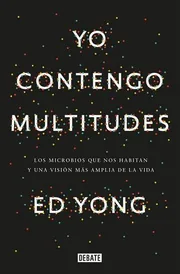
I Contain Multitudes
by Ed Yong · 2016
Suits curious older teens and adults comfortable with science writing, and requires no background in biology.
368 pages, about 6 to 8.5 hours.
A joyful tour of the microbes that make animals possible. 59% taste match
What it covers
I Contain Multitudes is a popular science book by Ed Yong, first published in 2016 and shelved under Science & Nature. It looks at the microorganisms that live in and on animals, humans among them, and at the relationships between those microbes and their hosts. Its subject matter sits within microbiology, physiology, and symbiosis, with particular attention to the microbiome and to the body as a place where many organisms live together.
The book moves across a range of creatures rather than focusing on people alone. Squid, beetles, wasps, and worms all appear, along with deep ocean animals that rely on microbes for their energy. It covers how bacteria take part in immune defense, protect against disease, help build the body, and influence health. Running through these chapters is a shift in perspective, from seeing each animal as a single individual to seeing it as a community of interdependent living things. The edition runs to roughly 368 pages, and the title has appeared in eleven editions. It suits readers curious about biology, the human body, and the hidden partnerships that shape life on Earth.
Themes
MicroorganismsHuman bodySymbiosisMicrobiologyNew York Times bestsellerNew York Times reviewedAnaerobic BacteriaPhysiology
- Want to read 84
- Reading now 4
- Read 18
Most people shelving it are saving it for later.
Of 106 readers who put it on a shelf, 79% want to read it, 4% are reading it now, 17% have finished it and 0% stopped before the end.
By the numbers
- The median edition runs 368 pages. Counting about 275 words a page and an adult reading pace of 250 words a minute, that is about 6.7 hours of reading.
- Open Library tracks 11 editions from 11 publishers, the earliest dated 2016 and the latest 2018, across 2 languages.
- On reader demand it ranks in the top 9% of the recent books in our catalog (6,647 of them).
- Libraries shelve it under Library of Congress class QR-0171.00000000.A1 Y66 2016b.
 BookWard’s take
A joyful tour of the microbes that make animals possible
Ed Yong's book flips a familiar idea: microbes are less enemies to be wiped out than partners that build bodies, guard health and shape what animals can do. Squid, beetles, wasps, worms and deep ocean creatures stand in for the human story, which keeps the subject surprising. The microbe's-eye view feels genuinely fresh, and the voice is distinctive, with humor running alongside the science. The rigor holds up too, because the scientists doing the work are the ones we meet. It is driven more by ideas than by narrative, and the reading is moderately demanding, though the writing explains as it goes. The curiosity and the clear thinking are the real pleasures here; what it asks in return is that you enjoy a good deal of explaining.
At about 368 pages it is substantial for a science book, longer than BookWard's tight ideal, though the material earns most of it.
It moves briskly from creature to creature, though the density of science means it is not a sprint.
Seeing animals through their microbes rather than as lone individuals is a genuinely new angle for popular science, matching BookWard's high bar.
The writing is clear and lively rather than ornate, serving the science first.
There is no plot or cast to drive it; the subject matter does the pulling.
It celebrates our microbial partners and recasts them as allies, an upbeat view that matches BookWard's leaning.
A grand tour through creatures and topics is a familiar popular science shape, not an experiment.
Humor appears alongside the erudition but the book stays mainly curious and informative.
Disease appears, but the tone is awe and curiosity rather than grimness.
The feeling is wonder and delight rather than intense emotion.
See all 50 dialsEvery position, side by side with this book
Where it lines up
- OriginalityBookWard 9 · book 9
- Shock for effectBookWard 9 · book 9
- Rigor (nonfiction)BookWard 9 · book 9
Where it pulls apart
- LengthBookWard 1 · book 6
- Story or ideasBookWard 3 · book 9
- ExpositionBookWard 2 · book 8
At about 368 pages it is substantial for a science book, longer than BookWard's tight ideal, though the material earns most of it.
The premise of animals as communities of microbes is intriguing from the start, which suits BookWard's love of an immediate pull.
It avoids the germ-fearing framing of microbes and offers a fresh view, which BookWard values.
The argument builds from example to example toward a coherent reframing of the animal body, matching BookWard's taste for airtight reasoning.
It moves briskly from creature to creature, though the density of science means it is not a sprint.
Seeing animals through their microbes rather than as lone individuals is a genuinely new angle for popular science, matching BookWard's high bar.
It is built around ideas and organisms, not drawn characters, so this dial does not reach BookWard's preference for depth.
A nonfiction argument that lands on a clear shift in how we see ourselves, giving a satisfying sense of resolution.
The tone is warm and wondering, with some emotion in its enthusiasm, though it stays grounded in evidence.
Its surprises, like squid invisibility cloaks, come from real science rather than manufactured drama, which BookWard respects.
It follows the researchers on the front lines of discovery and rests on real science, which BookWard prizes.
Yong's humor and erudition give it a recognizable personality, close to BookWard's liking for distinctive voices.
The engine is the idea of the microbiome, with creatures illustrating it, so ideas clearly lead over story.
Explanation carries the book, since the science has to be laid out directly, more than BookWard prefers.
Moving among very different creatures keeps the chapters fresh and avoids a slump.
The writing is clear and lively rather than ornate, serving the science first.
There is no plot or cast to drive it; the subject matter does the pulling.
It celebrates our microbial partners and recasts them as allies, an upbeat view that matches BookWard's leaning.
A grand tour through creatures and topics is a familiar popular science shape, not an experiment.
Humor appears alongside the erudition but the book stays mainly curious and informative.
Accessible popular science that explains as it goes, with enough biology to ask for some attention.
The perspective shifts among animals and the scientists studying them, giving some variety but one authorial frame.
The book proceeds topic by topic rather than hopping through time.
Everything described is real biology, even when it sounds almost fantastical.
A wide range of animals and scientists appear, giving it a fairly large cast for nonfiction.
It moves from single organisms up to a view of life on Earth, widening from the intimate to the grand.
It looks outward at organisms, ecosystems and research rather than into private thought.
Prose exposition dominates, with little in the way of conversation on the page.
There is no romance; the partnerships on the page are biological.
The deep ocean and the interior of the body are unfamiliar places for most readers, which adds to the wonder.
A 2016 book on current science puts it firmly in the modern conversation.
Science moves on, but the shift in perspective it offers should keep its value for a good while.
A clear authorial voice reporting on real science, not a narrator to second-guess.
It makes an argument about how to see ourselves rather than posing moral dilemmas.
It paints vivid pictures of creatures and microbial worlds to make the science tangible.
It blends storytelling about scientists and animals with analysis of the underlying biology.
The author is a visible, engaged guide, though the book is about the science more than himself.
It stands alone as a single book.
The surprises are discoveries about what microbes do rather than plot turns.
It asks readers to rethink what an individual is, which is a mild challenge to everyday assumptions.
Disease appears, but the tone is awe and curiosity rather than grimness.
The feeling is wonder and delight rather than intense emotion.
The humor is witty and understated in the service of explanation.
Biological threats such as disease are discussed, but there is little violence on the page.
Sexual content is not a focus of this science book.
The subject is biology rather than politics, which stay in the background.
Scientific terms appear, but the writing is clear and meant for general readers.
Yong makes a case for a new way of seeing life, so the narration carries a point of view.
It points toward where microbiome science is heading and how our view of nature may change.
It is optimistic about the discoveries ahead and our partnership with microbes, though it is grounded in evidence.
Review written by BookWard, dial version 1, November 2026.
Who is I Contain Multitudes right for?
Suits curious older teens and adults comfortable with science writing, and requires no background in biology. It discusses disease and the body in a factual, non-graphic way.
Accessible popular science that explains as it goes, with enough biology to ask for some attention.
Disease appears, but the tone is awe and curiosity rather than grimness.
The feeling is wonder and delight rather than intense emotion.
Biological threats such as disease are discussed, but there is little violence on the page.
Book CompanionI Contain Multitudes: ideas, characters, themes
Animals, humans included, are less single individuals than communities of interdependent living things, shaped and protected by the microbes they host.
- Microbes as partners. The book argues that the microbes in and on us are not simply germs to be eradicated but partners that matter to our health and bodies.
- Immune defense and protection. Microbes form part of our immune systems and help protect us from disease.
- Life without a mouth. Deep ocean creatures without mouths or guts depend on microbes for all their energy.
- Remarkable abilities. Bacteria give squid invisibility cloaks and help beetles bring down forests, showing microbes granting animals unusual powers.
- A new view of nature. The book asks readers to see animals as interconnected, interdependent multitudes and to reconsider where we belong in nature.
Themes
Living things depending on one another so closely that the relationship shapes how each of them lives.
The community of microbes that lives in and on a body and affects its health.
The shift from seeing each animal as a single self to seeing it as a crowd of living partners.
How microbes can both protect a body and, in some cases, cause illness.
The researchers on the front lines who uncover these hidden partnerships.
Discussion questions
- Does thinking of yourself as a community of microbes change how you think about your own body?
- Why might many people think of microbes only as germs, and what does the book offer in its place?
- Which animal example, whether squid, beetle, wasp or deep ocean creature, stood out to you most, and why?
- How does the microbe's-eye view alter the way we think about health and disease?
- What questions would you want scientists to answer next about the microbes living with us?
Personalize your Book Companion
This is the general edition. In BookWard, the Companion is written for you: your reading profile, your notes, and spoiler-safe to the page you are on.
Buy, listen or borrow I Contain Multitudes
Each link opens a search for this book on that store, in a new tab.
Read on a device
Borrow
Reviews and community
If you liked I Contain Multitudes
A history of secret writing that makes the mathematics approachable
The MartianAndy WeirOne stranded astronaut, one problem at a time, no wasted pages
A Short History of Nearly EverythingBill BrysonBryson turns the whole of science into a funny, readable tour
Omnivore's Dilemma. a Natural History of Four MealsMichael PollanFour meals, three food chains, and a sharp reporter's appetite
Sources: Open Library.
Track I Contain Multitudes and find your next favorite
Add it to your shelf, rate what you have read, and BookWard will recommend what fits you.
Free to start. No credit card needed.