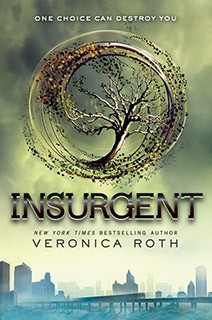
Insurgent
by Veronica Roth
★ Top 25 book of 2011 · #20 on Best Books of 2011
After a tragic initiation day, Tris Prior faces a looming war between the factions. Grief, guilt and shifting loyalties push her to accept her Divergence, whatever the cost, in this dystopian sequel.
Best for: Dystopian fans who read the first Divergent book and want the sequel
Insurgent is #20 on BookWard's Best Books of 2011, out of 53 2011 books that cleared our data bar.
What Insurgent is about
Tris Prior's initiation day was meant to be a celebration with the faction she chose. Instead it ended in horror, and this second book of the Divergent series picks up in its aftermath. Unrest is spreading through the factions, and the clash between their ideologies is moving toward war. Tris keeps trying to protect the people she loves, and herself, while wrestling with grief, guilt, forgiveness, loyalty, and love. Her choices change her, and she must decide whether to fully embrace her Divergence without knowing what it might cost. The tone is tense and action-driven, with identity and consequence at its centre.
Insurgent on the Best Books of 2011
Insurgent came out in 2011. Of the 53 books first published in 2011 that met BookWard's data bar, it ranks #20 on our Best Books of 2011 list.
Why it made the list: 796 readers have shelved it on Open Library; readers rate it 3.9 out of 5 (117 ratings); 47 are reading it right now. The list ranks each year’s books on how many readers have picked them up, how highly readers rate them, and how many are reading them right now.
Nearby on the 2011 list
- The Wise Man’s Fear Patrick Rothfuss, #18
- Dotcom Secrets Russell Brunson, #19
- Fifty Shades Darker E. L. James, #21
- The Night Circus Erin Morgenstern, #22
See all Best Books of 2011 Best books by year
More years: Best Books of 2010 Best Books of 2012.
The numbers behind it
- Readers: 544 want to read it, 47 are reading it now and 205 have read it, according to Open Library.
- Ratings: 3.9 out of 5 from 117 Open Library ratings.
| Signal | This book (0 to 100) | Weight |
|---|---|---|
| Reach | 68 | 55% |
| Reader love | 36 | 25% |
| Being read right now | 72 | 20% |
Questions about Insurgent
When was Insurgent published?
Insurgent by Veronica Roth was first published in 2011.
Was Insurgent one of the best books of 2011?
Insurgent is #20 on BookWard's Best Books of 2011, out of 53 2011 books that cleared our data bar. 796 readers have shelved it on Open Library; readers rate it 3.9 out of 5 (117 ratings); 47 are reading it right now.
Why is Insurgent on the Best Books of 2011 list?
796 readers have shelved it on Open Library; readers rate it 3.9 out of 5 (117 ratings); 47 are reading it right now.
More of the best books of 2011
- Sapiens Yuval Noah Harari, #1
- The Song of Achilles Madeline Miller, #2
- Thinking, Fast and Slow Daniel Kahneman, #3
- Steve Jobs Walter Isaacson, #4
- The Son of Neptune Rick Riordan, #5
- Shatter Me Tahereh Mafi, #6
See the full Best Books of 2011, the Top 100, or new books on Rising.
How we know
This page uses public data: Open Library reader counts and ratings, and Wikipedia page views for recent years. The description is paraphrased from real source text. Rankings reflect reading interest, not quality or sales, and can be affected by data gaps. Lists update monthly.
Best suited to teens and adult readers who enjoy YA dystopias.
Depends on the edition you pick.
A fast, factional war story that trades hooks for sequel stakes. 44% taste match
 BookWard’s take
A fast, factional war story that trades hooks for sequel stakes
Insurgent picks up right after the first book's brutal initiation day and never really slows down. The opening hooks at once, because Tris is already carrying grief and guilt and the factions are edging toward war. Where it loses ground is in its familiar tropes: the dystopian sorting, the love story and the chosen-one pressure are all well-worn shapes. The internal logic is looser than it should be, and the exposition tends to explain the faction politics outright rather than letting scenes carry it. The characters are its better card, since Tris is shaped by what she has done and has to live inside her choices. As the middle volume of a series, the ending hands you a setup for what comes next more than a resolution.
Events come quickly and conflict escalates steadily, matching BookWard's taste for momentum.
The premise is a recognizable dystopian template, and the sequel leans on it more than it reinvents it.
Plain, brisk sentences built for speed, not ornament.
Events drive the book, but Tris's guilt and decisions steer where they go.
Grief and betrayal dominate, with only thin threads of hope running through the conflict.
A straightforward forward-moving structure with no formal experiments.
Serious throughout, with only brief moments of lightness.
See all 50 dialsEvery position, side by side with this book
Where it lines up
- PaceBookWard 8 · book 8
- Story or ideasBookWard 3 · book 4
- OpeningBookWard 10 · book 8
Where it pulls apart
- Familiar tropesBookWard 10 · book 3
- Internal logicBookWard 10 · book 5
- LengthBookWard 1 · book 5
It opens in the aftermath of the first book's horrors, so the stakes are live from the first pages, which BookWard likes.
The faction system drives the plot but strains under scrutiny, so it holds together less tightly than BookWard prefers.
Events come quickly and conflict escalates steadily, matching BookWard's taste for momentum.
The premise is a recognizable dystopian template, and the sequel leans on it more than it reinvents it.
As the middle of a trilogy it resolves its immediate conflict while deliberately leaving larger questions open.
Romance and loss are played openly for emotion, a little warmer than the restraint BookWard favors.
Loss and violence carry consequences for the characters, but some beats are there to jolt the reader.
Tris's first-person narration is clear and urgent but not strongly distinctive.
Ideas about identity and loyalty are present, but story momentum clearly leads.
Faction politics and the world's rules are often spelled out rather than discovered in scene.
Momentum holds through most of the book, with some stretches of travel and regrouping that slow it.
Plain, brisk sentences built for speed, not ornament.
Events drive the book, but Tris's guilt and decisions steer where they go.
Grief and betrayal dominate, with only thin threads of hope running through the conflict.
A straightforward forward-moving structure with no formal experiments.
Serious throughout, with only brief moments of lightness.
Quick, accessible reading that asks little beyond keeping track of the factions.
Told through a single narrator's perspective.
Events unfold in order, continuing straight from the previous book.
A speculative dystopia with engineered society and technology, but no magic.
A sizable ensemble of faction leaders, allies and rivals, though a few carry most of the weight.
The story widens from personal survival to a society on the brink of war.
Action, escapes and confrontations lead, with Tris's emotions running alongside them.
Argument, negotiation and tense conversations carry much of the plot.
A central relationship is a major strand alongside the conflict.
An invented, faction-divided city that is unfamiliar but easy to grasp.
A near-future setting that feels like a present-day story in costume.
Strongly tied to the early-2010s YA dystopian wave, with themes that travel better than its format.
Tris reports events honestly, though her grief colors what she sees.
Right and wrong blur as factions justify their actions, though the story still leans on clear heroes.
Spare scene-setting that serves the action rather than lingering.
Review written by BookWard, dial version 1, November 2026.
Who is Insurgent right for?
Best suited to teens and adult readers who enjoy YA dystopias. It includes war violence, death and heavy grief.
Quick, accessible reading that asks little beyond keeping track of the factions.
Book CompanionInsurgent: ideas, characters, themes
After a devastating initiation day, Tris must face the consequences of her choices as faction tensions tip toward war and her sense of self is tested.
- Grief drives the story. Tris's loss and guilt shape her decisions, making her actions feel costly rather than automatic.
- A society splitting. Conflict between the factions escalates, forcing characters to pick sides.
- Secrets surface. Revelations reshape what characters believed about their world and each other.
- Divergence as identity. Tris must decide how fully to embrace what makes her different, and what it may cost.
- Shifting relationships. Loyalties and romantic ties are strained by the pressures of war.
Characters
Tris Prior
Narrator and protagonist
Carrying grief and guilt from the first book, she must decide how to use her Divergence.
Themes
How loss and responsibility reshape a person and her choices.
Who you are versus the category a society assigns you.
What you owe to people, factions and your own conscience when they conflict.
How ideology and leadership turn division into open conflict.
Discussion questions
- Is Tris's grief a strength, a weakness, or both in her decisions?
- Do the factions' ideologies hold up, or is the system doomed to fracture?
- How do the book's relationships change under the pressure of war?
- What does it mean to embrace being different when your society punishes it?
- Does the middle of a trilogy need its own resolution, and does this one provide it?
Personalize your Book Companion
This is the general edition. In BookWard, the Companion is written for you: your reading profile, your notes, and spoiler-safe to the page you are on.
Buy, listen or borrow Insurgent
Each link opens a search for this book on that store, in a new tab.
Read on a device
Borrow
Reviews and community
If you liked Insurgent
A fast YA dystopia where one choice shapes everything
The Darkest MindsAlexandra BrackenA fast YA dystopia with a hooked-in-chapter-one premise
Red QueenVictoria AveyardA Red girl, a Silver crown, and a rebellion brewing
Glass SwordVictoria AveyardFast, bloody YA sequel where Mare builds a rebel army
Find your own best books
Add what you have read, rate it, and BookWard will recommend what to read next.
Free to start. No credit card needed.